If you've spent any time with ChatGPT, you'll know it's remarkable. It can write poetry, explain quantum physics, and draft a business plan in seconds. So when your child asks why plants need sunlight, it is tempting to type the question into a general chatbot and let it answer. But ChatGPT vs. an AI tutor is not a fair comparison, because general AI isn't built for teaching children. The difference is the difference between handing your child an encyclopaedia and sitting them down with a patient teacher who knows what a seven-year-old needs.
This is not a dismissal of ChatGPT. It is about understanding that teaching primary-aged children on the British national curriculum needs something a general-purpose language model was not designed to do.
What's the Difference Between ChatGPT and an AI Tutor Made for Children?
Both use large language models. The similarity ends there.
ChatGPT is a general-purpose conversational AI. It is designed to respond to any prompt from any person on any topic. It does not know your child's age, their curriculum, what they studied last week, or that they always mix up "evaporation" and "condensation".
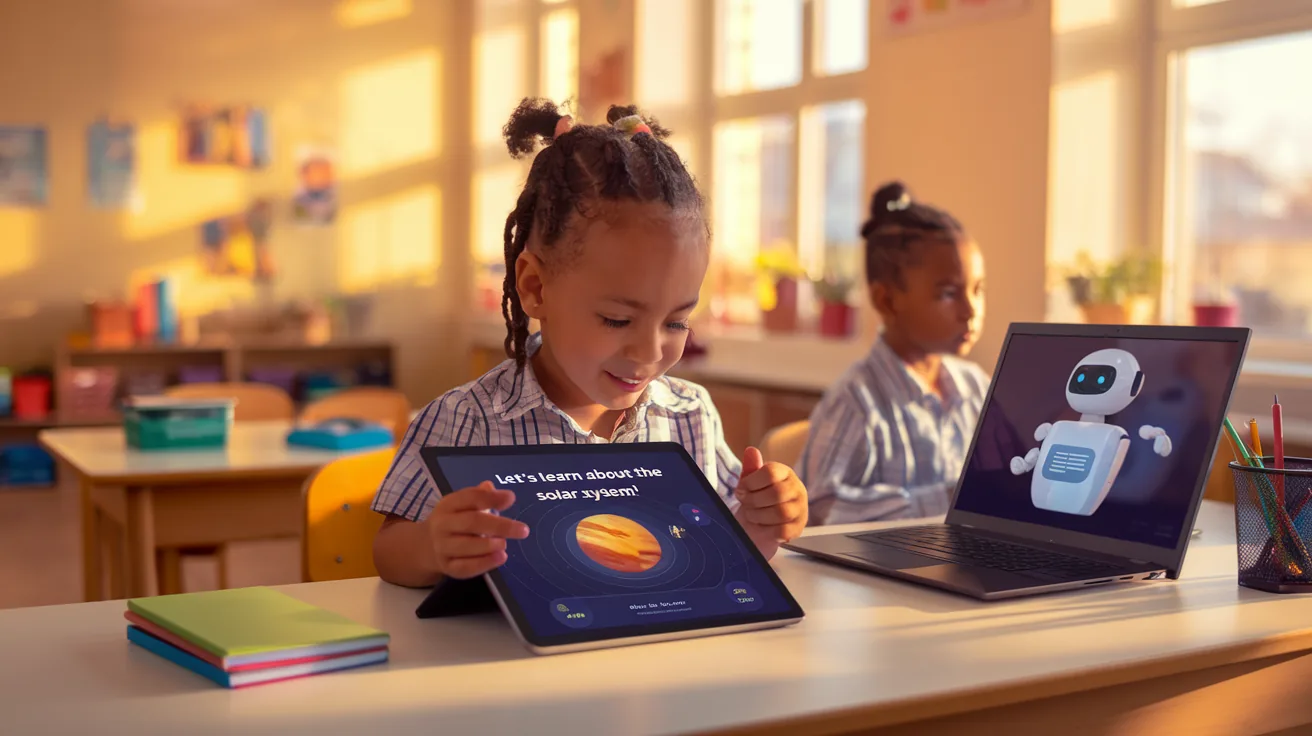
An AI tutor made for children is built for one job: helping a child learn. It knows the curriculum objectives for each year group, keeps track of what the child does and does not yet understand, adapts its language to the child's age, and uses teaching methods rather than simply giving answers.
The Knowledge vs. Teaching Distinction
John Hattie's Visible Learning (2009) makes the point that the quality of the teaching, not access to information, is what drives learning. A tool that knows everything but cannot pitch it for a child is like a professor lecturing a room of six-year-olds in university vocabulary. The knowledge is all there; the teaching is not.
Why Does General AI Struggle to Teach Young Children?
1. No Curriculum Alignment
When your Year 2 child asks ChatGPT "What are materials?", it does not know that the Key Stage 1 curriculum expects children to identify everyday materials and say which are suitable for which uses. It may launch into molecular structure, or give an accurate answer pitched at an adult. A tutor built for children maps each exchange to the curriculum, so your child learns what they are actually meant to be learning at their stage.
2. No Sense of the Child's Level
Lev Vygotsky's zone of proximal development is the range between what a child can do alone and what they can do with help. Good teaching works inside that range, stretching the child without overwhelming them.
ChatGPT has no way of finding that range. It does not adjust vocabulary, sentence length or depth according to whether it is talking to a five-year-old or a fifty-year-old, unless someone tells it to, every time. A tutor for children works inside age-appropriate limits by default.
3. It Gives Answers Instead of Building Understanding
This may be the most important difference. Ask ChatGPT a science question and it gives you the answer: clearly, accurately, at once. But a child who is handed the answer has done no thinking, and the thinking is what builds understanding that lasts.
A tutor made for children uses questions that surface misconceptions and guided discovery. Instead of "The answer is evaporation", it might ask: "You said the water disappeared. Where do you think it went? Can water just vanish?" This is what the research behind personalised learning supports.
4. No Record of Your Child's Learning
A good tutor remembers that your child struggled with food chains last Tuesday, connects it to this week's lesson on habitats, and returns to the earlier idea at the right moment, which is the basis of spaced repetition.
ChatGPT now has a memory feature, but it was not built as a learning record. It does not keep a model of what your child knows, track progress against the curriculum, or return systematically to weak spots. A tutor for children keeps what researchers call a learner model: a map of what the child knows and what to work on next.
Is ChatGPT Safe for Children to Use Alone?
ChatGPT is designed for adults. OpenAI has added safety measures, but the tool can still:
- Produce content that is unsuitable, frightening or confusing for a young child
- Follow a prompt off in an unintended direction
- State confident-sounding but wrong information (known as "hallucination") with no sign that it might be wrong
- Offer no parental view of what the child has been doing
A tutor built for children keeps to curriculum topics, filters language for age, and usually lets parents see what the child worked on. Our guide to AI safety for children covers this in more depth.
What About Bloom's 2 Sigma Problem?
In 1984 the educational psychologist Benjamin Bloom showed that children who received one-to-one tutoring performed about two standard deviations better than children in a conventional classroom. The challenge, known as Bloom's 2 Sigma Problem, was that a personal tutor for every child was unaffordable.
AI has been offered as the solution, and it can be, but only if the AI actually tutors. Answering questions is not tutoring. Bloom's work rested on mastery learning (making sure a child has understood one idea before moving on), continuous checking of understanding, and pacing set by the child, not the class. None of these emerge on their own from a general chatbot. They have to be built in.
When Is ChatGPT Actually Useful for Parents?

ChatGPT has a real place in a family's toolkit, just not as your child's tutor. It helps:
- For parents: brushing up on a topic before helping with homework ("Explain the rock cycle at a KS2 level")
- For parents: generating activity ideas ("Give me five hands-on experiments about forces for a Year 4 child")
- For parents: writing practice questions on a specific topic
- For older children, with you beside them: researching a project topic while you guide the conversation and check the facts
The key word is supervised. ChatGPT is a powerful tool in an adult's hands. It is not a substitute for structured teaching when your child is working alone.
What Should Parents Look for in an AI Tutor?
- Curriculum alignment: does it map to the British national curriculum (or your child's curriculum) by year group and topic?
- Adaptive difficulty: does it adjust the challenge to your child's answers, not only their age?
- Misconception handling: does it find and address common misunderstandings rather than only marking answers right or wrong?
- Age-appropriate interaction: are the language, tone and interface designed for primary-aged children?
- Parent visibility: can you see what your child is learning and where they are struggling?
- Sound teaching method: is it built on spaced repetition, retrieval practice and step-by-step support?
- Safety by design: are the content limits part of the design, not a filter added afterwards?
Fareed, our own Key Stage 2 science tutor, is being built to this list and is currently on a waitlist.
Which Tool, When?
- If your child needs to learn something new: use an AI tutor built for children, which teaches through structured, curriculum-aligned conversation.
- If you, the parent, need to understand something quickly: ChatGPT is a fine research assistant for adults.
- If your child wants to explore a topic out of curiosity: sit with them and use ChatGPT together, as a conversation partner rather than a teacher.
- If you're worried about screen time vs. learning time: a tutor gives a focused session with a clear end, while an open-ended chatbot can drift.
For families at British schools in the Gulf or South-East Asia, where a UK-based human tutor sits in the wrong time zone, this distinction matters even more: the tool your child uses alone has to be one that teaches.
The Bottom Line
Tools designed for a specific purpose do that job better than general tools. ChatGPT was not designed to teach your seven-year-old about forces and magnets, track their grasp of the Year 3 science curriculum, or guide them gently out of a misconception about how shadows form. That takes patience, curriculum knowledge, awareness of the child's stage, and a steady focus on one child's learning. Choose the tool that was built for it.