
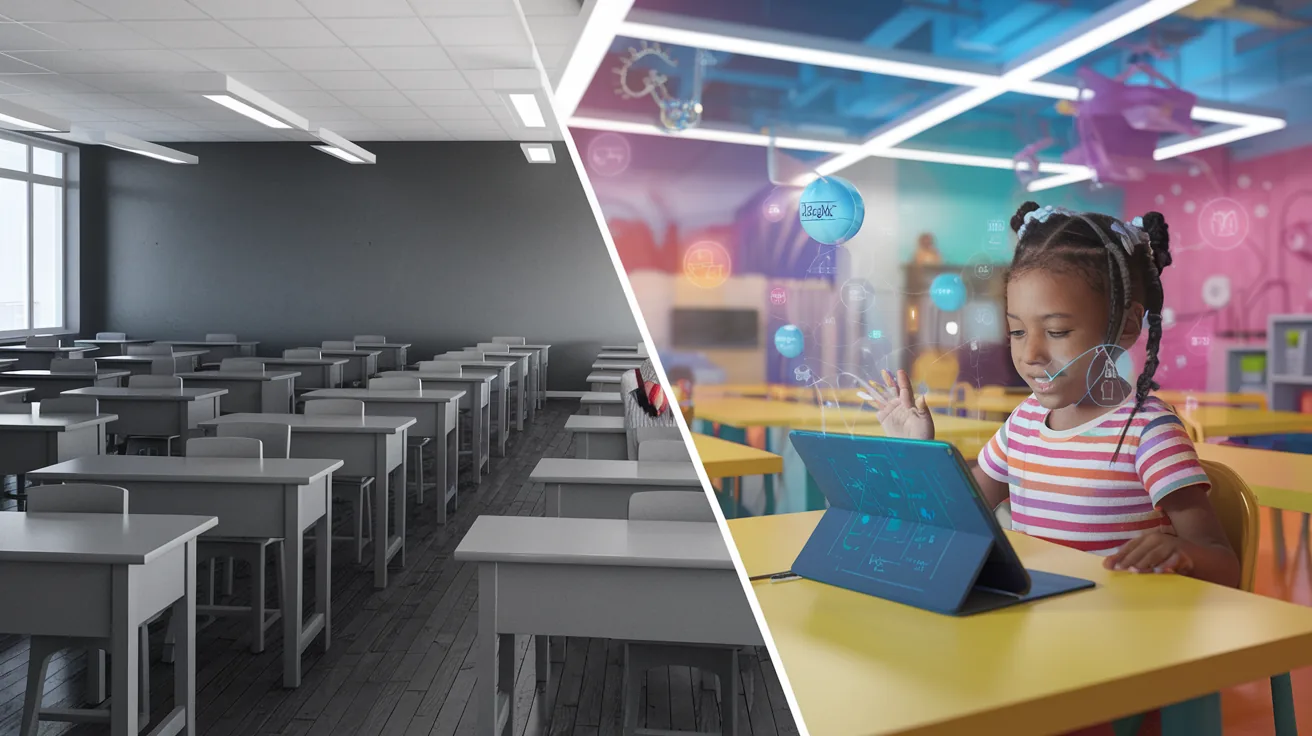
Picture a Year 3 science class. The teacher is explaining what plants need to grow. In that same room, one child already knows from a nature documentary that plants make their own food. Another thinks plants eat soil. A third is still working on reading the words on the whiteboard. The teacher has 45 minutes, one lesson plan, and 28 different minds.
This is the basic challenge of education: every child learns differently, but most classrooms have to teach the same way. It's not a failing of teachers. It's a limit of the classroom itself.
What Does "Personalised Learning" Actually Mean?
Personalised learning is more than a buzzword. It means teaching that adapts three things to the individual child:
1. Pace
How quickly new ideas are introduced. One child needs to meet the idea of a complete circuit five times before it sticks; another needs fifteen. Moving both at the same speed leaves one bored and the other lost.
2. Path
The order and method of teaching. A child who thinks visually might understand a circuit best from a diagram, while another needs to hold the battery, wires and bulb and see for themselves what happens when a wire comes loose.
3. Depth
How far a topic is explored before moving on. A child who asks "but why?" about gravity deserves a better answer than "because that's how it works", even if it isn't in the lesson plan.
The Research Behind It
Bloom's 2 Sigma Problem (1984)
In 1984 Benjamin Bloom published "The 2 Sigma Problem" in Educational Researcher. He compared children taught one-to-one, with a tutor who made sure each idea was mastered before moving on, against children taught in a conventional class. The tutored children performed two standard deviations higher. In plain terms, the average tutored child did better than 98% of the children taught in the ordinary class.
Bloom called this a "problem" because it set a challenge he could not solve: how could teaching a whole group ever get close to the results of one-to-one tutoring? Our guide to the 2 Sigma Problem goes into more detail.
Vygotsky's Zone of Proximal Development
The psychologist Lev Vygotsky described a "zone of proximal development": the gap between what a child can do alone and what they can do with help. Learning happens in that gap. A task that is too easy produces boredom; a task that is too hard produces frustration.
In a class of 28, every child's zone is in a different place. Anyone teaching one child at a time, a parent included, can keep them in that zone by noticing when a task is too easy or too hard and adjusting.
Hattie's Visible Learning (2009)
John Hattie's Visible Learning (2009) pulled together over 800 meta-analyses to rank the influences on children's achievement by effect size. Among the largest were feedback (0.73), spaced rather than massed practice (0.71) and teaching children to think about their own thinking (0.69). Hattie treats 0.40 as the average effect across everything he studied. All three of those high-scoring influences are far easier to deliver one-to-one than to a class of 28.
Why Classroom Differentiation Falls Short
Good teachers already try to differentiate. They create ability groups, offer extension tasks, and give extra support to children who are struggling. But the structure of a classroom makes true personalisation very hard:
- Time: In a class of 28, even if a teacher spent the entire hour moving from child to child, each would get barely two minutes of individual attention.
- Assessment lag: By the time a test is marked, the moment when the child was confused has passed.
- Hidden misconceptions: A marked test shows that a child got the wrong answer, but rarely why. A child who writes that a shadow is "black light", or that the heavier ball falls faster, has a specific idea behind the wrong answer. The test just shows a red mark.
- Attention: Teachers manage behaviour, emotions, logistics and learning at the same time. Even the best teacher can't watch every child's thinking at every moment.
What This Means at Home
You don't need a classroom or a qualification to give your child some of what Bloom's tutors gave. Ten minutes and the right questions will do. Four things that work:
- Find the edge. Ask your child to explain one thing from this week's science topic as if you know nothing. "How does the bulb light up?" If they can explain it, move on. If they can't, that's where the ten minutes go. You've found their zone.
- Give feedback that says what to do next. "Wrong" teaches nothing. If they say the bulb lights because the battery "sends power", say: "Interesting. What happens if we take one wire out? Let's try." The point is to make the next step obvious.
- Space it out. Come back to the same topic three days later, then a week later, five minutes each time. That's the spaced practice in Hattie's list, and our spaced repetition guide has a simple schedule.
- Follow the "why". If your child asks why their shadow is longer in the evening, follow it, even though it isn't on this week's worksheet. Depth is the part of personalised learning a school timetable can least afford, and the part a parent can most easily give.
An AI science tutor such as Fareed (currently on a waitlist) is one way to give a child some one-to-one attention between lessons; a parent with ten minutes and the questions above is another.
Why Teachers Still Matter
One-to-one attention is not a replacement for school. Children learn to collaborate, negotiate and take turns from working with other children. Practical science, with real magnets, real seeds and real circuits, needs a room and a teacher. And a teacher who notices a child is having a bad day gives something no tool can. The most effective model is not a choice between the classroom and personal attention. It is both: the teacher for the shared lesson, and someone at home to catch what the lesson couldn't.