
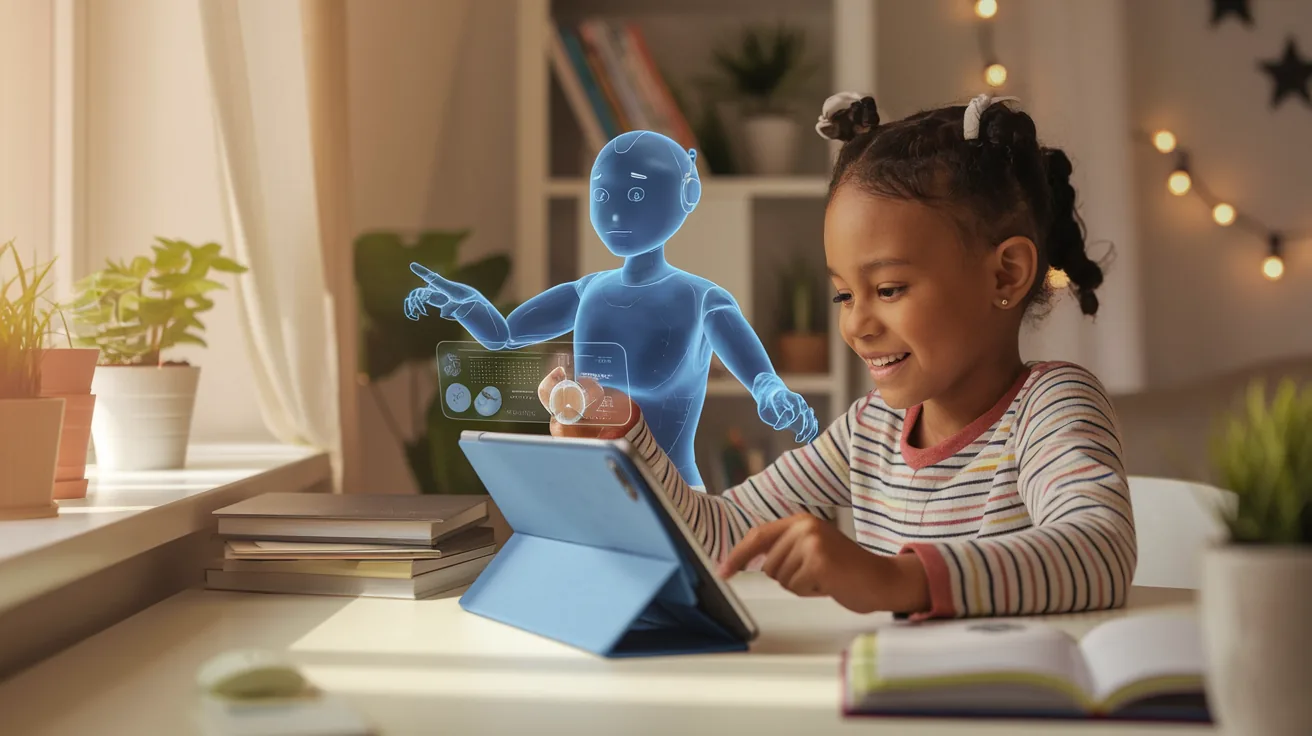
Picture a Year 4 child at a British school in Dubai or Kuala Lumpur, sitting at the kitchen table with a worksheet on electrical circuits. She has drawn a battery, a single wire running to a bulb, and she is certain the bulb will light. It won't. Her teacher has 26 other children and will not see this drawing until tomorrow. Her parents last thought about circuits twenty years ago.
This is the gap an AI tutor is meant to fill. It does not replace the teacher. It gives that child, at that moment, a patient guide who can ask, "Trace the path with your finger. Where does the electricity go after the bulb?"
The Gap That AI Tutoring Fills
Primary school teachers juggle 25 to 30 children with very different speeds, strengths and misconceptions. Benjamin Bloom's 1984 paper "The 2 Sigma Problem" (Educational Researcher) found that children tutored one-to-one performed about two standard deviations better than children in an ordinary classroom. Very few families can afford a private tutor for every subject.
What Makes Modern AI Tutors Different
Early educational software was a digital worksheet: fixed questions, right or wrong answers. A conversational AI tutor works differently in three ways.
1. Adaptive Pacing
Rather than marching through a topic at one speed, the tutor adjusts as it goes. When the child shows she has understood, it moves on. When it detects confusion, it slows down and approaches the idea from another angle. It never runs out of patience, and it never has 29 other children waiting.
2. Finding the Misconception Behind the Wrong Answer
Back to the circuit. The child's gap is not "circuits". It is a specific belief: that electricity flows out of the battery and into the bulb, like water from a tap, so one wire ought to be enough. A tutor that spots this can ask her to build the circuit with a real battery and bulb, try one wire, then two, and describe what she sees. The idea that a circuit must be a complete loop is then hers, not something she was told.
"The most important single factor influencing learning is what the learner already knows. Ascertain this and teach him accordingly." — David Ausubel, Educational Psychology: A Cognitive View (1968)
3. Talking It Through
A good tutor asks the child to explain in her own words, and listens to the explanation. That is where the learning shows: a child who can say why the second bulb is dimmer has understood something a tick on a worksheet cannot capture.
What Parents Should Look For
AI tutoring tools vary a great deal. When you look at one for your child, ask:
- Does it adapt to your child, or just present fixed content? A real tutor adjusts difficulty, pace and explanation to the answers it gets.
- Does it follow the curriculum your child is taught? For a British school, that means the National Curriculum for England, by year group and topic.
- How does it handle mistakes? Look for a tool that treats a wrong answer as information about what the child believes, and explains warmly.
- Is it conversational? A tutor that asks follow-up questions and expects reasoning is worth far more than a multiple-choice quiz engine.
- Is the content safe and suitable for the age? There should be firm limits that keep conversations on topic and free from inappropriate content. Our guide to AI safety for children goes into this.
Fareed, the tutor we are building, is a Key Stage 2 science tutor of this kind, and it is currently on a waitlist.