

You've seen it before. The night before a test, your child sits down with their science notebook, reads through everything twice, and confidently declares they're ready. Two weeks later, they can't remember a single fact about rocks or light sources. It's not that they didn't try — it's that the method failed them. Spaced repetition for kids is the memory trick that actually works, and it's backed by over a century of cognitive science. Understanding how it works could transform the way your child learns — not just for the next test, but for life.
Why Does Cramming Not Work for Children?
Let's start with the uncomfortable truth: cramming feels effective. Your child reviews the material, recognises it, and thinks they know it. Psychologists call this the illusion of competence — a phenomenon where familiarity with information is mistaken for genuine understanding and recall.
In reality, massed practice (studying the same thing repeatedly in one sitting) produces rapid forgetting. Hermann Ebbinghaus, the German psychologist who first mapped human memory in the 1880s, discovered what's now known as the forgetting curve. His research showed that without reinforcement, we forget approximately 70% of new information within 24 hours and up to 90% within a week.
"The most important thing we've learned about memory is that forgetting is not a failure — it's a feature. The act of retrieving something you've almost forgotten is what makes memory stronger." — Dr Robert Bjork, UCLA
For primary school children — who are building foundational knowledge in science, maths, and literacy — this has enormous implications. If most of what they study vanishes within days, then the typical Sunday-evening revision session is largely wasted effort. There is, however, a remarkably simple alternative.
What Is Spaced Repetition and How Does It Work?
Spaced repetition is a learning technique where information is reviewed at gradually increasing intervals over time. Instead of studying a topic once for 40 minutes, your child might revisit it for 10 minutes today, again in two days, then a week later, then a fortnight later. Each review session is short, but the cumulative effect is extraordinary.
The science behind spacing
The technique works because of two interacting principles in cognitive psychology:
- The spacing effect: Memory consolidation is stronger when study sessions are separated by time. The brain literally builds more durable neural pathways when it has to work to retrieve information after a gap.
- Desirable difficulty: When retrieval feels slightly hard — when your child has to think for a moment before recalling that "opaque" means light cannot pass through — that effort strengthens the memory trace far more than easy recognition does.
Research by Cepeda et al. (2006), published in Psychological Science, analysed 254 studies involving over 14,000 participants and concluded that spaced practice consistently outperformed massed practice for long-term retention. The effect size was large and remarkably consistent across age groups, including children.
More recently, a 2019 study by Dunlosky and Rawson found that students who used spaced retrieval practice retained up to three times more information over several weeks compared to those who crammed. This isn't a marginal improvement — it's a fundamental shift in learning outcomes.
How Can Spaced Repetition Help Primary School Children?
You might wonder whether a technique rooted in cognitive psychology research is really appropriate for a 7-year-old learning about plants, light, and rocks in Year 3. The answer is a resounding yes — but it needs to be implemented in a child-friendly way.
It aligns with how children's brains develop
Primary-aged children are in a critical period for building schemas — the mental frameworks that allow them to organise and connect new knowledge. Cognitive load theory, developed by John Sweller, tells us that children's working memory is limited. They can only hold a few new pieces of information at once. Spacing out practice prevents overload and gives the brain time to transfer knowledge from working memory into long-term memory.
It builds genuine confidence
There's an important link here to Carol Dweck's research on growth mindset. When children successfully recall information after a gap — when they know they remember something from last week — it builds authentic self-efficacy. This is far more motivating than the false confidence that comes from re-reading notes and thinking, "Yes, I know this."
It supports curriculum mastery
The British national curriculum is structured so that science concepts build on each other year by year. A child who genuinely retains their Year 3 understanding of light sources will find the Year 6 topic on light and how we see far more accessible. Spaced repetition for kids creates the kind of durable foundational knowledge that makes future learning easier — what Rosenshine's Principles of Instruction describe as ensuring pupils have a "well-connected web of knowledge" to draw upon.
What Does Spaced Repetition Look Like in Practice?
Implementing spaced repetition at home doesn't require special equipment or a degree in psychology. Here are practical strategies any parent can start using this week:
1. The dinner table quiz
After your child learns something new at school, ask them about it casually at dinner. Then ask again two days later. Then the following weekend. Keep the tone light and conversational — this isn't a test, it's a chat. "Do you remember what you told me about magnets on Monday? Which materials did you say were magnetic?"
2. The three-box flashcard system
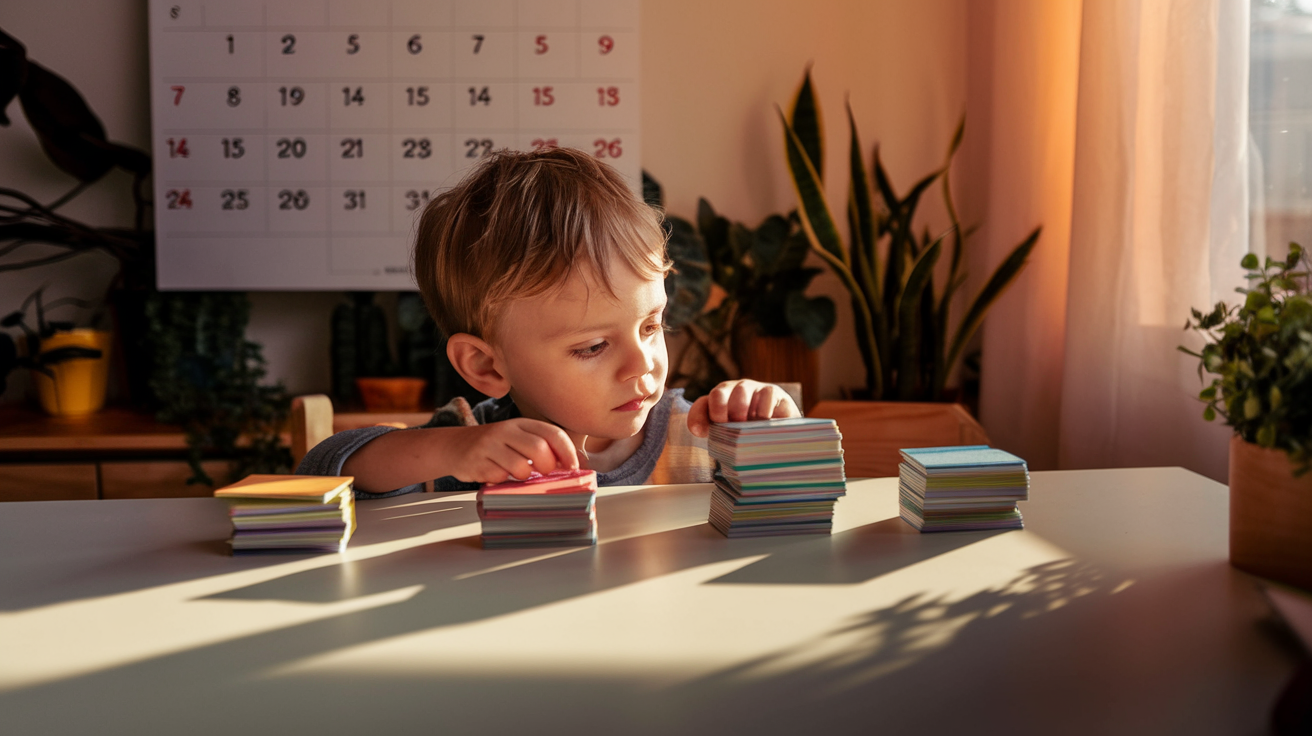
Create three boxes (or piles) of flashcards:
- Box 1 (daily): New or difficult facts your child is still learning
- Box 2 (every 3 days): Facts they've got right at least twice
- Box 3 (weekly): Facts they know well but need occasional reinforcement
When your child gets a card right, it moves to the next box. When they get it wrong, it goes back to Box 1. This is a simplified version of the Leitner system, and it's been used effectively in classrooms worldwide for decades.
3. Weekend mini-reviews
Dedicate 10–15 minutes each weekend to revisiting topics from previous weeks. The key insight is that these sessions should be short and varied. Mixing topics together (known as interleaving) further strengthens memory by forcing the brain to discriminate between different concepts.
4. Use technology wisely
This is where digital tools genuinely shine. Spaced repetition algorithms can automatically schedule reviews at optimal intervals — something that's difficult to manage manually across multiple subjects. Platforms like AI-powered tutoring tools can track what your child knows, identify what they're beginning to forget, and serve up perfectly timed revision without any planning effort from you. Fareed, for example, uses these principles in its adaptive science tutoring, ensuring children revisit key concepts at precisely the right moment for maximum retention.
If you're concerned about balancing technology with other activities, our guide on screen time versus learning time offers a practical framework for making digital learning purposeful.
What Are Common Mistakes Parents Make with Revision?
Even well-intentioned revision strategies can go wrong. Here are the pitfalls to watch for:
- Re-reading instead of recalling: Simply reading through notes is passive and creates the illusion of competence. Instead, close the book and ask your child to explain what they remember. This retrieval practice is the active ingredient that makes spacing work.
- Revising only what's coming up: Many families focus exclusively on the next topic assessment. But the power of spaced repetition lies in maintaining knowledge over months and years, not just until Friday's quiz.
- Making sessions too long: For a child aged 6–8, five to ten minutes of spaced review is ideal. For children aged 9–11, up to fifteen minutes works well. Beyond that, attention fades and returns diminish.
- Not embracing mistakes: When your child can't remember something during a spaced review, that's not failure — it's the system working. The struggle to retrieve is precisely what strengthens the memory. As we explore in our article on why getting it wrong helps children learn, errors are a powerful engine of understanding.
What Does the Research Say About Long-Term Results?
The evidence base for spaced repetition is one of the strongest in all of educational psychology. Professor John Dunlosky's landmark 2013 review in Psychological Science in the Public Interest evaluated ten common study techniques and rated distributed (spaced) practice as having "high utility" — one of only two techniques to receive that top rating.
John Hattie's meta-analytic research, synthesised in Visible Learning, places spaced practice among the strategies with effect sizes well above the 0.4 threshold he considers the "hinge point" for meaningful educational impact. In practical terms, this means that a child using spaced repetition could gain several months of additional learning progress compared to a child using conventional study methods over the same period.
"Distributed practice has one of the most robust effects in all of cognitive and educational psychology. It works across ages, materials, and settings." — Professor John Dunlosky, Kent State University
Perhaps most importantly for parents, spaced repetition doesn't require more study time — it requires better-distributed study time. Your child might actually spend fewer total minutes revising while remembering significantly more.
How Can You Start Using Spaced Repetition This Week?
You don't need to overhaul your child's entire routine. Start small:
- Pick one subject — science is ideal because it's full of specific vocabulary, concepts, and facts that benefit from retrieval practice.
- Identify 10–15 key facts from what your child has been learning recently. Write them as simple questions on cards or a sheet of paper.
- Schedule three short sessions this week: one today, one in three days, one at the weekend. Each session should take no more than ten minutes.
- Track what they find easy and what they find hard. Move easy items to less frequent review; keep hard items in regular rotation.
- Celebrate the effort, not just the answers. When your child struggles to recall something and then gets it right, that's the most valuable learning moment of all.
If you'd like to understand more about why personalised approaches to learning outperform one-size-fits-all methods, or how one-to-one tutoring achieves remarkable results, those articles provide deeper context for why tools like Fareed combine spaced repetition with adaptive, individualised learning paths.
The Bottom Line: Small Gaps, Big Gains
Spaced repetition for kids isn't a hack or a gimmick. It's one of the most thoroughly validated findings in cognitive science, and it works just as powerfully for a Year 2 child learning about animal habitats as it does for a medical student memorising anatomy. The principle is universal: spread out the practice, make retrieval effortful, and the memory sticks.
The best part? It's something any parent can start doing at home, today, with nothing more than a few questions and a little patience. Your child's brain is already wired for this. All you need to do is give it the right rhythm.