
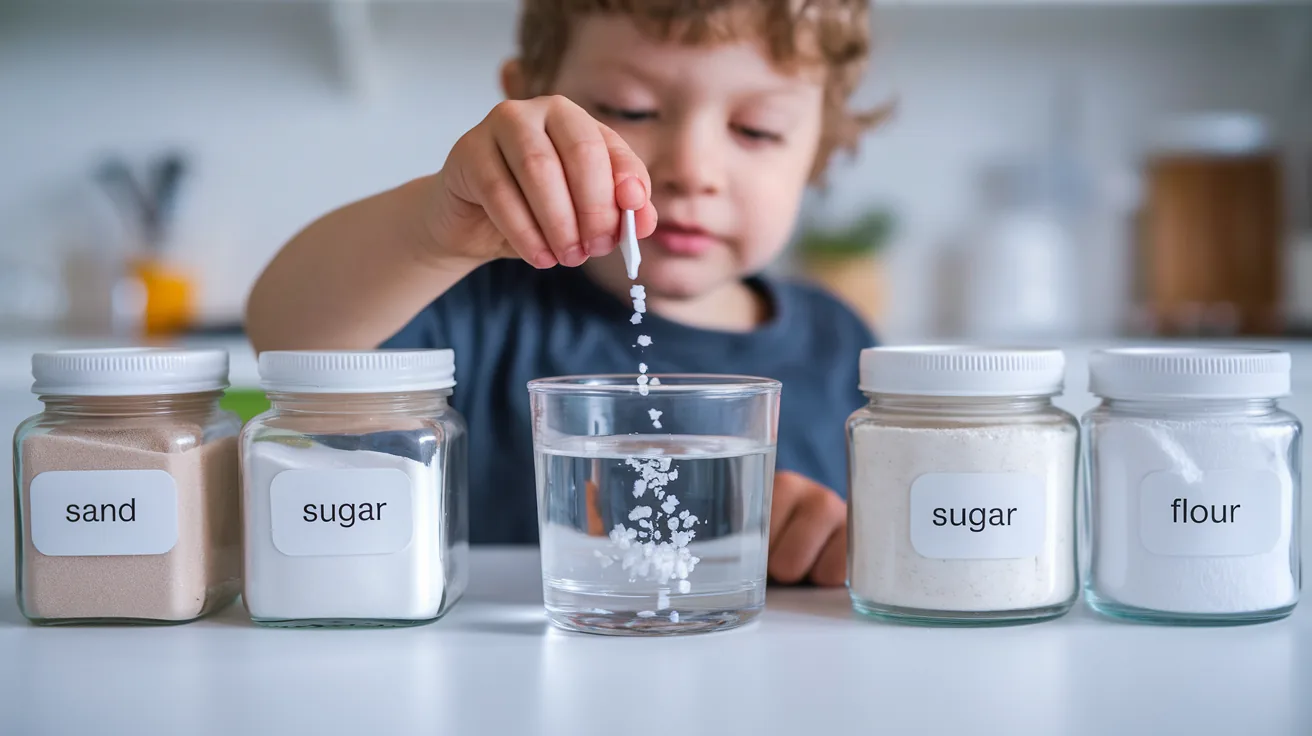
Stir sugar into tea and it disappears. Leave that sweet tea out for days and eventually, you'll find sugar crystals at the bottom of the cup. Mix sand and water vigorously and they seem to combine, but let the mixture sit and the sand settles out again. Burn a piece of paper, and no amount of waiting will turn the ash back into paper.
These everyday observations show how materials behave, change, and can (or cannot) be returned to their original state. The Year 5 Properties and Changes of Materials topic builds on earlier work on materials and prepares the ground for chemistry in secondary school.
Yet this topic confuses many children. The difference between dissolving and melting, between mixtures and solutions, between reversible and irreversible changes: these distinctions can feel slippery. As a parent, you might find yourself uncertain whether burning is a reversible change (it's not), or whether you can separate salt from salt water (you can, through evaporation).
This guide sets out the Year 5 materials curriculum in plain terms, gives experiments you can do at home with everyday materials, and covers the common misconceptions.
What the National Curriculum Requires
The Year 5 programme of study for Properties and Changes of Materials specifies that pupils should be taught to:
- Compare and group together everyday materials on the basis of their properties
- Know that some materials will dissolve in liquid to form a solution, and describe how to recover a substance from a solution
- Use knowledge of solids, liquids and gases to decide how mixtures might be separated, including through filtering, sieving and evaporating
- Give reasons, based on evidence from comparative and fair tests, for the particular uses of everyday materials
- Demonstrate that dissolving, mixing and changes of state are reversible changes
- Explain that some changes result in the formation of new materials, and that this kind of change is not usually reversible
In short, your child needs to understand material properties, how materials can be mixed and separated, and the difference between reversible changes (where you can get the original materials back) and irreversible changes (where new substances form that cannot easily be changed back).
Core Concept 1: Material Properties
Before understanding how materials change, children must observe and describe material properties, the characteristics that make each material what it is.
Key Properties to Understand
- Hardness: How resistant to scratching or denting. Diamond is very hard; chalk is soft.
- Flexibility: Can it bend without breaking? Rubber is flexible; glass is not.
- Transparency: Can you see through it? Clear glass is transparent; wood is opaque.
- Electrical conductivity: Does electricity pass through it? Metals conduct; plastics insulate.
- Thermal conductivity: Does heat pass through it quickly? Metal conducts heat; wood does not.
- Magnetic: Is it attracted to magnets? Iron is; aluminium is not.
- Solubility: Does it dissolve in water? Salt dissolves; sand does not.
Why Properties Matter
Understanding that properties determine uses is a key scientific principle. Windows are made of glass because it's transparent and hard. Electrical wires are coated in plastic because plastic insulates. Saucepans are metal because metal conducts heat well. Children should be able to explain these connections: "This material is used for this purpose because it has these properties."
Activity: Property Testing
Gather various household materials: aluminium foil, paper, fabric, plastic wrap, wood, sponge, cardboard. Test each for different properties:
- Transparency: Hold each up to light. Can you see through it?
- Flexibility: Try to bend each. Which bend easily? Which resist or break?
- Water resistance: Place drops of water on each. Does water bead up or soak in?
- Strength: Try to tear each. Which resist tearing?
Create a chart recording results. Discuss: "Why might we use fabric for towels? Why not plastic?" This builds the connection between properties and practical uses.
Core Concept 2: Dissolving and Solutions
Dissolving is one of the most important concepts in this year's curriculum, and also one of the most commonly misunderstood.
What Actually Happens When Something Dissolves
When sugar dissolves in water, the sugar doesn't disappear or turn into water. It breaks up into pieces far too small to see, which spread evenly through the water. The sugar is still there (you can taste it), but it's no longer visible as a solid. (Schools may call these tiny pieces "particles"; the particle model itself is taught properly in Key Stage 3.)
The result is called a solution:
- The substance that dissolves (sugar) is the solute
- The liquid it dissolves into (water) is the solvent
- The resulting mixture (sugar water) is the solution
Soluble vs Insoluble
Materials that dissolve in a particular liquid are soluble in that liquid. Materials that don't dissolve are insoluble.
Examples of soluble materials in water: salt, sugar, instant coffee, food colouring.
Examples of insoluble materials in water: sand, flour (it forms a suspension, not a solution), oil, chalk.
Activity: Testing Solubility
Set up clear glasses of water and test various substances:
- Salt: dissolves completely, solution stays clear
- Sugar: dissolves completely, solution stays clear
- Sand: does not dissolve, settles to the bottom
- Flour: makes a cloudy suspension, eventually settles
- Oil: does not dissolve, floats on top
Discuss observations: "The salt is still in the water even though you can't see it. How could we prove it?" (Taste it, or evaporate the water to recover salt crystals.)
Common Misconception to Address
Children often think dissolved substances have disappeared or been destroyed. Stress that dissolving is a physical change: the sugar spreads out but is still sugar. The sugar in the solution is exactly the same stuff as the sugar in the cube, only spread through the water.
Core Concept 3: Separating Mixtures
Year 5 students should understand several methods for separating mixtures, chosen based on the properties of the materials being separated.
Sieving and Filtering
Sieving separates larger solid particles from smaller ones. A flour sieve separates lumps from fine flour. A colander separates pasta from water.
Filtering separates insoluble solids from liquids using filter paper or cloth that allows liquid through but traps solid particles. Coffee filters separate coffee grounds from liquid coffee. Sand can be filtered out of a sand-water mixture.
The key distinction: filtering works for insoluble solids suspended in liquid. It will NOT separate dissolved substances (you can't filter salt out of salt water, because the dissolved salt passes through the paper with the water).
Evaporation
When a solution is heated, the solvent (usually water) evaporates, leaving the dissolved solute behind. This is how to recover salt from salt water: heat the solution until all water evaporates, and salt crystals remain.
This is how sea salt is produced: seawater is collected in shallow ponds, the sun evaporates the water, and the salt crystals are gathered.
Activity: Separating Mixtures Challenge
Create mixtures and challenge your child to separate them:
Mixture 1: Rice and paper clips. Method: Use a magnet to attract paper clips, leaving rice behind. Or pick them out manually. This demonstrates using magnetic properties to separate.
Mixture 2: Sand and water. Method: Filtering (using coffee filter or cloth). The sand is trapped; water passes through. Or let sand settle and pour off water (decanting).
Mixture 3: Salt water. Method: Evaporation. Pour salt water into a shallow dish and leave it in a warm place (a sunny windowsill or balcony) for several days. In the Gulf summer it can be done in a day. Water evaporates, leaving salt crystals. For faster results, gently heat the solution (adult supervision required).
After each separation, discuss: "Why did this method work? What property of the materials did we use?"
Core Concept 4: Reversible Changes
Reversible changes are changes where the original materials can be recovered. No new substances are formed.
Types of Reversible Changes
Changes of state: Melting (solid to liquid), freezing (liquid to solid), evaporating (liquid to gas), condensing (gas to liquid). Ice melts to water; water can be frozen back to ice. The substance stays the same; only its state changes.
Dissolving: Sugar dissolves in water to form a solution. Evaporate the water, and you recover sugar crystals. The sugar was unchanged by dissolving; it just spread out.
Mixing: Mix sand and salt together. You can separate them (dissolve salt in water, filter out sand, evaporate water to recover salt). Both materials are unchanged by being mixed.
Why These Changes Are Reversible
The key principle: in a reversible change, the substances themselves do not change. Ice is still water. Sugar in solution is still sugar. Because nothing new has been made, we can get the original materials back by reversing the process or by separating the mixture.
Activity: Demonstrating Reversibility
Melting and freezing: Freeze water in an ice cube tray. Remove ice cubes and place in a glass at room temperature. Watch ice melt back to water. Discuss: "Is the water in the glass different from the water we started with? No, we've only changed its state."
Dissolving and recovering: Dissolve several spoons of salt in warm water until no more will dissolve. Pour the solution into a shallow dish and leave it for a week in a warm place. Observe salt crystals forming as water evaporates. Discuss: "We recovered the salt that had dissolved. This proves dissolving is reversible."
Core Concept 5: Irreversible Changes
Irreversible changes (also called chemical changes) produce new materials with different properties from the original materials. Once these changes occur, you cannot easily reverse them to get the original materials back.
Examples of Irreversible Changes
Burning: Burning paper produces ash, smoke, and gases. These new materials are chemically different from paper. You cannot turn ash back into paper.
Cooking: Frying an egg changes its proteins chemically. A fried egg cannot be turned back into a raw egg. Baking cake batter creates new substances through chemical reactions; you cannot recover flour, eggs, and sugar from a baked cake.
Rusting: When iron rusts, it reacts with oxygen to form iron oxide (rust), a different substance with different properties. Rust is not the same as iron; it's a new material.
Mixing vinegar and bicarbonate of soda: This creates a chemical reaction producing carbon dioxide gas (the bubbles), water, and sodium acetate. New substances are formed that don't exist in the original vinegar or bicarbonate.
Why These Changes Are Irreversible
In an irreversible change, new substances are made. Because the materials at the end are different from the ones at the start, simple physical processes (cooling, evaporating, filtering) cannot undo the change. How this works at the level of atoms and bonds is Key Stage 3 chemistry.
Activity: Observing Irreversible Changes
Burning (adult supervision essential): Light a candle and observe. The wax burns, producing heat, light, water vapour, and carbon dioxide. Blow out the candle. Discuss: "Can we turn the smoke and gases back into wax? No, burning created new materials."
Cooking an egg: Crack a raw egg into a pan (cold pan, for observation). Observe the clear, runny white and soft yolk. Cook the egg. Observe the white becomes solid and opaque, the yolk becomes firm and lighter coloured. Discuss: "Could we make this cooked egg raw again? No, cooking changed the egg into different substances."
Vinegar and bicarbonate of soda: Put a spoon of bicarbonate of soda in a glass. Add vinegar. Watch the bubbling. Discuss: "Those bubbles are a new substance, carbon dioxide gas, that wasn't in either the vinegar or the bicarbonate. New materials were created."
Distinguishing Reversible from Irreversible: The Critical Question
The key question to ask: "Can we get the original materials back?"
If yes, it's reversible. Frozen water? Melt it to get water back. Sugar solution? Evaporate it to get sugar back. Mixed sand and salt? Separate them to get pure sand and pure salt back.
If no, it's irreversible. Burned paper? Cannot recover paper from ash. Baked cake? Cannot recover flour, eggs, and sugar from cake. Rusted iron? Difficult to recover pure iron from rust without complex chemistry.
Common Confusion: Dissolving vs Melting
Many children confuse these processes because both make a solid seem to disappear.
Dissolving: A solid (solute) spreads throughout a liquid (solvent) to form a solution. The solid stays at room temperature; it doesn't require heat. Sugar dissolving in cold water is dissolving, not melting.
Melting: A solid changes state to become a liquid due to heat. The solid substance itself becomes liquid. Ice melting to water is a change of state. Chocolate melting is melting (heat changes solid chocolate to liquid chocolate).
Key distinction: dissolving involves two substances (solid + liquid = solution). Melting involves one substance changing state (solid to liquid).
Connecting the Concepts: The Water Cycle
The water cycle is an excellent real-world example that connects many Year 5 materials concepts:
- Evaporation: Water (liquid) evaporates from oceans, lakes, and puddles, becoming water vapour (gas).
- Condensation: Water vapour (gas) cools and condenses to form water droplets (liquid) in clouds.
- Precipitation: Water droplets join together and fall as rain (liquid) or, if cold enough, snow (solid).
- Freezing/melting: In cold countries, water freezes to ice in winter and melts back to water in spring.
All these changes are reversible. Water changes state but stays water throughout. Nothing new is created; it cycles between solid, liquid and gas.
Supporting Your Child's Success
This topic suits home exploration well. Nearly everything in it can be shown with household materials: water, salt, sugar, sand, vinegar, bicarbonate of soda, ice cubes, candles.
Encourage hands-on exploration. When your child asks whether something will dissolve, reply: "Good question. Shall we test it?" Simple experiments make the ideas concrete.
Ask for the "why" alongside the "what". Knowing that salt dissolves and sand doesn't is useful. Being able to say why, and to predict what an unfamiliar substance will do, is what the curriculum is really after. If your child wants more practice at this kind of reasoning, Fareed, our AI science tutor (currently on a waitlist), is designed to ask exactly these "what will happen if" questions.