
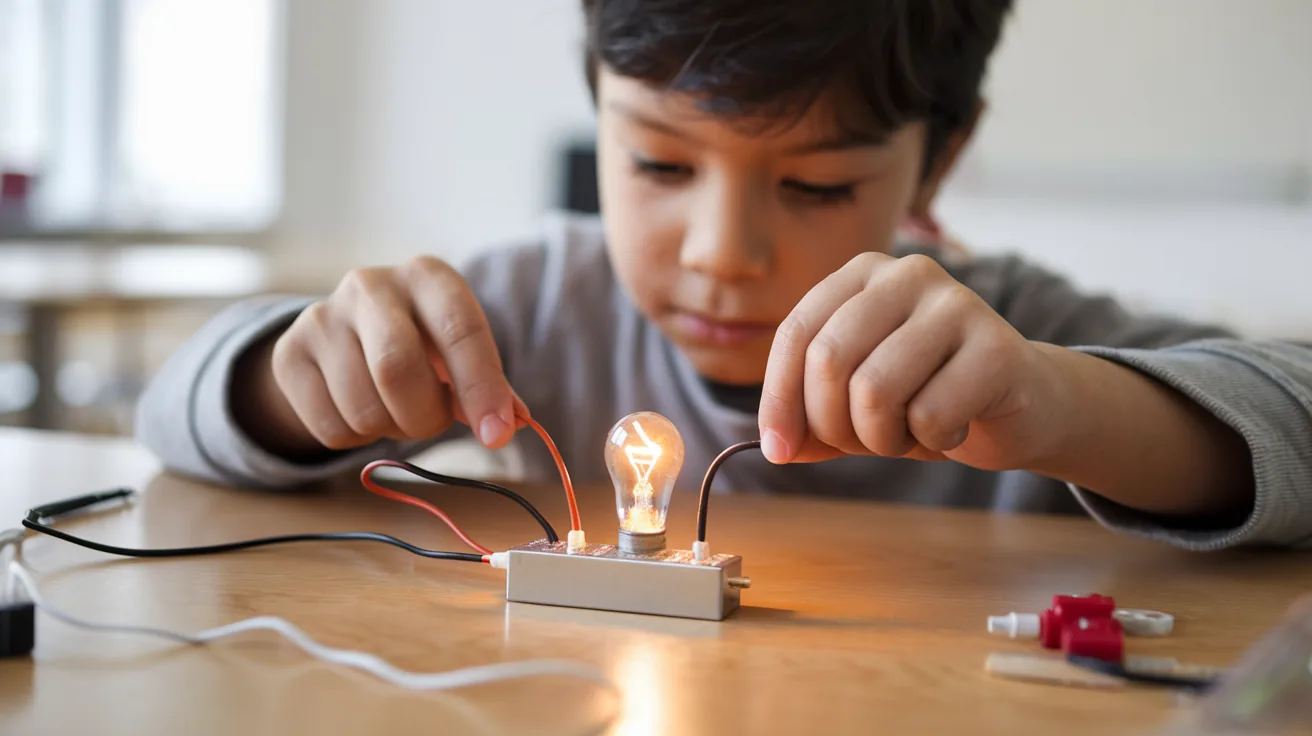
Your Year 4 child comes home with homework about electrical circuits. They need to draw a circuit, explain why the bulb isn't lighting in a particular setup, and identify which materials are conductors. You look at the worksheet and realise you can't quite remember the difference between series and parallel circuits, or why metal conducts electricity but plastic doesn't.
You're not alone. Electricity is a topic most adults learned once and forgot. This guide explains what Year 4 children learn about it, the misconceptions that trip them up, and how you can support their learning at home even if your own knowledge is rusty.
What the Curriculum Requires
The National Curriculum for science at Key Stage 2 specifies that Year 4 pupils should be taught to:
- Identify common appliances that run on electricity
- Construct a simple series electrical circuit, identifying and naming its basic parts, including cells, wires, bulbs, switches and buzzers
- Identify whether or not a lamp will light in a simple series circuit, based on whether or not the lamp is part of a complete loop with a battery
- Recognise that a switch opens and closes a circuit and associate this with whether or not a lamp lights in a simple series circuit
- Recognise some common conductors and insulators, and associate metals with being good conductors
Notice what's not included: parallel circuits, voltage, current, resistance, or any mathematical calculations. Year 4 electricity is fundamentally about understanding that electrical circuits need a complete loop, and that electricity flows through some materials but not others. That's it. Everything else builds towards that core understanding.
Key Concept 1: Complete Circuits
The foundational insight in Year 4 electricity is deceptively simple: electricity only flows in a complete loop from one terminal of the battery, through components, and back to the other terminal. Break the loop anywhere, and electricity stops flowing. Complete the loop, and it flows.
What Children Need to Understand
A battery has two terminals: positive and negative. For a bulb to light, electricity must flow from one terminal, through a wire, through the filament in the bulb, through another wire, and back to the other terminal. This creates a complete circuit—an unbroken path for electricity to flow.
If any part of this loop is missing or broken, the bulb won't light. It doesn't matter if 95% of the circuit is perfect; that last 5% matters absolutely. This is different from many phenomena children understand, where partial completion gives partial results. With circuits, it's binary: complete loop means it works, incomplete loop means it doesn't.
Common Misconception: "Electricity Gets Used Up"
Many children (and adults) think electricity flows out of the battery, powers the bulb, and disappears—like water being absorbed by a sponge. This leads them to draw circuits where wires connect to a bulb but don't continue back to the battery.
The correct model: electricity is flow, not stuff. Imagine a bicycle chain connecting pedals to the rear wheel. When you pedal, every link in the chain moves. If you break the chain anywhere, no links move—even the ones still connected. Electricity in a circuit is similar. The battery provides the push, and the flow happens all the way round the loop at once. Break the loop anywhere, and flow stops everywhere.
How to Support Learning at Home
If your child has access to a basic circuit kit from school (or you can buy one inexpensively online), let them experiment. Give them a battery, two wires, and a bulb, and challenge them: "Can you make the bulb light?" Don't give instructions. Let them try different configurations.
Most children will initially hold one wire from the battery to the bulb and expect it to light. When it doesn't, they problem-solve. Eventually they discover both terminals of the battery must connect to the bulb, creating a complete path. This discovery is far more powerful than being told the rule.
Then ask them to draw what they built as a clear, labelled picture that shows the complete loop. The standard circuit symbols (the lines and circles engineers use) come in Year 6, so a good drawing is enough for now.
Key Concept 2: Switches
Once children understand complete circuits, switches become obvious: a switch is simply a purposeful break in the circuit that you can open or close.
What Children Need to Understand
When a switch is closed (pushed to "on"), it completes the circuit. Electricity flows, and the bulb lights. When a switch is open (pushed to "off"), it creates a gap in the circuit. Electricity cannot jump across gaps (at least not the small voltages in classroom batteries), so flow stops and the bulb goes out.
This is exactly how light switches work in your home. When you flip the switch up, you're physically connecting two pieces of metal inside the switch, completing a circuit that includes the light bulb in the ceiling. Flip it down, the metals separate, the circuit breaks, and the light goes out.
Common Misconception: "The Switch Stores or Creates Electricity"
Some children think the switch does something active—creating electricity, or storing it, or controlling how much flows. In reality, switches are entirely passive. They simply make or break a connection. All the power still comes from the battery (or in your home, from the electrical grid).
How to Support Learning at Home
If you have a circuit kit with a switch, build a circuit together: battery, wire, switch, bulb, wire back to battery. Let your child turn the switch on and off, observing what happens. Then ask: "What do you think is happening inside the switch?"
If you're comfortable doing so, open a dead torch and let them see the physical switch mechanism—it's usually just a small piece of springy metal that moves to touch or separate from another metal contact. This makes the abstract concept concrete.
Around the house, point out switches everywhere: light switches, kettle switches, appliance switches. They're all doing the same job: completing or breaking an electrical circuit.
Key Concept 3: Conductors and Insulators
Some materials allow electricity to flow through them easily (conductors). Others don't (insulators). Understanding why certain materials conduct and others don't requires knowledge of atomic structure that's well beyond Year 4, but children can learn to recognise patterns.
What Children Need to Understand
Metals are good conductors. Copper, aluminium, iron, steel, gold, silver—if it's metal, electricity flows through it readily. This is why electrical wires are made of copper or aluminium.
Most non-metals are insulators. Plastic, rubber, wood, glass, cloth, paper—these materials don't conduct electricity. This is why electrical wires are wrapped in plastic insulation, and why electricians wear rubber gloves.
Water is a special case. Pure water is actually an insulator, but water with dissolved salts and minerals (which is all water you encounter in daily life—tap water, rain, seawater) conducts electricity reasonably well. This is why you must never touch electrical appliances with wet hands, and why dropping a hairdryer in the bath is lethal.
Common Misconception: "You Can Tell by Looking"
Children often think they can identify conductors visually—shiny things conduct, dull things don't, or hard things conduct, soft things don't. While metals are often shiny, this isn't a reliable rule. Graphite (pencil lead) is dull grey and conducts electricity. Aluminium foil is shiny and conducts. Glitter is shiny and doesn't conduct (it's plastic).
The reliable pattern is metals conduct, most non-metals don't. At Year 4 level, that's sufficient.
How to Support Learning at Home
If you have a circuit kit, build a circuit with a gap: battery, wire, bulb, wire—but the two loose wire ends don't connect. The bulb won't light because the circuit isn't complete. Now touch the two loose ends to various household objects:
- A metal spoon: bulb lights (conductor)
- A plastic ruler: bulb doesn't light (insulator)
- Aluminium foil: bulb lights (conductor)
- A wooden pencil: test both the wood and the graphite. Wood won't conduct, but surprisingly, the graphite core will (weakly)
- A coin: bulb lights (conductor)
- Paper: bulb doesn't light (insulator)
Let your child predict before each test: "Do you think this will light the bulb or not? Why?" Then test and see. They'll quickly pick up the metal/non-metal pattern.
Important safety note: Only test this with low-voltage batteries (1.5V or 3V). Never experiment with mains electricity. Never insert anything into wall sockets. Mains voltage (230V in the UK, and about the same in the Gulf and South-East Asia) can kill.
A Note on Circuit Symbols (Coming in Year 6)
In Year 4, children record circuits as labelled drawings. The standard symbols (a cell as two parallel lines, a bulb as a circle with a cross, a switch as a gap with a hinged line) are a Year 6 objective, so do not worry if your child's school has not introduced them. What matters now is that any drawing shows an unbroken loop from one end of the battery to the other.
Addressing Common Homework Questions
Year 4 electricity homework typically involves variations on a few standard questions. Here's how to approach them without simply giving your child the answers.
"Why Won't the Bulb Light in This Circuit?"
Guide your child to trace the path with their finger. Starting at one terminal of the battery, can they follow a continuous path through wires and components back to the other terminal, without lifting their finger? If yes, it should work. If not, identify where the break is.
Common reasons circuits don't work:
- Wire connects to only one side of the bulb, not both
- Switch is in the open position
- Wire connects both to the same battery terminal (positive to positive, or negative to negative) without going through any components
- There's a gap somewhere—two wires that should connect don't quite touch
"Is This Material a Conductor or Insulator?"
Ask: "Is it a metal?" If yes, it conducts. If no, it probably insulates. Then check special cases:
- Graphite (pencil lead): not a metal but conducts
- Water: pure water insulates, but realistic water with impurities conducts somewhat
- Human body: not a metal, but conducts (we're mostly salty water). This is why touching live wires is dangerous.
"Draw a Circuit That Will Light Two Bulbs"
Year 4 focuses on series circuits, where components are in a single loop. For two bulbs in series: battery → wire → bulb 1 → wire → bulb 2 → wire → back to battery. Both bulbs are part of the same loop, so electricity flows through both.
Each bulb will be dimmer than a single bulb on its own would be. Why is explained in Year 6; for now your child only needs to know that both light.
"What Does a Switch Do?"
Help your child phrase it precisely: "A switch opens or closes a gap in the circuit. When closed, it completes the circuit and allows electricity to flow. When open, it breaks the circuit and stops electricity flowing." This is more specific than "turns things on and off," which doesn't show understanding of the mechanism.
Hands-On Activities to Deepen Understanding
Practical experience beats theoretical explanation for this topic. If possible, invest in a simple electrical kit (available for under £15 from educational suppliers or online). Even cheaper, you can create circuits with just household items.
Build a Simple Circuit With Household Items
You need: a 1.5V battery (AA, AAA, C, or D), a small torch bulb (or LED, though these require correct orientation), and two pieces of wire. In a pinch, aluminium foil strips work as wires.
Challenge your child to make the bulb light. Let them experiment freely. Once they succeed, ask them to explain why that configuration works. Then introduce variations: "Can you add a second wire and connect it a different way?"
Create a Conductivity Tester
Build a circuit with a gap: battery → wire → bulb → wire (loose end). Second wire from battery to another loose end. Now you have two loose wire ends.
When you touch the two loose ends together, the circuit completes and the bulb lights. When separated, it goes out. Now touch the two ends to various objects: keys, plastic toys, pencils, vegetables, glass, fabric. Each time, predict first, then test. Record results.
This transforms abstract knowledge ("metals conduct") into concrete discovery ("the metal key made the bulb light, but the plastic ruler didn't").
Design a "Mystery Box" Circuit
This is more advanced, suitable for children who've mastered the basics. Create a simple circuit inside a cardboard box, with some wires coming out through holes. Challenge your child to work out what's in the box by testing which external connections make the bulb light.
For example, you might have a switch inside the box. When specific external wires are connected and the hidden switch is on, the bulb lights. Your child has to figure out there's a switch they can't see, just from observing when the circuit works and when it doesn't.
This develops scientific reasoning: making observations, forming hypotheses, testing them.
Connecting to Everyday Life
Electricity can feel abstract when confined to worksheets and battery-powered classroom circuits. Connecting it to your child's daily experience makes it meaningful.
Around the House
Every electrical device in your home is part of a circuit. The lamp in the living room: circuit runs from the plug, through the cable, through the bulb, and back. The television: circuit from plug, through power supply, through electronic components, back to plug. The toaster, kettle, phone charger—all circuits.
Point this out naturally. "See this cable going to the laptop? That's part of an electrical circuit, just like the ones you're learning about. Electricity flows from the wall socket, through the cable, through the laptop to power it and charge the battery, and back through the cable."
Safety Implications
Understanding circuits makes electrical safety less arbitrary. Instead of "don't touch that because I said so", you can say "if you touch that, you complete a circuit with your body, electricity flows through you, and that causes severe injury or death."
Explain why you don't use electrical appliances in the bathroom: water conducts electricity, so wet hands or a wet floor can allow electricity to flow through you to ground. This is why you must never use mains-powered devices near water.
When to Seek Additional Support
Most children grasp electricity concepts with hands-on experience and some parental support. But if your child is struggling persistently, additional help may be valuable.
Warning Signs
Consider extra support if your child:
- Consistently can't identify whether simple circuits are complete or broken, even after building several working circuits
- Draws circuits where wires don't form complete loops, even after correction
- Can't predict whether a bulb will light from a drawing of a circuit
- Shows significant anxiety or frustration around electricity homework
These might indicate that they're missing foundational understanding, or that they need a different explanatory approach than what's being used at school or in your home.
Options for Support
Talk to the class teacher first. They may be able to provide additional practice resources, recommend specific activities, or work with your child in a small group at school.
Online resources like BBC Bitesize offer interactive simulations where children can build virtual circuits and see immediate results. This provides unlimited practice without needing physical equipment.
If your child needs the topic explained another way, Fareed is an AI science tutor for this curriculum; it is currently on a waitlist.