
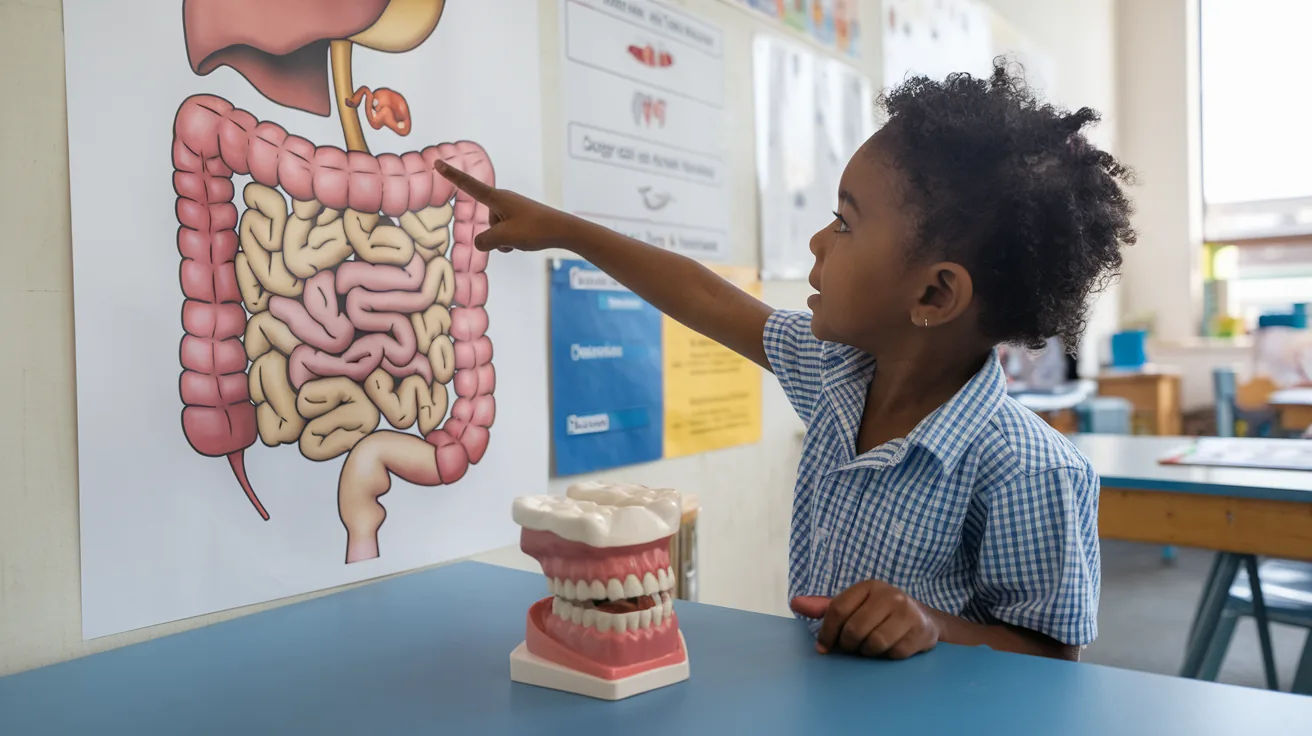
Few topics fascinate Year 4 children quite like learning about their own bodies. The digestive system and teeth unit taps into this natural curiosity, answering questions children have wondered about since they first lost a tooth: Why do we have different shaped teeth? Where does food go after we swallow it? How does the body turn a sandwich into energy?
The topic has its challenges. The organs cannot be seen, the processes take hours, and the vocabulary is hard to remember (oesophagus, anyone?). This guide sets out what your child needs to know, practical activities, and the common misconceptions to watch for.
What the National Curriculum Requires
The Year 4 programme of study for Animals Including Humans specifies that pupils should be taught to:
- Describe the simple functions of the basic parts of the digestive system in humans
- Identify the different types of teeth in humans and their simple functions
- Construct and interpret a variety of food chains, identifying producers, predators and prey
Your child needs to understand the path food takes through the body, what happens at each stage, the different types of teeth and what they do, why dental care matters, and how to draw and read a food chain. Food chains are covered in their own short section below.
The curriculum emphasises simple functions and basic parts — Year 4 students aren't expected to learn about enzymes, villi, or the biochemistry of digestion. The goal is building a conceptual understanding of the body as a system that breaks down food to extract nutrients and energy.
Core Concept 1: The Digestive System Overview
The digestive system (also called the alimentary canal) is essentially a long tube running through the body, with various organs performing different jobs to break down food, absorb nutrients, and eliminate waste.
The Route: Mouth to the Other End
Children need to understand the sequence:
- Mouth: Food enters and chewing begins breaking it down. Saliva moistens food and begins chemical breakdown of starches.
- Oesophagus: A muscular tube that moves food from mouth to stomach using wave-like muscle contractions (peristalsis, though the term isn't required).
- Stomach: A muscular bag that churns food and mixes it with acid and digestive juices, breaking it down further.
- Small intestine: A very long, coiled tube where most nutrient absorption happens. Useful substances pass through the wall into the bloodstream.
- Large intestine: Absorbs water from remaining waste material and forms it into faeces.
- Rectum and anus: Store and eliminate waste from the body.
Making It Concrete: The Rope Activity
Create a visual map of the digestive system using simple materials. You'll need: a long piece of string or rope (about 7-8 metres to represent the full length of the digestive system), labels for each organ, and markers showing approximate lengths.
Lay out the string to show: mouth (point), oesophagus (about 25cm), stomach (expand the string into a bag shape), small intestine (about 6 metres, coiled up), large intestine (about 1.5 metres), rectum and anus (end point). This physical representation makes the extraordinary length of the digestive system tangible — children are often amazed that their small intestine is longer than they are tall.
Walk through a meal's route: "Your sandwich enters your mouth. Teeth break it down. You swallow, and it travels down this tube to your stomach. Your stomach churns it for a few hours. Then it moves into this very long tube where nutrients are absorbed..." Physical movement through the space reinforces the sequence.
Common Misconception to Address
Many children think food goes straight from the mouth to the stomach, falling down like dropping something in a tube. In reality, the oesophagus actively pushes food downwards using muscle contractions. A good way to make the point: astronauts on the space station swallow food and drink perfectly well with no gravity at all, so it cannot be gravity doing the work. This often surprises children and corrects the "falling food" model.
Core Concept 2: What Happens at Each Stage
Beyond knowing the sequence, children should understand what each organ does.
Mechanical vs Chemical Breakdown
Digestion happens two ways:
Mechanical digestion: Physically breaking food into smaller pieces. Teeth chewing, stomach churning, intestines mixing.
Chemical digestion: Using special substances (digestive juices) to break down food molecules. Saliva in the mouth, acid and enzymes in the stomach, more enzymes in the small intestine.
Use this comparison: mechanical digestion is like tearing paper into smaller and smaller bits; the paper is still paper. Chemical digestion is more like cooking an egg: the digestive juices turn the food into new, different substances that the body can absorb. (Dissolving sugar in water is not a good comparison, because dissolved sugar is still sugar.)
Absorption: Getting Nutrients into the Body
An important idea that children often miss: food in your digestive system is technically still outside your body. Think of the digestive system as a tube passing through you. Until nutrients cross through the intestinal wall into the bloodstream, they're not really "in" your body.
The small intestine is where absorption happens: its walls absorb nutrients (proteins, sugars, fats, vitamins, minerals) into the blood, which carries them to cells throughout the body. What's left over — fibre, water, and waste — moves to the large intestine.
Activity: Simulating Digestion
This hands-on activity makes the abstract process visible:
Mechanical digestion simulation: Put crackers in a sealed plastic bag. Crush them with your hands. This represents teeth chewing. The crackers break into smaller pieces but are still crackers.
Chemical digestion simulation: Add a small amount of water (representing saliva or stomach acid) to the bag. Squish and mix. Over time, the crackers break down into a paste. This is only a rough stand-in for chemical digestion: in the body, the digestive juices do more than wet the food, they change it into different substances.
You can extend this by adding the paste to a coffee filter over a cup (representing the small intestine). The liquid passes through (nutrients being absorbed into the blood) while solid waste stays in the filter.
Core Concept 3: Types of Teeth and Their Functions
Humans have four types of teeth, each designed for specific jobs in mechanical digestion.
The Four Types
Incisors: The flat, sharp teeth at the front (eight total — four on top, four on bottom). These are for biting and cutting food. Think of biting into an apple.
Canines: The pointed teeth next to incisors (four total — one on each side, top and bottom). These are for tearing and gripping food. More prominent in carnivores, but humans use them for tearing meat or tougher foods.
Premolars: The teeth behind canines with flatter surfaces and small points (eight total in adults, none in young children who still have all baby teeth). These crush and grind food.
Molars: The large, flat teeth at the back (twelve total in adults, including wisdom teeth). These are the primary grinding teeth, with large surface areas for crushing food.
Baby Teeth vs Adult Teeth
Most Year 4 children are in the midst of losing baby teeth and gaining adult teeth, making this personally relevant. Children should understand:
- Baby teeth (20 total) begin falling out around age 6-7
- Adult teeth (32 total, including wisdom teeth) are permanent — they won't be replaced
- Adult teeth are larger and stronger but need good care to last a lifetime
- Losing baby teeth is normal and happens because adult teeth push them out from underneath
Activity: Teeth Function Experiment
Give your child different foods and ask them to pay attention to which teeth they use:
- Biting into an apple — which teeth do the initial biting? (Incisors)
- Tearing off a piece of meat or chewy bread — which teeth help? (Canines)
- Chewing that food before swallowing — which teeth do most work? (Premolars and molars)
This conscious attention to normally automatic actions makes teeth function concrete rather than abstract.
Common Misconception to Address
Children often think baby teeth falling out happens because the teeth are "dying" or damaged. In reality, adult teeth developing underneath gradually dissolve the roots of baby teeth, causing them to loosen and fall out. It's not decay or damage — it's a normal developmental process. Adult teeth won't fall out the same way because there are no more teeth developing underneath them.
Core Concept 4: Caring for Teeth
Understanding tooth structure helps explain why dental care matters.
Tooth Structure (Simplified)
- Enamel: The hard, white outer covering. Hardest substance in the body, but can be damaged by acid.
- Dentine: The layer underneath enamel. Softer than enamel and sensitive.
- Pulp: The soft centre containing blood vessels and nerves. If decay reaches here, it causes pain.
How Tooth Decay Happens
Year 4 children should understand the basic process:
- Bacteria naturally live in mouths
- When we eat sugary or starchy foods, bacteria feed on the sugar
- As bacteria digest sugar, they produce acid
- Acid attacks tooth enamel, gradually wearing it away
- If enamel wears through, decay can reach dentine and pulp, causing cavities and pain
The key message: it's not sugar directly damaging teeth — it's the acid produced by bacteria feeding on sugar.
Why Dental Care Works
Brushing: Removes bacteria and food particles before bacteria have time to produce much acid. Brushing twice daily (morning and before bed) prevents bacterial buildup.
Fluoride toothpaste: Fluoride strengthens enamel and helps repair early damage before it becomes a cavity.
Reducing sugar frequency: Constant snacking means constant acid production. It's better to have sweets once than to graze on them all day, giving teeth recovery time between acid attacks.
Dental checkups: Dentists can spot and fix small problems before they become painful cavities.
Activity: The Egg Shell Experiment
This classic demonstration shows how acid affects enamel:
Place a hard-boiled egg (representing a tooth — the shell is like enamel) in a cup of vinegar (representing acid produced by bacteria). Leave it overnight. By morning, the shell becomes soft and may dissolve, showing how acid weakens the hard protective covering.
For comparison, place another egg in water overnight. It remains hard, showing that water doesn't damage enamel the way acid does.
Discuss: "If vinegar (acid) can do this to a hard egg shell overnight, imagine what happens if acid is on your teeth every day. That's why we brush to remove the bacteria that make acid."
Connecting Teeth and Digestion
Help your child see how these topics connect: teeth are the beginning of the digestive process. Proper chewing breaks food into smaller pieces, increasing surface area for chemical digestion later. Food that's chewed well is easier for the stomach and intestines to process.
You can demonstrate this with a simple experiment: drop a whole sugar cube in water versus dropping crushed sugar. The crushed sugar dissolves faster because it has more surface area exposed to water. Similarly, well-chewed food is digested more efficiently than large chunks.
Addressing Common Questions
"Why do we have an appendix if it doesn't do anything?"
The appendix is a small pouch attached to the large intestine. For a long time people thought it did nothing. Scientists now think it may help store useful gut bacteria and play a small part in the body's defences. If it becomes infected (appendicitis) it is removed, and people live normally without it.
"How long does digestion take?"
Food spends roughly two to four hours in the stomach, then several more hours in the small intestine, where most absorption happens. The whole trip from eating to the toilet usually takes one to three days, depending on what you ate. This long timescale surprises children.
Core Concept 5: Food Chains
The third statutory requirement is to construct and interpret food chains. A food chain shows what eats what. It always starts with a producer, a plant that makes its own food. Everything after that is a consumer. An animal that hunts another is a predator; the animal it hunts is its prey.
The arrows are the part children get wrong. An arrow means "is eaten by", so it points from the food to the eater: leaves → caterpillar → blackbird. Ask your child to say the arrow out loud as "is eaten by" every time and the direction stops being a guess. Build chains from where you live: in the Gulf, sea grass → green turtle → tiger shark; in a Malaysian garden, hibiscus leaves → caterpillar → myna bird.
Two things to check: the chain starts with a plant, and each living thing appears once. A useful question is "What would happen to the blackbirds if all the caterpillars disappeared?", which shows that each link depends on the one before it.
If your child needs the topic explained another way, Fareed is an AI science tutor for this curriculum; it is currently on a waitlist.
Has Your Child Got It?
Your child has truly mastered this topic when they can:
Sequence the digestive system correctly: Starting from mouth and moving through each organ in order, explaining what happens at each stage.
Explain both types of digestion: Distinguish between mechanical (physical breaking) and chemical (molecular change) digestion, with examples of each.
Identify teeth types and functions: Point to their own teeth and explain what each type does, making connections to the foods they eat.
Explain tooth decay process: Connect bacteria, sugar, acid, and enamel damage in a logical sequence, and explain why dental care prevents decay.
Make connections: Link concepts together, explaining how proper chewing helps digestion, or why nutrients need to be absorbed into blood to be useful.
Draw and read a food chain: Start with a plant, point the arrows the right way, and name the producer, a predator and its prey.