
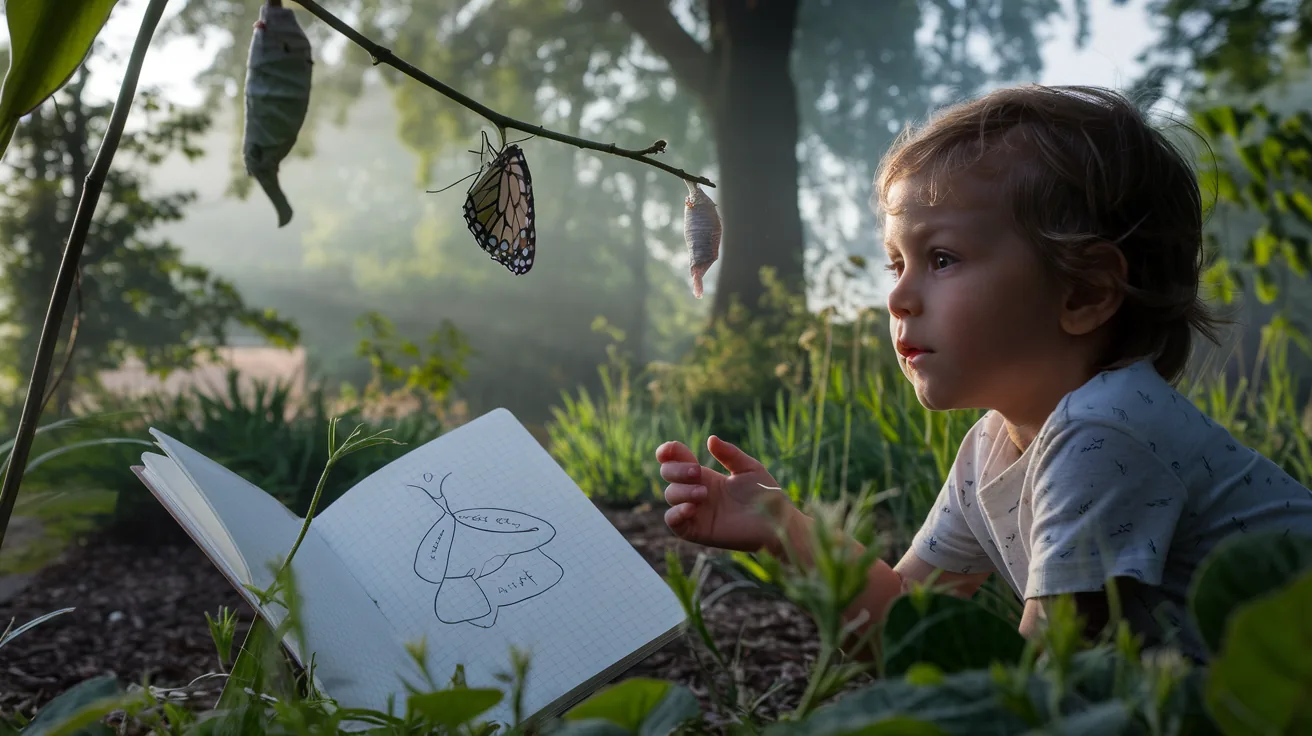
Your Year 5 child mentions that science this term is "living things and reproduction". You pause. What exactly will they be learning? How much detail about human reproduction is covered? And when they ask for help with homework about plant reproduction or animal life cycles, will you actually know the answers?
This topic sometimes worries parents, partly because the word "reproduction" suggests sex education, and partly because many of us have forgotten the biology we learned decades ago. The reality is simpler than you might fear, and more interesting than you might remember.
This guide explains what Year 5 children actually learn about life cycles and reproduction in science lessons, why this knowledge matters, common misconceptions, and how you can confidently support your child's learning at home.
What the National Curriculum Requires
The Key Stage 2 science curriculum specifies that Year 5 pupils should be taught to:
- Describe the differences in the life cycles of a mammal, an amphibian, an insect and a bird
- Describe the life process of reproduction in some plants and animals
That is the whole statutory list: two statements. Notice what is absent: detailed human reproduction, sexual intercourse, pregnancy or birth. In state schools in England those topics sit in Relationships and Sex Education (RSE), not science. International schools that follow the English curriculum set their own policies on this, so ask your school what it teaches and when.
The science curriculum focuses on understanding that all living things reproduce, that reproduction creates new individuals of the same species, and that different organisms have different reproductive strategies and life cycles. It's biology, not human sexuality education.
Understanding Life Cycles
A life cycle describes the sequence of stages an organism passes through from birth to reproduction to death. Different types of organisms have characteristically different life cycles.
Mammal Life Cycles: Direct Development
Mammals, including humans, dogs, cats, whales, and bats, share a common life cycle pattern:
- Birth: Young are born live (not hatched from eggs, with exceptions like platypuses and echidnas, which are rarely discussed at Year 5 level)
- Infancy: Young are fed on milk produced by the mother
- Growth and maturation: The young mammal grows larger and develops adult characteristics
- Reproductive maturity: The mammal becomes capable of reproduction
- Reproduction: Adult mammals produce offspring
- Death: Eventually, the individual dies
This is called "direct development" because the young mammal looks like a smaller version of the adult. A puppy looks like a small dog; it doesn't transform into a radically different form as it matures.
Bird Life Cycles: Egg-Laying with Parental Care
Birds share many features with mammals but have key differences:
- Egg laying: Female birds lay eggs with hard shells
- Incubation: Parent birds keep eggs warm (usually by sitting on them) until they hatch
- Hatching: Chicks break out of eggs
- Parental care: Most bird chicks require extensive parental feeding and protection
- Fledgling stage: Young birds learn to fly and become independent
- Maturity and reproduction: Adult birds reproduce, laying eggs to continue the cycle
Like mammals, birds show direct development: chicks look like small versions of adult birds. The key differences from mammals are egg-laying and the lack of milk production.
Amphibian Life Cycles: Metamorphosis
Amphibians (frogs, toads, newts, salamanders) have very different life cycles involving metamorphosis, a transformation from one body form to another:
- Eggs: Laid in water, soft and jelly-like (no hard shell)
- Larval stage: Eggs hatch into larvae (tadpoles for frogs/toads) that live entirely in water, breathe through gills, and have tails for swimming
- Metamorphosis: Dramatic transformation occurs. Tadpoles develop legs, lose their tails, develop lungs for breathing air
- Adult stage: Adult amphibians typically live on land but return to water to reproduce
- Reproduction: Adults lay eggs in water, continuing the cycle
This is indirect development. A tadpole looks nothing like an adult frog. It has a different body, a different habitat and a different way of life.
Insect Life Cycles: Complete and Incomplete Metamorphosis
Insects show two main patterns:
Complete metamorphosis (butterflies, moths, beetles, bees, flies):
- Egg: Laid by adult female
- Larva: Hatches as a worm-like larva (caterpillar, grub, maggot) that eats voraciously and grows
- Pupa: Larva forms a protective case (chrysalis for butterflies, cocoon for moths) and undergoes transformation
- Adult: Emerges with a completely different body: wings, different mouthparts, reproductive organs
- Reproduction: Adults mate and lay eggs
Incomplete metamorphosis (grasshoppers, dragonflies, crickets):
- Egg: Laid by adult
- Nymph: Hatches looking like a small adult but without wings or reproductive organs
- Growth through moults: Nymph sheds its outer skin several times, growing larger each time
- Adult: After the final moult, gains wings and can reproduce
- Reproduction: Adults reproduce and lay eggs
Plant Reproduction: Often Overlooked but Equally Important
The curriculum includes plant reproduction, which many parents find less familiar than animal reproduction.
Flowering Plant Life Cycle
- Seed: Contains embryo plant and food store
- Germination: When conditions are right (water, warmth, sometimes light), the seed sprouts
- Growth: Seedling develops roots, stem, leaves
- Maturity: Plant grows to full size and develops flowers
- Pollination: Pollen from one flower reaches the stigma of another (or the same) flower, often carried by insects or wind
- Fertilisation: Pollen fertilises ovules inside the flower
- Seed formation: Fertilised ovules develop into seeds
- Seed dispersal: Seeds spread by wind, animals, water, or explosive mechanisms
- Cycle repeats: Seeds germinate into new plants
Key Vocabulary
- Pollination: Transfer of pollen from the male part (anther) to the female part (stigma) of a flower
- Fertilisation: The joining of male and female cells to form a seed
- Seed dispersal: How seeds spread away from the parent plant
Common Misconception: "Flowers Are Just Decorative"
Many children (and adults) think flowers exist to look pretty. In reality, flowers are reproductive organs. Their colours, scents, and nectar exist to attract pollinators (bees, butterflies, birds) that transfer pollen between flowers. Beauty is a byproduct of reproductive strategy.
Asexual Reproduction: The Alternative Strategy
While the curriculum emphasises sexual reproduction (requiring two parents), Year 5 children also learn that some organisms reproduce asexually (one parent creates offspring genetically identical to itself).
Examples of Asexual Reproduction
- Plant cuttings: A piece of stem or root cut from one plant can grow into a complete new plant
- Bulbs and tubers: Daffodils produce new bulbs; potatoes produce new tubers. These grow into new plants genetically identical to the parent
- Runners: Strawberry plants send out runners (horizontal stems) that root and form new plants
- Binary fission: Single-celled organisms like bacteria simply divide in two
Why Asexual Reproduction Matters
Asexual reproduction is faster and requires only one parent. If you find a good environment, you can rapidly produce many offspring. The disadvantage: no genetic variation. Every offspring is identical, meaning if a disease can kill one, it can kill them all.
Sexual reproduction is slower and requires finding a mate, but produces genetic variation. This makes populations more adaptable and resilient to changing conditions.
Addressing the Human Reproduction Question
Parents often worry about how much detail Year 5 science provides about human reproduction. The answer: typically very little in science lessons specifically.
What Science Lessons Cover
In science, humans are usually discussed as an example of mammals: live birth, milk production, parental care, direct development. The focus is on the life cycle (infant, child, adolescent, adult, elderly) and the concept that reproduction creates the next generation.
Diagrams might show a baby, child, teenager, and adult, illustrating stages of human development. Discussion focuses on changes during growth: babies can't walk or talk; children develop these abilities; adolescents undergo puberty (rapid growth, development of secondary sexual characteristics); adults can reproduce; elderly people experience ageing.
What RSE Lessons Cover (England Only)
More detailed teaching about human reproduction, puberty and relationships happens in Relationships and Sex Education (RSE), not science. The rules below apply to state schools in England. Relationships education has been compulsory in English primary schools since September 2020, and schools must consult parents about what they teach and when. Parents can withdraw a child from sex education lessons, but not from relationships education or from the science curriculum.
International schools in the Gulf and South-East Asia are not bound by these rules, even when they follow the English curriculum. Some teach an RSE programme, some teach a reduced version, and some leave it to families. Ask your school for its policy.
Having the Conversation at Home
If your child asks questions about human reproduction prompted by science lessons, age-appropriate honesty works best:
For younger/less curious Year 5 students: "All mammals, including humans, grow inside their mother's body before being born. The baby starts very tiny and grows for about nine months before it's ready to be born."
For more curious students asking for more detail: "Just like the frog eggs need male and female frogs to make them, human babies need a cell from a man and a cell from a woman to start growing. Those cells join together, and the baby grows inside the woman's uterus, a special organ just for this purpose."
Match your detail level to your child's questions and maturity. Answer what they ask, but you don't need to provide information they haven't requested. Most Year 5 children are genuinely interested in the biological science without wanting extensive detail about human sexuality.
Common Misconceptions to Watch For
Several predictable misunderstandings arise with this topic. Spotting and addressing them helps your child build accurate knowledge.
Misconception: "All Animals Lay Eggs"
Young children often generalise from birds and insects. Clarification: mammals give live birth (with rare exceptions); birds, most reptiles, amphibians, fish, and insects lay eggs.
Misconception: "Animals Choose to Transform"
Children sometimes think caterpillars decide to become butterflies, or tadpoles choose to grow legs. Reality: metamorphosis is automatic, triggered by hormones and environmental cues. It's not a decision; it's biology.
Misconception: "Reproduction Is Optional"
Some children think organisms can choose whether to reproduce. Clarification: while individual organisms might not reproduce (due to circumstances, health, etc.), reproduction is essential for species survival. If a species stopped reproducing entirely, it would become extinct within one generation.
Misconception: "Plants Don't Reproduce"
Because plant reproduction is less visible and dramatic than animal reproduction, children sometimes don't recognise it as reproduction. Point out that seeds, bulbs and cuttings are all forms of plant reproduction that create new individuals.
Hands-On Activities to Deepen Understanding
Life cycles make much more sense when children watch them happen.
Grow Plants from Seeds
Cress, sunflowers, or bean plants grow quickly and visibly. Plant seeds, observe daily growth, and watch the complete cycle: seed → germination → growth → flowering (for longer-term projects) → seed production.
Discuss: Where did the seed come from? What does it need to germinate? What will this plant do when it's fully grown? How will it make more seeds?
Observe Butterflies or Caterpillars
Butterfly rearing kits are widely available and relatively inexpensive. You receive caterpillars, watch them eat and grow, form chrysalises, and emerge as butterflies. Witnessing metamorphosis firsthand is far more impactful than any diagram.
If a kit isn't practical, watching caterpillars on garden plants works too, though you're less likely to see the whole cycle. Families in Dubai can see hundreds of butterflies at every stage at the Dubai Butterfly Garden.
Visit a Pond, Wetland or Nature Reserve
In the UK in spring, many ponds contain frog spawn (clusters of eggs in jelly) or tadpoles. In the Gulf and South-East Asia, wetland reserves are the equivalent trip: Ras Al Khor in Dubai for nesting and feeding birds, Sungei Buloh in Singapore for mudskippers, herons and dragonflies at every stage.
Safety note: always supervise children near water. Don't remove spawn or tadpoles unless you can care for them properly and return them.
Document Life Cycles Photographically
If your family has a pet that has babies (responsibly, not as a science experiment), documenting the offspring's development creates a personal life cycle record. Alternatively, observe a neighbour's dog with puppies, or follow a bird's nest (from a respectful distance).
Photos taken weekly showing growth stages make the concept of life cycles tangible and memorable.
Supporting Homework and Revision
Typical Year 5 homework on this topic includes:
Comparing Life Cycles
Questions like: "Describe two differences between the life cycle of a butterfly and the life cycle of a chicken."
Guide your child to think systematically: How does each organism start life? (Egg for both.) How does the young organism develop? (Butterfly: larva, then pupa, then adult, with metamorphosis. Chicken: chick, then adult, direct development.) What does the young organism look like compared to the adult? (Very different for butterfly, similar for chicken.)
Labelling Diagrams
Your child might need to label the stages of a life cycle diagram. If they can't remember a term (e.g., "pupa"), encourage them to describe what's happening at that stage, then look up the correct term. Understanding is more important than memorisation.
Ordering Life Cycle Stages
Given scrambled stages, they must put them in correct order. The strategy: find the beginning (egg or birth) and the end (death or reproduction), then logically order what happens in between.
Explaining Reproduction
Questions like: "Explain how flowering plants reproduce."
Encourage your child to use key vocabulary (pollination, fertilisation, seed dispersal) but in their own sentences, not memorised definitions. If they can explain it in their own words, they understand it.
When Concepts Don't Click
Some children find life cycles hard, particularly metamorphosis or the difference between pollination and fertilisation in plants.
Watch It Happen
Time-lapse videos of caterpillars becoming butterflies, or seeds germinating and growing, make the ideas concrete. BBC Bitesize has good short animations.
Act It Out
Acting out a life cycle helps many children remember the order. They crouch like a seed, "sprout" by standing, "grow" leaves (arms), "flower" (jazz hands), then "make seeds" to throw to new places. Silly, but it sticks.
Persistent Struggles
If your child consistently confuses life cycle stages, can't distinguish between different organism types, or shows significant frustration with this topic, they may benefit from extra support. Fareed, our AI science tutor (currently on a waitlist), is designed to give children patient, repeated explanation on topics like this one.