
Evolution and inheritance is one of the most interesting topics in the Year 6 science curriculum, and often one of the hardest for children and parents to grasp. Unlike topics with clear cause-and-effect relationships (like electricity or forces), evolution requires thinking across enormous timescales and understanding processes that happen too slowly to observe directly.
Yet this topic is also uniquely powerful. It explains why giraffes have long necks, why polar bears are white, and why your child might have their grandmother's eyes. It connects the fossils children see in museums to the living creatures in their gardens. And importantly for the national curriculum, it introduces fundamental scientific concepts about variation, adaptation, and evidence-based reasoning.
This guide breaks the Year 6 evolution and inheritance curriculum into three ideas, gives practical activities you can do together, and covers the misconceptions that trip up even able children.
What the National Curriculum Requires
The Year 6 programme of study for evolution and inheritance specifies that pupils should be taught to:
- Recognise that living things have changed over time and that fossils provide information about living things that inhabited the Earth millions of years ago
- Recognise that living things produce offspring of the same kind, but normally offspring vary and are not identical to their parents
- Identify how animals and plants are adapted to suit their environment in different ways and that adaptation may lead to evolution
Broken down, this means your child needs to understand three interconnected concepts: the evidence for evolution (primarily fossils), the mechanism of inheritance (why children resemble but aren't identical to parents), and the process of adaptation leading to evolutionary change over time.
The curriculum deliberately avoids detailed mechanisms like DNA and natural selection in favour of building conceptual understanding. Year 6 children aren't expected to explain genetics or how new species form. They are building the idea that living things change over time in response to their environments.
Core Concept 1: Fossils and Evidence of Change Over Time
The first major idea is deceptively simple: living things today are different from living things in the past, and we know this because of fossil evidence.
What Your Child Needs to Understand
Children should grasp that:
- Fossils are the preserved remains or traces of living things from millions of years ago
- Different rock layers contain different types of fossils, showing that life has changed over time
- Many fossilised organisms (like dinosaurs or ammonites) no longer exist today; they are extinct
- Some ancient organisms look similar to modern ones but with key differences (early horses were much smaller, for instance)
Making It Concrete: Activities to Try
Create fossil imprints at home: Press shells, leaves, or toy dinosaurs into clay or playdough, then carefully remove them to leave an imprint. This demonstrates how fossils form when organisms leave impressions in soft sediment that later hardens into rock.
Timeline exercise: Use a 10-metre piece of string or ribbon to stand for Earth's 4.6 billion years, so every metre is 460 million years. Mark the events along it: the first simple life appears about 2 metres from the start, the dinosaurs occupy a stretch from about 50 cm before the end to about 15 cm before the end, and humans fit into the last few millimetres. Seeing it laid out helps children grasp the timescales involved.
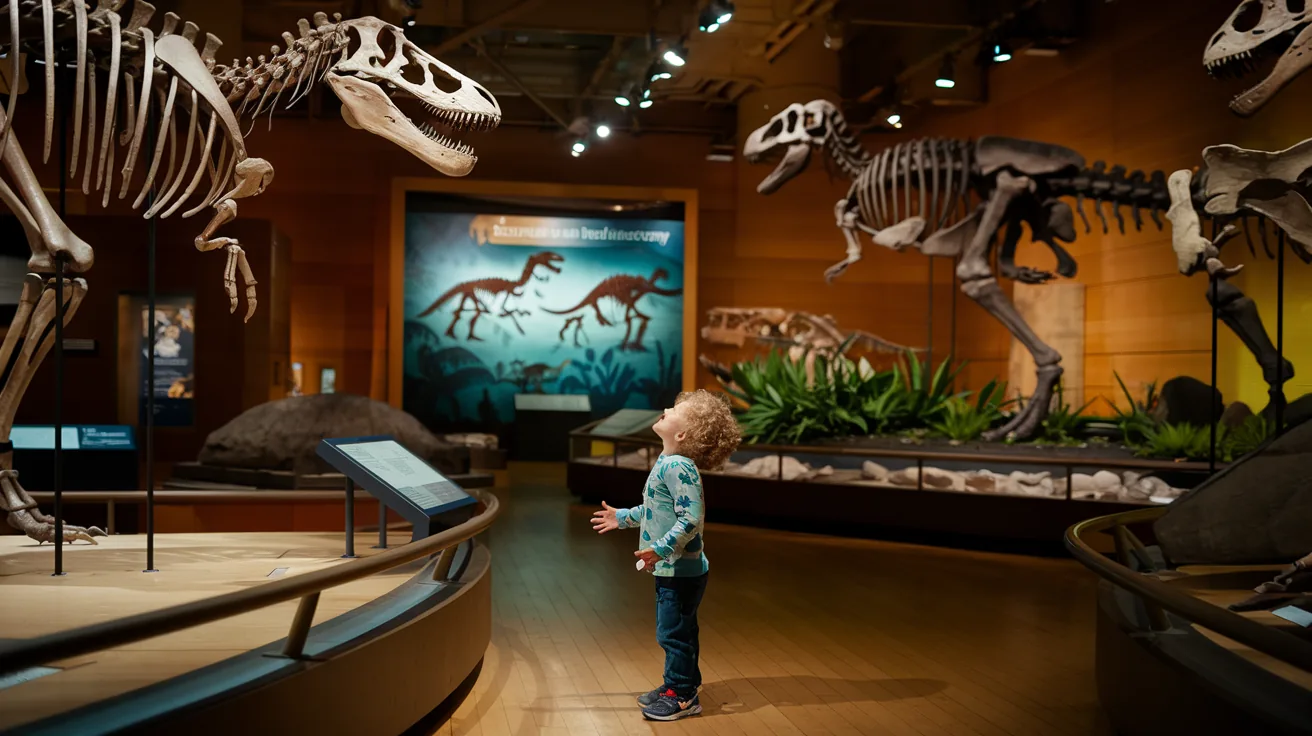
Museum visit with purpose: If you visit a natural history museum, focus on one evolutionary sequence. The horse evolution display, showing progression from the small Eohippus to modern horses, is particularly clear. Ask your child to notice what changed (size, number of toes, tooth shape) and discuss why those changes might have been useful.
Common Misconception to Address
Many children think fossils are simply "very old bones." While some fossils are mineralised bones, others are impressions, traces (like footprints), or even preserved soft tissue in exceptional circumstances. The key concept is that fossils are evidence of past life, preserved in various ways.
Core Concept 2: Inheritance and Variation
The second key idea is why children look like their parents but aren't identical copies, something every child can see in their own family.
What Your Child Needs to Understand
- Living things produce offspring of the same species (dogs have puppies, not kittens)
- Offspring inherit characteristics from their parents (eye colour, hair type, height potential)
- But offspring also vary; even siblings from the same parents look different
- Some characteristics are inherited (eye colour), while others are acquired through experience (scars, language, fitness level)
Making It Concrete: Activities to Try
Family trait survey: Make a chart of characteristics across your family: eye colour, hair colour, freckles, whether hair is straight or curly. Include siblings, parents and grandparents. This makes inheritance concrete and shows both the patterns and the variation. One caution: inheritance is more complicated than "one gene, one feature". Brown-eyed parents can have a blue-eyed child, and older examples like tongue rolling and attached earlobes turn out not to be simple inherited traits at all. Look for family resemblance, not rules.
Pet breeding research: If your family has pets, or if your child is interested in animals, research the breed. Why do Golden Retrievers look different from German Shepherds? How did humans create these different breeds through selective breeding? This introduces the idea that selecting which individuals reproduce can change characteristics over generations.
Plant variation: Grow bean plants from seeds. Even with identical growing conditions, the plants will vary in height, leaf size, and growth rate. Measure and compare them, discussing how these differences arise despite identical environments.
Common Misconception to Address
Children often struggle to distinguish inherited characteristics from learned or acquired ones. A classic mistake: thinking that because a father is a talented musician, his children will automatically be musical. The truth is more subtle: some abilities may have inherited components, but the skill itself must be learned. Use specific examples: a scar isn't inherited, but the tendency to have freckles is.
Core Concept 3: Adaptation and Evolution
This is where the previous concepts come together: variation plus environmental pressures over long periods equals evolutionary change.
What Your Child Needs to Understand
- Animals and plants have features (adaptations) that help them survive in their specific environments
- These adaptations didn't appear overnight; they developed over many generations
- Individuals with helpful adaptations are more likely to survive and reproduce, passing those traits to offspring
- Over very long periods, this process can lead to significant changes in a species
Making It Concrete: Activities to Try
Adaptation sorting game: Make cards with different animals and cards with different environments (Arctic, desert, rainforest, ocean). Match animals to environments and name the adaptations: the polar bear's thick fur and white camouflage for the Arctic, the camel's wide feet and long eyelashes for the desert, the mudskipper's ability to breathe out of water on a mangrove mudflat, the fish's gills and fins for the ocean.
Beak simulation: This classic activity uses different tools (tweezers, spoons, chopsticks, clothespins) to represent different bird beak shapes. Place different "foods" (rice grains, larger beans, water with floating items) in separate areas. Children try to collect food using each tool, discovering that different beaks work better for different food sources. Discuss how birds with beaks suited to available food would be more successful and likely to survive.
Camouflage investigation: Cut out paper "butterflies" in various colours and patterns. "Release" them in your garden or a park (some on grass, some on bark, some on flowers). Ask your child to collect as many as they can find in two minutes. The best camouflaged ones will be hardest to spot, just as predators struggle to find well-camouflaged prey, so those individuals survive to reproduce.
Critical Concept: Evolution Requires Time
One of the hardest aspects of evolution for children (and adults) to grasp is the timescale. Evolution doesn't happen in an individual's lifetime or even across several generations of humans. It requires hundreds, thousands, or millions of generations.
Help your child understand this by contrasting individual adaptation (a single animal responding to its environment, like growing thicker fur in winter) with evolutionary adaptation (a species changing over many generations). The giraffe doesn't stretch its neck to reach high leaves. But over countless generations, giraffes with slightly longer necks fed and bred more successfully, and the whole population gradually shifted towards longer necks.
Connecting the Three Concepts
The real understanding comes when children connect these ideas into a coherent explanation of how life changes over time:
- Fossils show us that living things in the past were different from today's organisms
- Living things produce offspring that vary: not clones, but individuals with slight differences
- In any environment, some variations are more helpful than others for survival
- Individuals with helpful variations are more likely to survive and have offspring
- Over very long periods, this process can lead to big changes, even new species
Told this way, evolution is a logical process with evidence behind it rather than a list of facts.
Addressing Common Questions and Challenges
"Why don't we see animals evolving now?"
We do, but in most cases it happens too slowly for us to see. Exceptions include bacteria developing antibiotic resistance (they reproduce quickly enough that we can observe evolutionary change) and Darwin's finches, where scientists have documented beak size changes over just a few decades in response to changing seed availability. For most organisms, evolution takes far longer than a human lifetime to observe.
"If evolution is real, why are there still monkeys?"
This common misconception assumes evolution is a ladder, with everything climbing towards being human. In reality, humans and other primates share a common ancestor from millions of years ago. That ancestral species branched into different evolutionary paths, one eventually leading to modern humans, others to modern chimpanzees, gorillas, and other primates. Modern monkeys aren't our ancestors; they're our distant cousins, which evolved along their own paths.
"How can something as complex as an eye evolve?"
Complex structures evolve through accumulation of small changes, each providing some advantage. Eye evolution shows this beautifully: simple light-sensitive cells provide basic awareness of light and dark (useful for knowing when to be active). A slight depression holding those cells provides directional information. A deeper depression with a small opening creates a pinhole camera effect, producing a rough image. A clear covering protects the structure and can evolve into a lens. Each tiny step provides some survival benefit, making it more likely to be passed on.
Supporting Your Child's Success
Be patient. If your child struggles to see how tiny changes add up to big differences, or why evolution needs so much time, that's normal. These ideas puzzled scientists for decades after Darwin proposed them. What matters is building understanding through concrete examples and correcting misconceptions as they come up. Some children need to hear the same explanation from several different angles before it clicks. Fareed, our AI science tutor (currently on a waitlist), is designed to give that kind of patient, repeated explanation.