
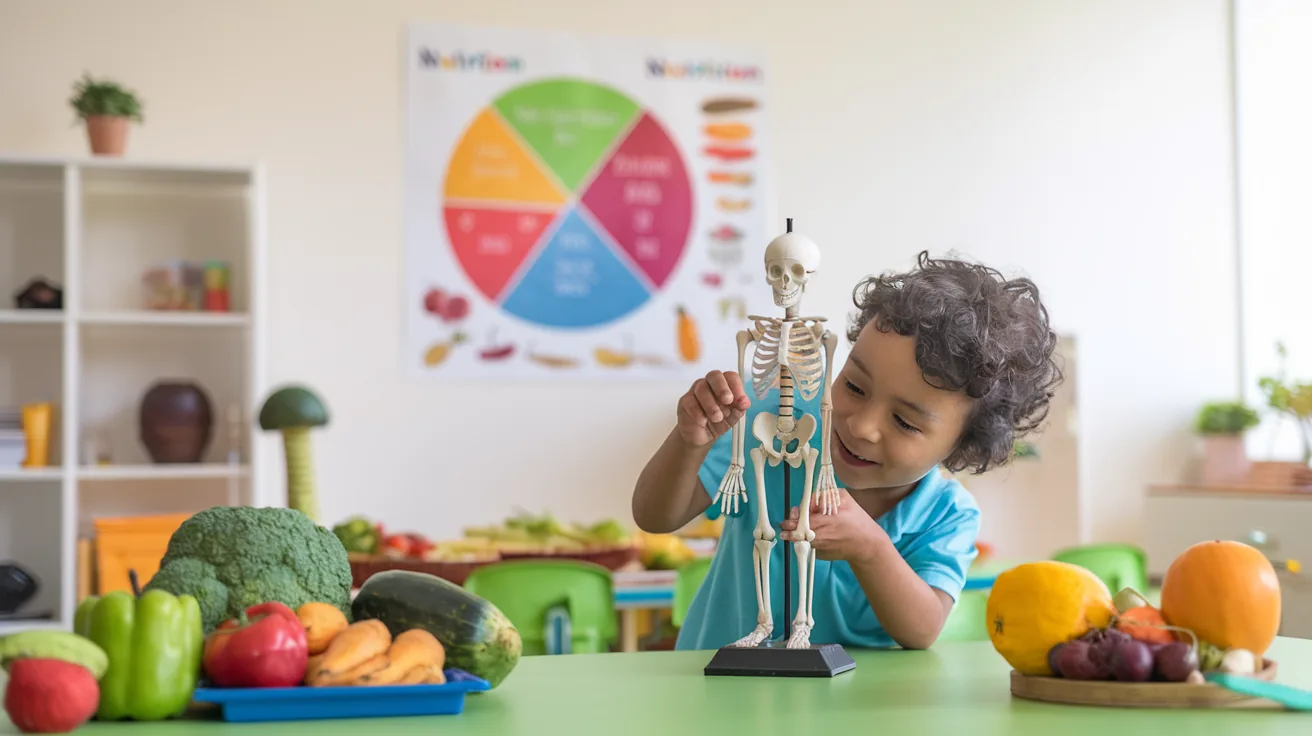
Year 3 is the year children move from observing the world around them to understanding some of the systems inside their own bodies. The "Animals Including Humans" unit covers nutrition, skeletons and muscles.
If your child has come home asking why we need bones, what vitamins do, or how muscles work, this is why. This guide explains what your Year 3 child is learning, where children get confused, and how you can support them at home.
What the Year 3 Curriculum Covers
The National Curriculum for England specifies that Year 3 students should be taught to:
- Identify that animals, including humans, need the right types and amount of nutrition
- Understand that they cannot make their own food and get nutrition from what they eat
- Identify that humans and some other animals have skeletons and muscles for support, protection, and movement
Understanding Nutrition
When teachers introduce nutrition in Year 3, they're not simply reinforcing healthy eating messages your child has heard since nursery. They're teaching genuine biology: the relationship between food and bodily function.
The Seven Nutrient Groups
Year 3 children learn that food provides seven essential nutrients, each with specific jobs:
- Carbohydrates provide energy for activity and growth (found in bread, pasta, rice, potatoes)
- Proteins build and repair body tissues, including muscles (found in meat, fish, eggs, beans, lentils)
- Fats provide concentrated energy and help absorb certain vitamins (found in butter, oils, nuts, oily fish)
- Vitamins keep various body systems healthy (different vitamins found in fruits, vegetables, dairy, meat)
- Minerals support specific functions like bone strength and blood health (calcium in dairy, iron in red meat and leafy greens)
- Fibre aids digestion and keeps the digestive system healthy (found in wholegrains, fruits, vegetables)
- Water regulates temperature, transports nutrients, and keeps cells functioning (from drinks and watery foods)
The key conceptual understanding here is that different nutrients do different jobs. This isn't about "good foods" versus "bad foods" but about variety and balance. A child who grasps this understands why eating only their favourite food wouldn't keep them healthy, even if that food is nutritious.
Why Animals Can't Make Their Own Food
Year 3 introduces a basic distinction: plants make their own food, while animals (including humans) must get their nutrition from what they eat. This might seem obvious to adults, but it is a new idea for an eight-year-old. How plants make their food is covered properly later, in Key Stage 3.
The idea that our food comes from plants, or from animals that ate plants, leads into food chains in Year 4.
Skeletons: The Framework of Life
The skeleton unit captivates most Year 3 students. There is something fascinating about the hidden framework inside our bodies, and the unit also teaches important ideas about structure and function.
What Skeletons Do: Three Essential Functions
Year 3 children learn that skeletons serve three critical purposes:
1. Support
Without a skeleton, our bodies would collapse into shapeless masses. The skeleton provides a rigid framework that holds us upright and maintains our shape. Teachers often demonstrate this by comparing our skeleton to tent poles that hold up fabric, or the steel frame of a building that supports the walls.
2. Protection
The skull protects the delicate brain, the ribcage shields the heart and lungs, and the vertebrae (spine bones) safeguard the spinal cord. Children learn that our most vital organs are housed within protective bony structures. This makes intuitive sense once explained — we can bump our forehead much harder than we could safely bump our brain.
3. Movement
Bones work with muscles to enable movement. The skeleton provides the levers and joints that muscles pull on to create motion. This concept often requires hands-on demonstration because it's mechanically complex for young children to visualise.
Key Bones Children Learn to Identify
While Year 3 doesn't require memorising all 206 bones in the adult human body, children typically learn to identify and locate major bones:
- Skull — protects the brain
- Ribs — protect heart and lungs, form the ribcage
- Spine (backbone/vertebrae) — supports body, protects spinal cord
- Pelvis — supports lower body, protects organs
- Femur (thigh bone) — the longest, strongest bone in the body
- Humerus (upper arm bone) — connects shoulder to elbow
- Radius and ulna (forearm bones) — connect elbow to wrist
- Tibia and fibula (lower leg bones) — connect knee to ankle
Teachers use songs, rhymes, and physical movement activities to help children remember bone locations. If your child is dancing around pointing to their femur and singing, they're engaging with exactly the kind of multi-sensory learning that aids retention.
Invertebrates: Animals Without Skeletons
Year 3 also looks at animals without an internal skeleton, such as insects, worms, jellyfish and snails. Some, like beetles and crabs, have a hard outer casing. Others, like earthworms, have no hard parts at all. The technical names for these body plans, and how they work, come later in Key Stage 3; in Year 3 the point is simply that not every animal has bones inside it.
Muscles: The Engines of Movement
How Muscles and Bones Work Together
The key concept is that muscles pull on bones to create movement. Muscles can only pull (contract); they cannot push. This means movement in two directions requires two muscles working in opposition.
The classic example taught in Year 3 is the bicep and tricep pair in the upper arm:
- When you bend your elbow, your bicep (front of upper arm) contracts and pulls your forearm up
- When you straighten your elbow, your tricep (back of upper arm) contracts and pulls your forearm down
- While one muscle contracts, the other relaxes
Muscles working in pairs like this is how movement happens throughout the body. The term "antagonistic pair" for this comes later, in Key Stage 3; in Year 3 children only need the idea that muscles pull and work in pairs.
Common Misconceptions to Watch For
Children often hold several misconceptions about nutrition, skeletons and muscles. Being aware of these helps you reinforce the correct ideas:
"Bones are solid and don't change"
Many children think bones are like rocks — completely solid and unchanging. In reality, bones are living tissue with blood vessels and nerves. They grow throughout childhood, heal when broken, and continually remodel themselves. Emphasising that bones are alive helps children understand why calcium and vitamin D matter.
"Any food gives you energy"
Children sometimes think all nutrients provide energy. In fact, only carbohydrates, fats, and proteins provide energy (measured in calories). Vitamins, minerals, fibre, and water are essential for health but don't provide energy. This distinction matters for understanding why balanced nutrition includes multiple nutrient types.
"Muscles push and pull"
The idea that muscles can only pull, not push, is counterintuitive. We experience ourselves as pushing objects, so children assume muscles push. Reinforcing that all movement is actually pulling, and that pushing an object involves muscles pulling bones that then push the object, helps solidify correct understanding.
"The skeleton is separate from the rest of the body"
Skeleton models and diagrams can give the impression that bones are separate structures. Children need to understand that bones are connected to muscles by tendons, held together by ligaments, and an integrated part of a living body, not a separate frame.
Practical Activities to Support Learning at Home
The best way to reinforce Year 3 science learning is through concrete, hands-on experiences that make abstract concepts tangible.
Nutrition Activities
Food group sorting: Look at your meals together and identify which food groups are represented. Can your child identify the protein source, the carbohydrate, the vegetables providing vitamins and minerals? This works with any cuisine: a plate of nasi lemak or a bowl of machboos has a carbohydrate, a protein and vegetables just as a roast dinner does.
Reading nutrition labels: Many Year 3 children can read well enough to explore food packaging. Look at the nutritional information together. Which nutrients does this food provide? Why might someone choose this food? This connects science to literacy and real-world decision-making.
Planning a balanced meal: Challenge your child to plan a meal that includes all food groups. Discuss why each component matters. This applies their learning in a creative, practical context.
Skeleton Activities
Feel your own bones: Children can locate bones by feeling through their skin. Can they find their skull, ribs, spine, and arm bones? Feeling their own bones makes the skeleton personal and memorable.
Compare animal skeletons: Look at images of different animal skeletons online or in books. How is a bird skeleton similar to and different from a human skeleton? What about a fish or a cat? This extends curriculum content and encourages comparative thinking.
X-ray exploration: If your child or a family member has ever had an X-ray, discuss what it shows. Why can we see bones but not muscles in an X-ray? This connects learning to medical technology and real experiences.
Muscle Activities
Observe muscle action: Have your child place one hand on their bicep and slowly bend and straighten their elbow. Can they feel the muscle bulging when it contracts and softening when it relaxes? This makes the abstract concept of muscle contraction tangible.
Find other muscle pairs: Once children understand the bicep-tricep example, can they identify other opposing muscle pairs? When you smile, muscles pull your mouth corners up; when you frown, different muscles pull them down. This extends the principle to new contexts.
Discuss exercise: Why do we exercise? Connect this to muscle function. Exercise makes muscles stronger by making them work harder. This gives purpose to physical activity and reinforces that muscles are living tissues that respond to use.
Questions Children Commonly Ask
Year 3 children ask wonderful questions that reveal their developing understanding. Here are some common ones and how to address them:
"Why do we have bones but worms don't?"
Different animals have different body structures suited to their way of life. Worms live in soil and move by squeezing and stretching their bodies. Bones would make that impossible! We need bones because we're large animals that walk upright, and that requires rigid support.
"If muscles can only pull, how do we push things?"
Great question! When you push something, your muscles are pulling your arm bones, and your arm bones push against the object. So it's still pulling by the muscles, but it feels like pushing because of what happens next.
"Why do we need so many different foods?"
Each nutrient does a specific job, and most foods only provide some nutrients. Eating many different foods ensures we get all the nutrients we need. It's like building a house — you need bricks, wood, glass, and nails; one material alone won't work.
"Do all animals have muscles?"
All animals have some way of moving, and most have muscles of some kind. Even tiny animals like insects have muscles! But the muscles look different in different animals depending on how they need to move.
Revision Checklist
Your child is ready for the end of the unit when they can:
- Say that animals, including humans, cannot make their own food and get nutrition from what they eat
- Name the main nutrient groups and give a food that provides each one
- Explain why eating only one favourite food would not keep them healthy
- Give the three jobs of a skeleton: support, protection and movement
- Point to and name the skull, ribs, spine, pelvis, femur and humerus
- Name one animal with bones inside it and one animal without
- Explain that muscles pull, never push, and work in pairs
- Show the bicep and tricep working by bending and straightening their arm
When to Seek Additional Support
Most Year 3 children will grasp these concepts with time, classroom instruction, and home reinforcement. However, if your child consistently struggles to remember basic body parts, can't distinguish between different nutrients even with repeated explanation, or seems significantly behind classmates in understanding biological concepts, it may be worth discussing with their teacher.
Sometimes difficulty with this content reflects broader challenges with abstract thinking or remembering complex information. Teachers can differentiate instruction or recommend additional support if needed. Early intervention is always more effective than waiting.