
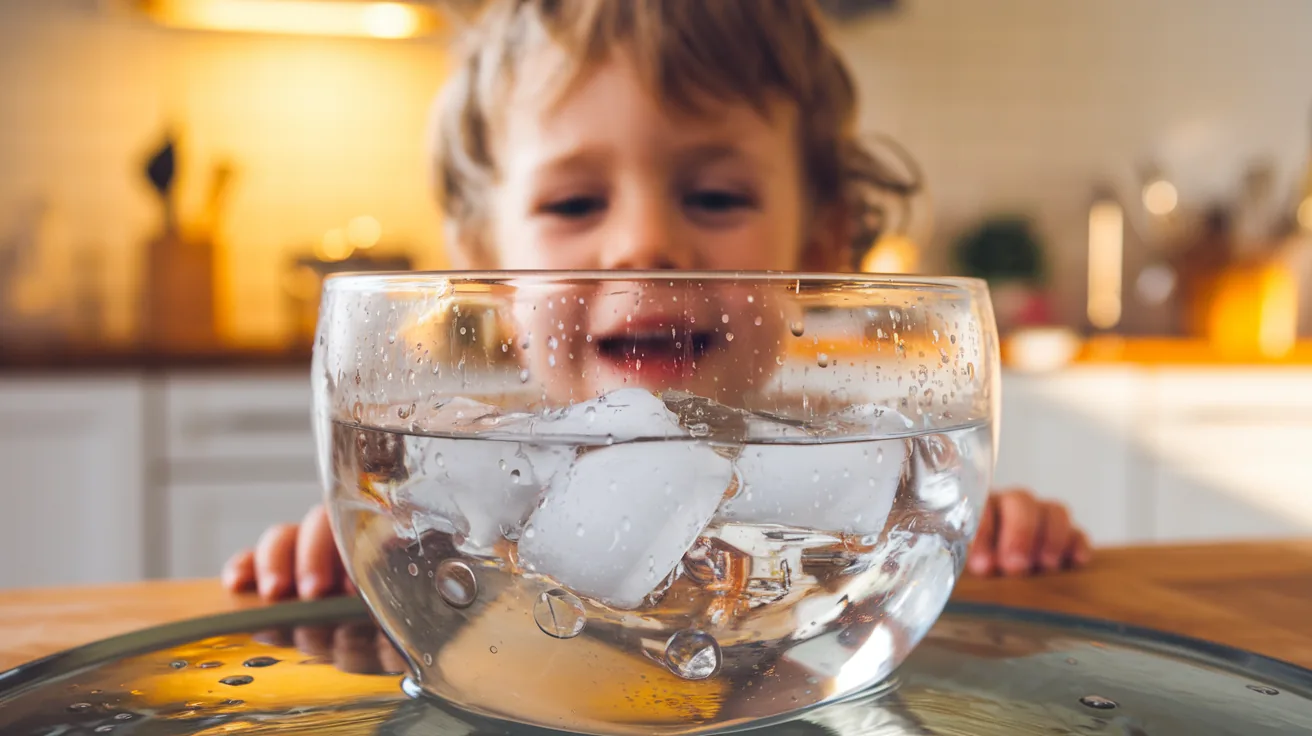
States of matter is one of those foundational science topics that seems deceptively simple — until your Year 4 child asks, "But Mum, if ice is solid and water is liquid, why are they both still water?" or "How can gas be matter if I can't even see it?"
Suddenly, you're searching your memory for GCSE chemistry knowledge while trying to explain particle theory to an 8-year-old who yesterday was confident steam was just "hot air."
This is where many parents find themselves when their child encounters the Year 4 states of matter unit in the National Curriculum. The topic forms a crucial foundation for future chemistry learning, but it requires children to grasp abstract concepts about particles they can't see behaving in ways that sometimes contradict their everyday observations.
This guide will help you understand exactly what your child is learning, why they find certain aspects confusing, and how you can support their understanding at home — no chemistry degree required.
What the National Curriculum Requires
The Year 4 science programme of study for states of matter is specific about what children should learn. According to the National Curriculum in England, pupils should be able to:
- Compare and group materials together, according to whether they are solids, liquids or gases
- Observe that some materials change state when they are heated or cooled, and measure or research the temperature at which this happens in degrees Celsius (°C)
- Identify the part played by evaporation and condensation in the water cycle and associate the rate of evaporation with temperature
Beyond just knowing the definitions, children are expected to use particle theory to explain the properties and behaviours of different states. This represents a significant cognitive leap from the observational science of earlier years to more abstract, theoretical thinking.
Understanding the Three States: What Your Child Needs to Know
Solids: Fixed Shape and Volume
At the observable level, solids are easy to understand — they're things like rocks, ice, tables, and books that maintain their shape and can't be poured.
At the particle level (which is where Year 4 gets challenging), solids have particles that are:
- Very close together — packed tightly with almost no gaps
- Arranged in regular patterns — often in a fixed structure called a lattice
- Vibrating in place — they have energy and move, but only by vibrating on the spot rather than moving around
This particle arrangement explains why solids have a fixed shape (particles can't move past each other) and are difficult to compress (there's no space to push particles closer together).
Common misconception: Many children think particles in solids don't move at all. In reality, they vibrate constantly — they just don't change position relative to each other. When solids get hotter, these vibrations increase until eventually the bonds holding particles in place break, and the solid melts.
Liquids: Fixed Volume, Changeable Shape
Liquids are the in-between state that children encounter constantly — water, juice, oil, milk. They can be poured, they take the shape of their container, but they don't expand to fill it entirely like gases do.
At the particle level, liquids have particles that are:
- Close together but not touching — similar density to solids, which is why liquids are also incompressible
- Randomly arranged — no fixed structure or pattern
- Moving around each other — sliding past one another, which allows liquids to flow and take the shape of their container
This explains why you can pour a liquid (particles move past each other) but why liquids have a fixed volume (particles are still close together, so a litre of water is always a litre, regardless of container shape).
Common misconception: Children often think liquid particles are further apart than solid particles, which would suggest liquids should be less dense than solids. While this is true for water/ice (ice is unusually less dense than liquid water), it's not generally true. The key difference is movement and arrangement, not spacing.
Gases: No Fixed Shape or Volume
Gases are the most difficult state for children to grasp because most gases we encounter daily (air, oxygen, carbon dioxide) are invisible. Yet gas is still matter — it has mass and takes up space.
At the particle level, gases have particles that are:
- Very far apart — much more space between particles than in solids or liquids
- Moving very fast in random directions — constantly zooming around and bouncing off each other and container walls
- Having very weak forces between them — particles are essentially independent
This explains why gases expand to fill their container (particles spread out to fill available space), why they're compressible (lots of empty space between particles), and why they have much lower density than solids or liquids (same number of particles spread over much larger volume).
Common misconception: Many children think gas particles don't weigh anything because they can't see or feel most gases. A simple demonstration: a deflated balloon weighs less than the same balloon inflated with air, proving gas has mass.
Changes of State: Where the Learning Gets Challenging
Understanding that ice, water, and steam are all the same substance in different states is conceptually difficult. The substance hasn't changed — the H₂O molecules are identical — only the arrangement and movement of particles has changed.
Melting and Freezing
Melting occurs when a solid is heated enough that particles vibrate so vigorously they break free from their fixed positions and begin to move around each other. The melting point of pure water is 0°C at sea level — a specific temperature your child should know.
Freezing is the reverse: when a liquid is cooled, particles slow down until they lock into fixed positions. Freezing point is the same as melting point (0°C for water) but approached from the opposite direction.
Key point for children: Temperature doesn't change during melting or freezing. If you heat ice at -5°C, the temperature rises to 0°C, then stays at 0°C until all the ice melts, then continues rising. The heat energy is being used to break bonds between particles rather than increase particle vibration (temperature).
Evaporation and Boiling
This is where it gets nuanced — and where many children (and parents) get confused.
Evaporation is the process where liquid particles at the surface gain enough energy to escape into the gas state. This happens at any temperature, not just when water is hot. Puddles dry up on cold days. Washing dries on the line. This is all evaporation.
The rate of evaporation increases with:
- Higher temperature (particles move faster, more likely to escape)
- Larger surface area (more particles at the surface)
- Wind or air movement (removes evaporated particles, allowing more to escape)
- Lower humidity (dry air "pulls" more water particles)
Boiling is rapid evaporation that occurs throughout the liquid, not just at the surface, when it reaches its boiling point (100°C for water at sea level). Bubbles form inside the liquid as water turns to steam within the body of the water, not just at the surface.
Common misconception: Children often think evaporation only happens when water is hot, or that boiling and evaporation are completely different processes. In reality, they're the same change of state (liquid to gas) happening at different rates and temperatures.
Condensation
Condensation is the change from gas to liquid, occurring when water vapour cools. This happens when warm, moisture-laden air meets a cold surface — like your bathroom mirror after a shower, or morning dew on grass.
At the particle level, gas particles slow down as they cool until they get close enough for attraction forces between them to pull them together into liquid state.
Common misconception: Many children think condensation is water "coming through" the mirror or window, rather than water vapour in the air turning to liquid on the cool surface.
The Water Cycle: Bringing It All Together
The water cycle is where Year 4 children apply their understanding of evaporation and condensation to explain a real-world phenomenon. The basic cycle involves:
- Evaporation: Heat from the sun causes water from oceans, rivers, and lakes to evaporate into water vapour
- Condensation: Water vapour rises, cools at altitude, and condenses into tiny water droplets that form clouds
- Precipitation: Water droplets combine and grow until they're heavy enough to fall as rain (or snow/hail if cold enough)
- Collection: Water flows back into bodies of water, and the cycle continues
This ties together multiple concepts: evaporation at varying temperatures, condensation on cooling, and changes of state. It's an excellent application of particle theory to explain observable phenomena.
Common Misconceptions and How to Address Them
Research on children's science learning has identified persistent misconceptions about states of matter. Being aware of these helps you address them proactively:
Misconception 1: Air Isn't Matter
Many children don't consider air to be "stuff" because they can't see it. Demonstrate that air has mass (weigh a deflated vs inflated balloon) and takes up space (try to push an upturned cup underwater — air prevents water entering).
Misconception 2: Steam Is Visible
What children call "steam" coming from a kettle is actually tiny water droplets (liquid) formed when invisible water vapour (gas) immediately cools and condenses. The true steam — water vapour — is invisible. Look closely near a kettle spout: there's a gap of clear air (true steam) before the visible white cloud appears (condensed droplets).
Misconception 3: Ice Is Colder Than 0°C Water
Ice and ice-water mixture are both at exactly 0°C. Ice feels colder because it absorbs more heat from your hand to melt and then warm up.
Misconception 4: Particles Get Bigger When Heated
Particles themselves don't expand when substances are heated. Instead, they move faster and spread further apart, causing the substance to expand, but individual particles remain the same size.
Misconception 5: When Water Evaporates, It Disappears
Water doesn't cease to exist; it becomes water vapour (gas) mixed with the air. The water molecules are still there, just spread out and invisible.
Hands-On Activities to Support Learning at Home
Abstract concepts become concrete through experience. Try these activities to reinforce understanding:
Activity 1: Observing States
Fill three identical clear containers: one with ice, one with water, one with just air (sealed). Ask your child to describe similarities and differences. All three contain matter, all can be the same substance (water/ice/water vapour), but properties differ based on particle arrangement.
Activity 2: Chocolate States of Matter
Use chocolate buttons to model particle arrangement. When solid (in hand), place chocolate pieces close together in a regular pattern. When melting (in warm hand), move them around each other while keeping them close. When "evaporated" (completely melted and imagined as gas), spread them far apart moving rapidly. This kinaesthetic activity helps children visualise particle behaviour.
Activity 3: Racing Evaporation
Create three identical puddles of water in different locations: one in a sunny spot, one in shade, one inside. Measure and observe which evaporates fastest. Discuss why (temperature affects evaporation rate). Try again with one puddle spread wide and one in a deeper container to demonstrate surface area effect.
Activity 4: Condensation Detective
Fill a glass with ice water and watch condensation form on the outside. Ask: where did this water come from? (Water vapour in the air, not through the glass.) Why? (Cold glass cooled nearby air below its dew point, causing condensation.) Leave for 15 minutes and note the "puddle" on the surface beneath — visible evidence of invisible water vapour.
Activity 5: Temperature During State Change
Fill a pot with ice and place a thermometer in it. Heat gently and record temperature every minute. Graph the results. Children will see temperature rising to 0°C, then staying at 0°C while ice melts, then rising again once fully liquid. This demonstrates that temperature doesn't change during state changes.
How to Explain Difficult Concepts
When your child asks challenging questions, these explanations can help:
"Why does ice float if solids are denser than liquids?"
Water is unusual. When it freezes, the particles arrange in a structure with more space between them than in liquid water, making ice less dense. This is why ice floats and why frozen water pipes burst (water expands when freezing). For most substances, the solid form is denser and sinks in its liquid form.
"Why does water disappear when I leave it out?"
It doesn't disappear — it evaporates into water vapour that mixes with the air. The water molecules are still there; you just can't see them. If you condensed all the water vapour in a room, you'd collect quite a bit of water!
"If gas particles are moving so fast, why don't I feel them?"
Individual particles are incredibly tiny and light. Although air particles constantly bombard your skin at high speed, each impact is too small to feel. Collectively, they create air pressure, which you do experience (but are so used to that you don't notice).
"Why do some things never seem to evaporate?"
Different liquids have different boiling and evaporation points. Water evaporates relatively easily at room temperature. Olive oil or honey evaporate much more slowly because their particles are heavier and need more energy to escape the liquid surface.
Supporting Children Who Struggle
States of matter requires abstract thinking that develops at different rates. If your child finds this topic particularly challenging:
Use multiple representations: Some children grasp concepts through diagrams, others through physical models, others through videos. The same concept presented different ways helps different learners.
Connect to familiar experiences: "Remember how the puddle dried up yesterday? That was evaporation. The water turned into water vapour we can't see." Linking abstract concepts to concrete memories builds understanding.
Don't rush particle theory: Understanding that everything is made of tiny particles in constant motion is genuinely difficult. Some children need months to fully internalise this. Revisit the idea frequently in different contexts rather than expecting immediate mastery.
Address misconceptions explicitly: If your child says "the water disappeared," gently correct: "The water changed from liquid to gas — it's still there as water vapour, just invisible now." Letting misconceptions persist makes later learning harder.
Celebrate incremental progress: Understanding states of matter is a journey. Recognise steps forward: "Last week you weren't sure why puddles dried up, and now you can explain evaporation to your little brother. That's real progress!"
Connecting to Future Learning
States of matter isn't isolated knowledge — it forms the foundation for extensive future science learning:
Year 5: Properties and changes of materials builds on understanding that substances can change state and that these are reversible changes (unlike burning, which is irreversible).
Year 6: No specific chemistry, but particle understanding supports learning about circulation (blood is liquid) and respiration (gas exchange).
Secondary school: Particle theory developed in Year 4 becomes crucial for understanding density, pressure, chemical reactions, the periodic table, and atomic structure. Solid conceptual foundations now prevent confusion later.
Assessment: What Schools Expect Children to Demonstrate
By the end of the states of matter unit, your child should be able to:
- Correctly classify a range of materials as solid, liquid, or gas
- Describe the properties of each state in terms of particle arrangement and movement
- Explain why solids have fixed shape, liquids have fixed volume but not shape, and gases have neither
- Identify examples of changes of state in everyday life
- Describe the water cycle using correct terminology (evaporation, condensation, precipitation)
- Explain factors affecting evaporation rate (temperature, surface area, wind)
- Measure temperature using a thermometer in degrees Celsius
- Know that water melts/freezes at 0°C and boils at 100°C
Schools assess through a combination of written tests, practical investigations, and verbal questioning. Focus on understanding over memorisation — children who genuinely grasp particle theory can reason through unfamiliar situations; those who've just memorised definitions cannot.
When to Seek Additional Support
Most children find states of matter challenging initially but gradually build understanding. However, if your child:
- Cannot classify common materials (ice, water, air) into states after multiple lessons
- Still believes evaporated water has "disappeared" despite explanations
- Cannot describe any differences between solids, liquids, and gases
- Shows significant anxiety or frustration about this topic
...additional support may help. This could be extra practice activities at home, targeted sessions with a teacher, or use of AI tutoring platforms that can provide personalised explanations and unlimited patient practice.
Conclusion: Building Scientific Thinking
States of matter represents a pivotal moment in your child's science education — the transition from observable, concrete science to abstract, particle-level thinking. It's genuinely difficult because it requires children to explain visible phenomena (ice melting, puddles drying) using invisible causes (particle movement and arrangement).
This cognitive leap doesn't happen overnight. Be patient with confusion, celebrate incremental understanding, and provide lots of hands-on experiences that make the abstract concrete. The child who can explain why washing dries on the line using particle theory has developed scientific thinking that will serve them throughout their education.
And the next time your child announces that steam is "water that got so hot it turned into air," you'll know exactly how to guide them toward the more accurate explanation — while appreciating that their current understanding represents meaningful progress in grasping one of science's most fundamental concepts.
