
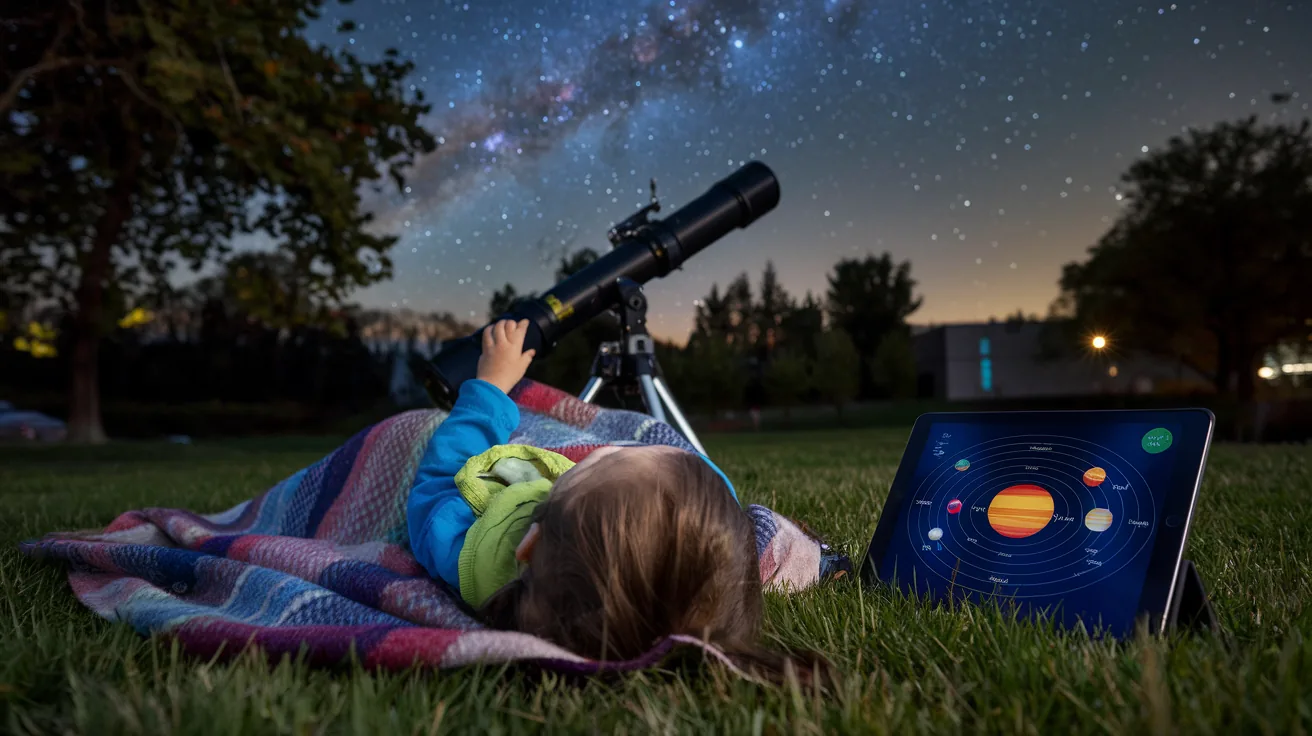
Few science topics capture children's imagination like space. Yet when it comes to understanding how our solar system works (why we have day and night, what causes the seasons, how the Moon's phases occur), many children, and many adults, hold surprisingly inaccurate ideas.
The Year 5 Earth and Space topic in the National Curriculum tackles these fundamental astronomical concepts. At first glance, the content seems straightforward: the Earth orbits the Sun, the Moon orbits the Earth, the Earth spins on its axis. But genuine understanding requires three-dimensional spatial reasoning about objects moving in relation to each other at scales impossible to directly observe. This is genuinely challenging for 9-10 year olds.
This guide sets out what Year 5 children need to learn about Earth and Space, the common misconceptions, practical ways to make the ideas concrete, and how to check that your child has understood rather than memorised.
What the National Curriculum Requires
The Year 5 Earth and Space unit sits within the KS2 science programme of study under Physics. According to the statutory guidance from the Department for Education, pupils should be taught to:
- Describe the movement of the Earth and other planets relative to the Sun in the solar system
- Describe the movement of the Moon relative to the Earth
- Describe the Sun, Earth and Moon as approximately spherical bodies
- Use the idea of the Earth's rotation to explain day and night and the apparent movement of the sun across the sky
The working scientifically skills expected include using models to explain phenomena, using evidence to support or refute ideas, and reporting findings using scientific language and labelled diagrams.
Notice the curriculum asks for describing and explaining: being able to say how and why these things happen, rather than only knowing facts.
The Core Concepts Your Child Needs to Master
Let's examine each learning objective in detail, breaking down the understanding children need to develop.
Concept 1: The Structure of the Solar System
Children need to understand the solar system's basic organisation: the Sun at the centre, with eight planets orbiting it in elliptical (roughly circular) paths. In order from the Sun outward: Mercury, Venus, Earth, Mars, Jupiter, Saturn, Uranus, Neptune.
Key points of understanding include:
- The Sun is a star: a huge ball of hot gas that produces light and heat
- Planets are much smaller than the Sun and do not produce their own light; they're visible because they reflect sunlight
- The inner four planets (Mercury, Venus, Earth, Mars) are small and rocky; the outer four (Jupiter, Saturn, Uranus, Neptune) are much larger and made mostly of gas and liquid
- The distances between planets are vast. Diagrams showing planets as beads on a string hugely distort the real spacing
Children should also know that many planets have moons (natural satellites) orbiting them, and that the solar system includes other objects like asteroids and comets, though these aren't the primary focus at Year 5.
Concept 2: Planetary Orbits
All planets orbit the Sun because of gravity. The Sun's enormous mass creates a pull that keeps the planets moving around it rather than flying off into space. The planets orbit in the same direction and roughly in the same plane (imagine a flat disc with the Sun at the centre and planets moving around it).
Each planet takes a different amount of time to complete one orbit:
- Earth takes one year (365.25 days)
- Planets closer to the Sun orbit faster (Mercury takes just 88 Earth days)
- Planets farther from the Sun orbit more slowly (Neptune takes 165 Earth years)
Children aren't expected to memorise orbital periods for all planets, but they should understand the principle that orbital period increases with distance from the Sun.
Concept 3: Spherical Bodies
The Sun, Earth, Moon, and other planets are approximately spherical (ball-shaped). This seems obvious to adults but isn't intuitive to children, who've never seen Earth from space except in photos and may hold flat-earth misconceptions absorbed from historical references or media.
They should understand that:
- Gravity pulls matter towards the centre of a massive object, naturally creating a sphere
- We can't see Earth's curve in everyday life because it is so large. A ball the size of Earth looks flat when you stand on it
- Historical evidence proved Earth's sphericity: ships disappearing hull-first over the horizon, circumnavigation, different stars visible from different latitudes, and ultimately, photographs from space
Concept 4: Earth's Rotation and Day/Night
This is where conceptual understanding often becomes shaky. Day and night are caused by Earth spinning on its axis, an imaginary line through the North and South poles. Earth completes one full rotation every 24 hours.
Critical points children must grasp:
- At any moment, half of Earth faces the Sun (experiencing daylight) and half faces away (experiencing night)
- As Earth rotates, different parts move into and out of sunlight, creating the cycle of day and night
- The Sun isn't actually moving across our sky. Earth's rotation makes it appear to move from east to west
- This is why sunrise happens in the east (that's the direction Earth is rotating towards) and sunset in the west
Many children (and adults) incorrectly think day and night are caused by Earth orbiting the Sun, or by the Sun orbiting Earth. This misconception must be explicitly addressed.
Concept 5: The Moon's Orbit and Phases
The Moon orbits Earth once every 27.3 days (roughly a month; the words "month" and "Moon" share the same root). From one Full Moon to the next takes a little longer, about 29.5 days, because Earth is also moving round the Sun. As it orbits, we see different amounts of its sunlit side, creating the phases: New Moon, Crescent, First Quarter, Gibbous, Full Moon, and back through Gibbous, Last Quarter, and Crescent to New Moon again.
Key understanding points:
- The Moon doesn't produce its own light; we see it because it reflects sunlight
- Half of the Moon is always lit by the Sun (just as half of Earth always is), but we see different portions of that lit half depending on the Moon's position relative to Earth and Sun
- When the Moon is between Earth and Sun, the lit side faces away from us (New Moon: we see the dark side)
- When Earth is between the Moon and Sun, we see the fully lit side (Full Moon)
- The cycle takes about a month to complete
This is conceptually challenging because it requires visualising three objects in three-dimensional space and mentally rotating perspectives.
Concept 6: The Seasons (Not Statutory, but Often Taught Here)
The seasons are not in the Year 5 statutory list, but many schools introduce them as part of the Earth and Space topic. The seasons are caused by Earth's axial tilt (23.5 degrees), not by Earth's changing distance from the Sun.
Because Earth's axis is tilted, during part of the orbit the Northern Hemisphere tilts towards the Sun (summer in the north, winter in the south), and during the opposite part of the orbit it tilts away (winter in the north, summer in the south).
The tilt means the Sun's rays hit at different angles and the length of daylight changes throughout the year, creating seasonal temperature variations.
Common Misconceptions That Block Understanding
Teachers meet the same misconceptions about space every year. Knowing them helps you spot and address them when supporting your child.
Misconception 1: "The Sun orbits Earth"
This geocentric model feels intuitively correct because from our perspective, the Sun appears to move across the sky while Earth feels stationary. Children need to understand that we are on a spinning platform, which creates the illusion that the Sun is moving.
Misconception 2: "Day and night are caused by Earth orbiting the Sun"
Many children and adults confuse Earth's daily rotation with its yearly orbit. They know Earth moves relative to the Sun and incorrectly attribute day/night to orbital motion rather than rotation. The difference between spinning (rotation) and orbiting must be made very clear.
Misconception 3: "The Moon only comes out at night"
The Moon is frequently visible during the day, particularly around First and Last Quarter phases. Children who think the Moon is "the night-time Sun" need to see it for themselves: go outside during the day and spot the Moon together.
Misconception 4: "Earth's shadow causes the Moon's phases"
This is a very common misconception. Children reason that the Moon is dark sometimes because Earth blocks the Sun's light. In reality, Moon phases are caused by our viewing angle: we see different portions of the lit half as the Moon orbits. Earth's shadow does occasionally fall on the Moon (lunar eclipse), but this is rare and temporary, not the cause of monthly phases.
Misconception 5: "Summer happens when Earth is closer to the Sun"
Earth's orbit is nearly circular, and the distance variation has minimal effect on temperature. In fact, Earth is actually closer to the Sun during the Northern Hemisphere's winter. The seasons are caused by the tilt of Earth's axis, not by distance. This surprises most people.
Misconception 6: "Planets are roughly the same size"
Diagrams showing planets in a row create the impression they're similar in size. In reality, Jupiter is over 1,300 times the volume of Earth. The Sun is vastly larger than any planet. Understanding these scale differences is important for grasping gravitational relationships.
Misconception 7: "Space is empty between planets"
Space is mostly empty, but the solar system also contains asteroids, comets and dwarf planets moving between the planets.
Practical Activities to Support Learning at Home
Astronomical concepts are abstract because the scales involved are beyond direct experience. Hands-on activities that create physical models or enable direct observation are essential for building understanding.
Activity 1: Day/Night Rotation Model
Use a globe (or a ball with a sticker marking "your location") and a torch or lamp to represent the Sun. Darken the room and shine the torch on the globe from one side. Slowly spin the globe and watch as the sticker location moves into and out of the light. This demonstrates how rotation creates day and night.
Ask your child: "Is the torch moving?" "Is the globe moving around the torch?" "So what's actually causing day and night, the spinning or the orbiting?" This helps them separate rotation from orbit.
Activity 2: Moon Phases with a Ball
In a darkened room, place a lamp (representing the Sun) at one side. Have your child stand in the centre holding a ball (representing the Moon) at arm's length. Slowly turn in place (representing Earth orbiting the Sun, though actually the Moon orbiting Earth). Watch how the lit portion of the ball changes from their perspective as they turn.
When the ball is between them and the lamp, they see mostly shadow (New Moon). When they're between the ball and lamp, they see the fully lit side (Full Moon). This kinaesthetic activity makes the geometry of phases tangible.
Activity 3: Scale Model of the Solar System
Create a scale model to help children grasp the distances involved. If Earth is a peppercorn (about 2 mm across), the Moon is a pinhead about 6 cm away, the Sun is a ball about 22 cm across roughly 24 metres away, and Jupiter is a small marble about 125 metres away. You cannot fit this in a flat, but pacing it out in a park, along a beach, or across a shopping mall car park makes the distances real.
Alternatively, use toilet paper to represent distance, with each sheet standing for 10 million kilometres. Earth to Sun is about 15 sheets. Earth to Neptune is about 450 sheets (half a roll). This creates a sense of the vast spaces involved.
Activity 4: Observational Astronomy
Nothing beats direct observation. Over a month, go outside each week at the same time and location and observe the Moon's phase. Have your child sketch what they see and label the date. After four weeks they will have recorded a full lunar cycle (about 29.5 days) and can see the pattern directly.
For day/night, mark a window position where the Sun is visible at a particular time in the afternoon. Every few days at the same time, note where the Sun appears relative to the mark. Over weeks you'll see the Sun's position change as Earth moves round its orbit, with earlier sunsets in autumn and later ones in spring. The change is large in Europe and small near the equator, so a family in Singapore will see much less movement than one in London.
Activity 5: Seasons Tilt Model
Take a globe and a lamp. Tilt the globe's axis and hold it on one side of the lamp so the Northern Hemisphere leans towards the light (summer). Move the globe to the opposite side of the lamp, keeping the tilt pointing the same way, and now the Northern Hemisphere leans away (winter).
This demonstrates that the tilt direction stays constant as Earth orbits, which creates the seasons. Use a protractor to show the angle of incoming light rays changes with tilt.
How to Know If Your Child Truly Understands
Memorising planet names in order doesn't equal understanding. Here's how to assess genuine conceptual grasp.
They Can Explain Using Models or Diagrams
Ask your child to draw a diagram explaining day and night, or to use objects (torch, ball, etc.) to demonstrate Moon phases. If they can represent the concepts physically or visually without prompting, they understand the spatial relationships involved.
They Can Predict and Explain
Pose scenarios: "If Earth spun twice as fast, how long would a day be?" "If you were standing on the Moon during a New Moon phase, what would Earth look like?" "Why is it summer in Australia when it's winter in Europe?"
Answering these means applying understanding to new situations rather than recalling facts.
They Can Identify Errors in Reasoning
Present incorrect statements: "The Moon is dark during New Moon because the Sun isn't shining on it." "Day and night happen because Earth goes around the Sun." "Summer is when Earth is closest to the Sun."
If your child can explain precisely why these are wrong, they've genuinely understood.
They Can Connect Ideas Across Concepts
Understanding in science is interconnected. If your child can explain how the Moon's phases relate to its orbit, or how they could tell whether a planet is farther or closer to the Sun based on its orbital period, they're thinking scientifically rather than treating each fact as isolated.
Supporting Children Who Struggle
Space concepts are abstract and require spatial reasoning skills that develop at different rates. If your child finds this topic challenging, here are targeted strategies.
Use Physical Models Extensively
Some children struggle to visualise spatial relationships from diagrams alone. Repeated use of physical models (balls, torches, globes) that they can move and view from different angles builds understanding that static diagrams cannot.
Connect to Direct Experience
Abstract concepts become meaningful when linked to observable phenomena. If discussing why we have seasons, go outside and feel the warmth of direct versus angled sunlight (use a torch shining on your hand straight on versus at an angle). This makes "angle of incoming light" tangible rather than abstract.
Break Down Complex Movements
The Earth rotates and orbits, and the Moon orbits while Earth does both. Keeping track of several movements at once is demanding. Focus on one motion at a time first (Earth's rotation explaining day/night), then add the next layer (Earth's orbit explaining the year), and finally combine them.
Address Misconceptions Explicitly
If your child holds a misconception, don't just tell them it's wrong. Set up an investigation: "You think the Moon's phases are caused by Earth's shadow. If that were true, what pattern would we see? Would we see the Moon in these shapes? Let's test your idea with our model." When a prediction fails, the idea behind it is much easier to let go of.
Use Accessible Technology
Websites like NASA's Eyes on the Solar System, or apps that show real-time Moon phases and planet positions, let children explore spatial relationships interactively. These tools let them rotate perspectives and see movements that take days, months, or years compressed into seconds.
When to Consider Additional Support
Most children grasp space concepts with quality teaching and home support. However, if your child struggles persistently, consider additional help. Signs they might benefit from extra support include:
- Inability to distinguish rotation from orbit despite multiple physical demonstrations
- Persistent geocentric thinking (believing Earth is at the centre with everything revolving around it) after instruction
- Difficulty picturing objects in space: cannot mentally rotate objects or imagine other viewpoints
- Frustration or disengagement with the topic
- Falling significantly behind in end-of-unit assessments
This doesn't mean inability. Spatial reasoning develops at different rates, and some children need more time and more approaches. Fareed, our AI science tutor (currently on a waitlist), is designed to give children patient, repeated explanation on topics like this one.