
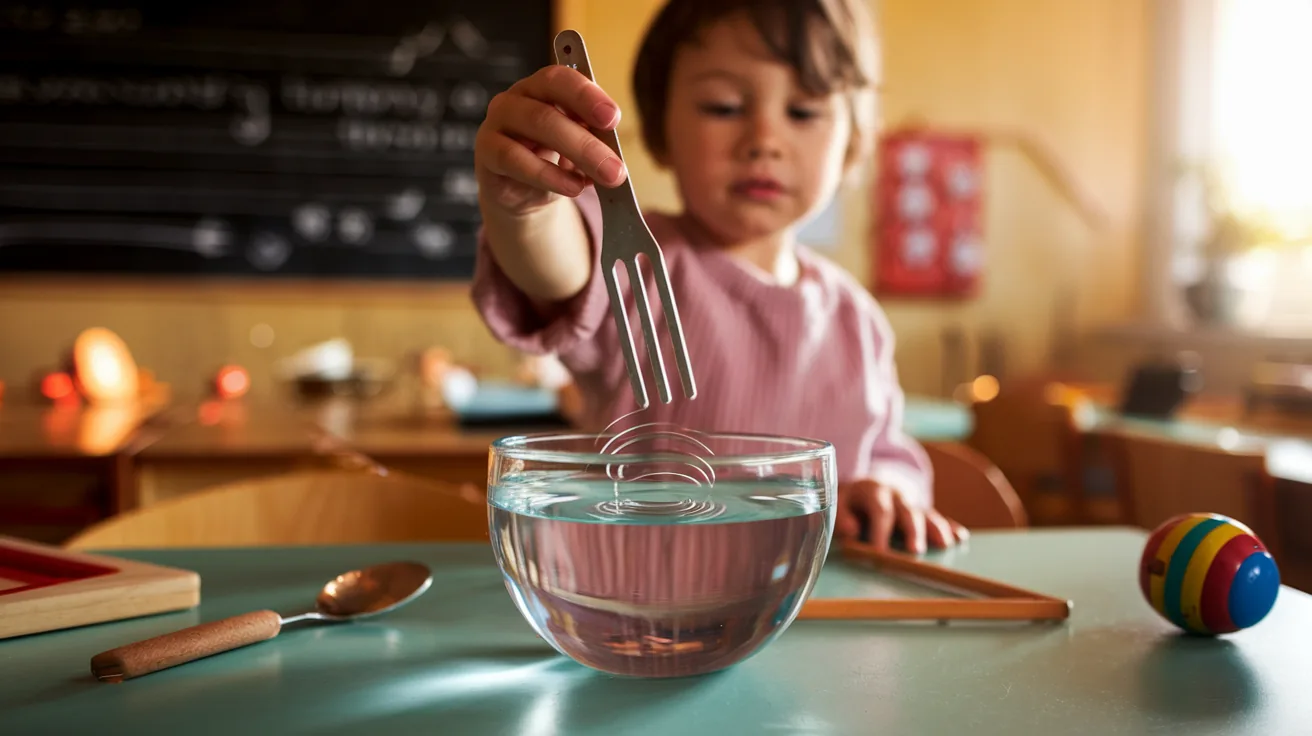
Your child hears sound all day, from the alarm clock to the traffic outside. Yet understanding how sound actually works (what creates it, how it travels, why some sounds are high-pitched and others low) is surprisingly hard for many Year 4 children.
The National Curriculum for England introduces sound as a topic in Year 4, for children aged 8-9. As a parent, you might remember your own school lessons on it as abstract: diagrams of waves, vague references to "vibrations", perhaps a tuning fork demonstration that seemed more like magic than science.
This guide sets out what your Year 4 child is expected to learn about sound, the common misconceptions, practical activities for home, and how to tell whether they have understood the ideas rather than memorised definitions.
What the National Curriculum Requires
The Year 4 sound unit sits within the KS2 science programme of study under "Physics." According to the Department for Education's statutory guidance, pupils should be taught to:
- Identify how sounds are made, associating some of them with something vibrating
- Recognise that vibrations from sounds travel through a medium to the ear
- Find patterns between the pitch of a sound and features of the object that produced it
- Find patterns between the volume of a sound and the strength of the vibrations that produced it
- Recognise that sounds get fainter as the distance from the sound source increases
The working scientifically skills expected include observing patterns, taking measurements, recording findings using drawings and labelled diagrams, and reporting on findings from enquiries.
Notice that the curriculum asks children to identify, recognise and find patterns, not to memorise facts. Sound suits this because the effects can be observed with simple equipment.
The Core Concepts Your Child Needs to Master
Let's break down each learning objective into the conceptual understanding children need to develop.
Concept 1: Sound is Caused by Vibrations
The basic principle is that all sounds are created by objects vibrating, that is, moving rapidly back and forth. When you speak, your vocal cords vibrate. When a guitar plays, the strings vibrate. When a drum sounds, the drum skin vibrates.
This is true beyond obvious examples like musical instruments. Less obvious sounds also come from vibrations: a door creaking (wood vibrating as it moves), a crisp packet rustling (plastic vibrating as it's manipulated), even silence being broken by a pin drop (the pin vibrating as it hits the surface).
The key insight is that no vibration means no sound. If you stop the vibration (touch the guitar string, hold the tuning fork still), the sound stops instantly.
Concept 2: Sound Travels Through a Medium
This is where many children's understanding becomes shaky. Sound doesn't simply "exist in the air". It travels through materials (called mediums) by making the tiny particles in those materials vibrate. (The particle model of matter is taught properly in Key Stage 3; in Year 4 the point is only that sound needs a material to travel through.)
When a drum vibrates, it makes the air particles next to it vibrate. Those particles bump into their neighbours, making them vibrate, which bump into their neighbours, and so on. This chain of vibrating particles carries the sound energy from the drum to your ear.
Children should understand that:
- Sound can travel through different mediums: gases (like air), liquids (like water), and solids (like wood or metal)
- Sound cannot travel through a vacuum (empty space with no particles) because there's nothing to vibrate
- Sound travels at different speeds through different materials: faster through solids than liquids, and faster through liquids than gases
This last point isn't required by the curriculum, but it often comes up in questions.
Concept 3: Pitch Depends on Frequency of Vibration
Pitch refers to how high or low a sound is. A bird singing has a high pitch; a lorry rumbling has a low pitch. The pitch of a sound depends on how quickly the object vibrates (the frequency of vibration).
Fast vibrations create high-pitched sounds. Slow vibrations create low-pitched sounds. Children should be able to predict and explain patterns such as:
- Shorter strings on instruments produce higher pitches than longer strings (they vibrate faster)
- Tighter strings produce higher pitches than looser strings (they vibrate faster)
- Thinner strings produce higher pitches than thicker strings (they vibrate faster)
- Smaller instruments generally produce higher pitches than larger instruments (smaller vibrating components)
The scientific term is "frequency" (measured in hertz, Hz), but at Year 4 children aren't expected to work with numbers, only to understand that faster vibration means higher pitch.
Concept 4: Volume Depends on Amplitude of Vibration
Volume (or loudness) refers to how quiet or loud a sound is. Volume depends on the amplitude of the vibration, which means how far the vibrating object moves back and forth.
Large vibrations (large amplitude) create loud sounds. Small vibrations (small amplitude) create quiet sounds. Children should recognise that:
- Hitting a drum harder makes it vibrate more (larger amplitude), producing a louder sound
- Plucking a guitar string gently makes it vibrate less (smaller amplitude), producing a quieter sound
- The same object can produce different volumes depending on how much energy you put into making it vibrate
It's worth noting that pitch and volume are independent. You can have high-pitched quiet sounds (a whistle blown gently) or low-pitched loud sounds (a bass drum struck hard). Many children initially confuse these properties.
Concept 5: Sound Gets Fainter with Distance
As sound travels further from its source, it gets quieter. This is because the vibration energy spreads out over a larger area and is gradually absorbed by the medium it's travelling through.
Children should understand this through everyday examples: a friend calling from across the playground sounds quieter than when they're standing next to you; music from a distant party gradually becomes audible as you approach.
They should also grasp that while the sound gets fainter, the pitch doesn't change. Your friend's voice doesn't get deeper because they are far away.
Common Misconceptions That Hold Children Back
Teachers see the same misconceptions about sound year after year. Knowing them helps you spot and address them when supporting your child.
Misconception 1: "Sound is carried by air, not through air"
Many children think of sound as a kind of substance that rides on air currents, like smell. This is why they might think sound can't travel through solids or liquids: they imagine sound needs air to "carry" it.
The correct understanding is that sound travels through materials by making particles vibrate. It doesn't ride on top of air; it is the vibration of air particles.
Misconception 2: "Vibrations stop when the sound reaches your ear"
Some children think vibrations only occur at the source of the sound, and then the sound somehow "detaches" and travels independently. They don't realise that sound is vibration all the way from source to ear.
Your eardrum vibrates because the air particles next to it vibrate. Those particles vibrate because the ones next to them vibrate, and so on back to the source. It's vibration the whole way through.
Misconception 3: "Pitch and volume are the same thing"
As mentioned earlier, children often conflate these properties. They might describe a loud sound as "high" or think that making something louder automatically makes it higher-pitched.
This confusion is understandable. Demonstrations showing the same pitch played at different volumes help clear it up.
Misconception 4: "Harder/denser materials block sound"
While it's true that some materials are better sound insulators than others, children often think this means sound can't travel through solid materials. In fact, sound often travels better through solids than through air. Think of putting your ear to a table and hearing someone tapping at the other end.
The difference between sound travelling through a material and sound being blocked by it needs careful explanation.
Misconception 5: "You can see sound waves"
Diagrams showing sound as wavy lines are helpful representations, but some children interpret them literally, thinking they could see these waves if they looked carefully. Sound waves in air are places where the air is squeezed together or spread out, and they are invisible.
What they might see are the effects of sound (a drum skin vibrating, water in a bowl rippling when near a speaker), but not the sound waves themselves as they travel through air.
Practical Activities to Support Learning at Home
The best way to secure understanding of sound is through hands-on investigation. Here are activities you can do with things you already have at home.
Activity 1: Seeing Vibrations
Place a small amount of rice or dried lentils on a baking tray or drum. Have your child hum, sing, or shout near (not at) the surface and watch the rice dance. The rice moves because the tray is vibrating from the sound waves in the air. Stop making sound, and the rice stops moving. This makes the invisible vibration visible.
Activity 2: String Telephone
Make a string telephone using two paper cups and a length of string (3-5 metres). Poke a small hole in the bottom of each cup, thread the string through, and knot it inside so it can't pull back through. Pull the string taut and have one person speak into their cup while the other listens with theirs.
This demonstrates that sound can travel through solids (the string). When you let the string go slack, it doesn't work, because the vibrations can't travel through a loose string. This activity also shows that sound needs a medium; if you cut the string, the sound doesn't magically jump across the gap.
Activity 3: Pitch Experiments with Bottles
Take 4-6 identical glass bottles or jars. Fill them with different amounts of water. Gently tap each with a spoon and listen to the pitch. When you tap, it is the glass and the water that vibrate. More water means a heavier bottle that vibrates more slowly, so the note is lower. Less water gives a higher note.
Now blow across the top of each bottle. This time it is the air inside that vibrates. More water leaves a shorter column of air, which vibrates faster, so the note is higher. The order of the notes reverses. This shows that the same object can give different results depending on what you make vibrate.
Activity 4: Volume Control
Stretch a rubber band over an empty tissue box to create a simple guitar. Pluck the band gently, then pluck it harder. The pitch stays the same (same band, same tension, same length), but the volume changes because the amplitude of vibration changes.
You can watch the band's vibration. Plucking harder makes it move further from side to side (larger amplitude) and it sounds louder.
Activity 5: Sound Insulation Investigation
Place a ticking clock or a phone playing music inside a box. Ask your child to rate the volume from 1-10. Then wrap the box in different materials (a towel, bubble wrap, newspaper, a blanket) and rate the volume again each time. Which material is the best sound insulator?
This introduces the idea that while sound travels through materials, some materials absorb more sound energy than others. Soft, thick materials generally absorb more sound than hard, thin ones.
How to Know If Your Child Has Truly Understood
Memorising definitions doesn't equal understanding. Here's how to tell if your child has genuinely grasped the concepts rather than just parroted back what they've heard.
They Can Explain in Their Own Words
Ask your child to explain how sound works to a younger sibling or grandparent. If they can adapt their language, use examples, and respond to questions, they understand it. If they can only repeat word-for-word what their teacher or textbook said, understanding is surface-level.
They Can Apply Concepts to New Situations
Present scenarios they haven't met before: "Why does your voice sound funny when you breathe helium?" (Your vocal folds vibrate at the same rate, so the basic pitch does not change. Sound travels faster through helium, which changes the way your throat and mouth reinforce the sound, so the voice sounds thin and squeaky.) "Why can you hear a train coming by putting your ear to the track?" (Sound travels faster and better through solid steel than through air.)
If they can reason through unfamiliar examples using the principles they've learned, they've genuinely understood.
They Can Identify and Correct Mistakes
Give them incorrect statements: "Sound travels faster the further it goes from the source." "You can hear explosions in space films because sound travels through space." "A big drum makes higher sounds than a small drum."
Can they explain why these are wrong? This shows they can judge claims against their understanding rather than recall correct answers.
They Can Design Simple Experiments
Ask: "How could we test whether sound travels through water?" or "How could we find out which material is the best sound insulator?" If they can propose an investigation with a clear method and prediction, they're thinking scientifically about sound rather than memorising facts.
Supporting Children Who Struggle
Sound is an abstract topic because while we experience it constantly, we can't directly observe what's happening at the particle level. If your child finds it challenging, here are targeted strategies.
Make Vibrations Visible
Use the rice-on-a-drum activity mentioned earlier, or stretch cling film over a bowl and place sugar or salt on top, then hold a tray near it and bang the tray. The particles jump because the cling film vibrates from the sound waves. Making the invisible visible helps concrete thinkers grasp abstract concepts.
Use Analogies Carefully
Analogies can help or hinder. A useful one: sound travelling through air is like a line of people doing the wave at a stadium. Each person moves up and down (vibrates), passing the wave along, but the people themselves don't travel around the stadium. The wave (sound) travels, but the medium (people/air particles) just vibrate in place.
Build from Their Experience
Connect abstract concepts to direct experiences. They know echoes happen in big empty rooms but not in carpeted, furnished rooms. Why? Because hard surfaces reflect sound well while soft materials absorb it. This makes "absorption" and "reflection" tangible rather than abstract.
Address Misconceptions Explicitly
If your child holds a misconception, don't just tell them they're wrong. Help them test their idea. If they think sound can't travel through solids, do the cup-and-string telephone experiment. When it works, discuss why their prediction was incorrect and what that tells them about sound. Confronting misconceptions through evidence is more powerful than correction.
When to Consider Additional Support
Most children grasp sound with good teaching and some practice at home. If your child keeps struggling after several approaches, they may benefit from extra support.
Signs they might need extra help include:
- Inability to connect sound to vibration even after hands-on demonstrations
- Confusion between pitch and volume persisting after multiple explanations
- Difficulty applying concepts to new examples
- Frustration or anxiety about science lessons
- Falling behind in working scientifically skills (making predictions, explaining observations)
This doesn't mean a lack of ability. Science understanding develops at different rates, and thinking about invisible things is genuinely hard for some 8-9 year olds. Fareed, our AI science tutor (currently on a waitlist), is designed to give children patient, repeated practice on topics like this one.