
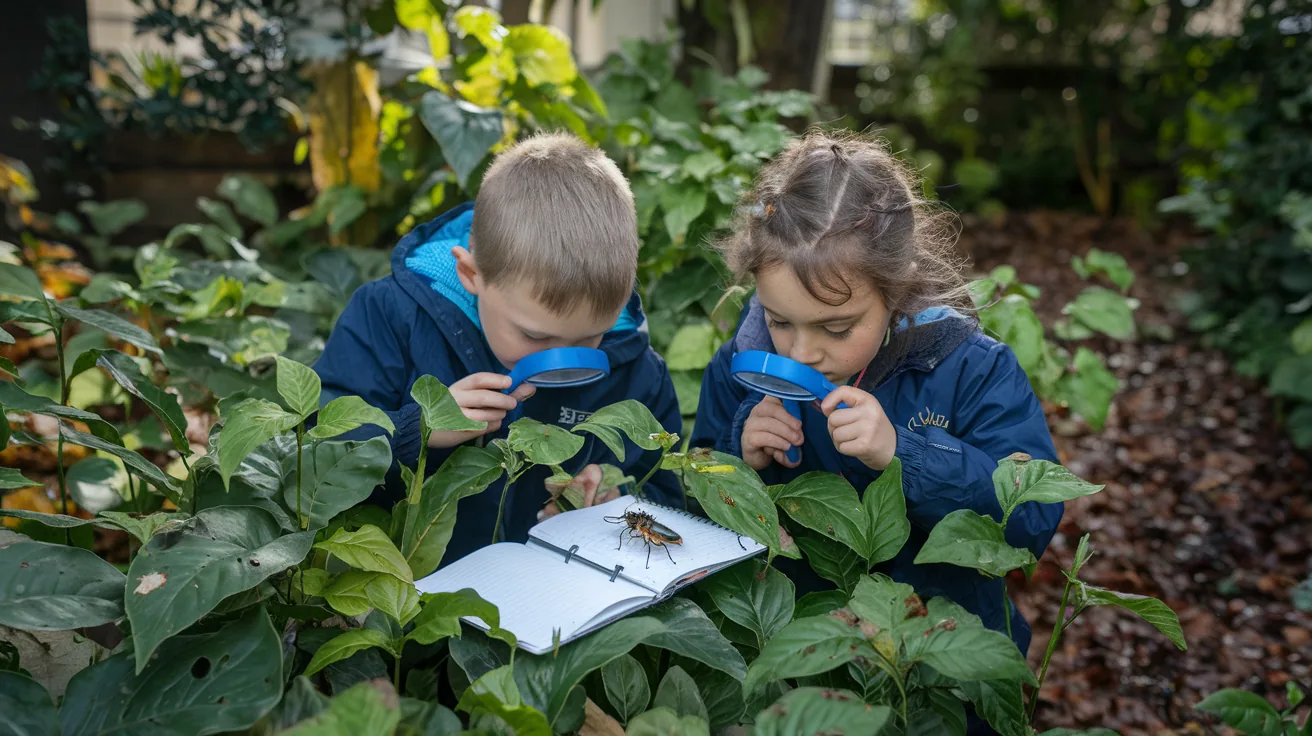
Year 4 living things and their habitats builds on younger children's natural curiosity about animals and plants. It introduces classification, food chains and environmental change. It is the step from looking at different animals to understanding how living things depend on each other and on their surroundings.
This guide covers what your Year 4 child needs to know, including classification keys, which many children find hard at first. It gives plain explanations, examples and activities you can do together at home, wherever you live.
What Do Year 4 Students Learn About Living Things and Habitats?
The National Curriculum for England specifies that Year 4 pupils should be taught to:
- Recognise that living things can be grouped in a variety of ways
- Explore and use classification keys to help group, identify and name a variety of living things in their local and wider environment
- Recognise that environments can change and that this can sometimes pose dangers to living things
- Construct and interpret a variety of food chains, identifying producers, predators and prey (this is listed under the Year 4 "animals, including humans" unit, but it is statutory and schools usually teach it alongside habitats)
Many schools also cover related topics including:
- Different habitat types (deserts, oceans, rainforests and so on)
- Adaptations that help organisms survive in their habitats
- Human impacts on habitats and conservation
What Is a Habitat?
A habitat is the natural home or environment where an organism lives. It provides everything that organism needs to survive: food, water, shelter, and suitable conditions (temperature, light, etc.).
Key Habitat Types
Year 4 children should be familiar with these major habitat types:
Woodland/Forest: Areas dominated by trees; home to deer, foxes, squirrels, woodpeckers, insects, ferns and fungi.
Ocean/Marine: Saltwater environments covering most of Earth's surface; includes shallow coral reefs, open ocean, and deep sea; home to fish, whales, dolphins, sharks, octopuses, seaweed, and plankton.
Freshwater (Rivers, Lakes, Ponds): Non-salty water habitats; home to fish like pike and trout, frogs, newts, dragonflies, water lilies, and reeds.
Desert: Very dry environments with little rainfall; home to specially adapted organisms like camels, the Arabian oryx, dhub lizards, scorpions, desert foxes and date palms. If you live in the Gulf, this is the habitat on your doorstep.
Grassland/Savanna: Open areas dominated by grasses rather than trees; home to grazing animals like zebras and wildebeest, predators like lions, and many insects.
Polar (Arctic and Antarctic): Extremely cold, icy regions; home to polar bears, penguins, seals, Arctic foxes, and hardy plants like mosses and lichens.
Rainforest: Hot, wet forests with an enormous variety of life; home to monkeys, hornbills, parrots, tree frogs, thousands of insect species and dense plant life. Families in Malaysia and Singapore can visit one on a day trip.
Microhabitats
Within larger habitats, there are smaller, more specific environments called microhabitats. For example, within a park or garden you might find:
- Under a log or a flowerpot: damp, dark, sheltered; home to woodlice, beetles, worms
- Tree canopy: high, exposed to light and wind; home to birds, squirrels, certain insects
- Ground under a hedge or a palm: shaded, covered in leaf litter; home to fungi, ants, insects
Microhabitats help children see that even within one area, different organisms live where their particular needs are met.
Adaptations: How Organisms Suit Their Habitats
One of the most important concepts in ecology is adaptation: features or behaviours that help an organism survive in its particular habitat.
This addresses a common misconception: animals don't live in habitats because they "like" them or "choose" them. They live there because their bodies and behaviours suit those conditions. Why that is so (evolution) is a Year 6 topic, so in Year 4 it is enough to say "this animal is suited to this place".
Examples of Adaptations
Polar Bear (Arctic habitat):
- Thick white fur for insulation and camouflage in snow
- Layer of fat (blubber) for warmth and energy storage
- Large paws to distribute weight on ice and swim efficiently
- Excellent sense of smell to find seals under ice
Cactus (Desert habitat):
- Thick, waxy skin to reduce water loss
- Stores water in its fleshy stem
- Spines instead of leaves (reduce water loss and deter animals from eating it)
- Extensive shallow root system to quickly absorb any rainfall
Camel (Desert habitat):
- Hump stores fat (not water) for energy when food is scarce
- Can survive long periods without drinking
- Large, flat feet to walk on sand without sinking
- Long eyelashes and closeable nostrils to keep out sand
When revising adaptations, encourage children to explain why each feature helps, rather than only list features. "Polar bears have thick fur" is accurate but incomplete. "Polar bears have thick fur to keep warm in the freezing Arctic temperatures" demonstrates understanding.
Classification: Grouping Living Things
With millions of species on Earth, scientists need ways to organise and categorise them. Classification groups organisms based on shared characteristics.
Broad Classification Groups for Year 4
Children at this stage work with relatively broad categories:
Vertebrates vs. Invertebrates:
- Vertebrates: Animals with backbones (fish, amphibians, reptiles, birds, mammals)
- Invertebrates: Animals without backbones (insects, spiders, worms, snails, jellyfish)
The Five Vertebrate Groups:
- Fish: Live in water, have gills, lay eggs, cold-blooded, have scales and fins
- Amphibians: Start life in water with gills, develop lungs as adults, moist skin, cold-blooded (frogs, toads, newts)
- Reptiles: Dry scaly skin, lay eggs on land, cold-blooded (snakes, lizards, crocodiles, turtles)
- Birds: Have feathers, wings, lay eggs, warm-blooded, have beaks
- Mammals: Have fur or hair, produce milk for young, warm-blooded, most give birth to live young
Major Invertebrate Groups (examples):
- Insects: Six legs, three body parts (head, thorax, abdomen), often have wings
- Arachnids: Eight legs, two body parts (spiders, scorpions)
- Molluscs: Soft bodies, often with shells (snails, slugs, octopuses)
- Worms: Long, soft, segmented bodies
Plants:
Plants can be grouped as:
- Flowering plants: Produce flowers and seeds (roses, sunflowers, grasses, most trees)
- Non-flowering plants: Don't produce flowers; reproduce via spores or cones (ferns, mosses, conifers like pine trees)
Classification Keys: The Tricky Bit
Classification keys (also called identification keys) are tools that help identify organisms through a series of yes/no questions about observable characteristics. This is often the most challenging part of Year 4 living things for both children and parents, so let's break it down carefully.
What Is a Classification Key?
A classification key presents a series of questions, each with two possible answers. Based on your answer, you follow a path to the next question until you arrive at the identification of the organism.
Think of it like a flowchart or a "Choose Your Own Adventure" book, but for identifying living things.
Example Classification Key
Here's a simple key for identifying common garden invertebrates:
1. Does it have legs?
Yes → Go to question 2
No → Go to question 5
2. Does it have 6 legs?
Yes → Go to question 3
No → Go to question 4
3. Does it have wings?
Yes → It's a flying insect (e.g., fly, bee, butterfly)
No → It's a wingless insect (e.g., ant)
4. Does it have 8 legs?
Yes → It's a spider
No → It's a woodlouse (14 legs) or millipede (many legs)
5. Does it have a shell?
Yes → It's a snail
No → It's a slug or worm
Using this key, if you find a creature with 8 legs, you'd answer: "Yes" to question 1 (has legs), "No" to question 2 (doesn't have 6 legs), "Yes" to question 4 (has 8 legs) → Spider.
How to Create a Classification Key
Year 4 children are often asked to create simple classification keys as well as use them. Here's the process:
1. Choose your group of organisms (e.g., five different leaves, five birds you see near home, five insects)
2. Observe them carefully and note observable features (size, colour, number of legs, presence of wings, etc.)
3. Find a feature that splits the group into two
For example, if classifying maple leaf, oak leaf, pine needles, holly leaf, and grass blade:
- First question: "Does it have a broad, flat shape?" (Yes: maple, oak, holly; No: pine needles, grass)
4. For each resulting group, find another feature that splits it further
- For the "Yes" group: "Does it have spiky edges?" (Yes: holly; No: maple, oak)
- For maple and oak: "Does it have pointed lobes?" (Yes: maple; No: oak)
5. Continue until each organism is identified
Key principles:
- Each question should have only two possible answers (yes/no or A/B)
- Use observable features that can be clearly determined
- Questions should progressively narrow down the possibilities
- Every organism should be identifiable by following the key
Common Mistakes with Classification Keys
Using subjective descriptions: "Is it beautiful?" or "Is it scary?" are not good key questions because different people might answer differently. Use objective features: "Does it have fur?" "Is it longer than 5cm?"
Creating questions that don't divide the group: If you're classifying five birds and ask "Does it have feathers?" all five answer "yes", so the question doesn't help divide them into groups.
Not testing the key: After creating a key, test it with each organism to make sure it leads to the correct identification every time.
Food Chains and Food Webs
Living things in a habitat are connected through feeding relationships. Energy flows from one organism to another when one eats another.
Understanding Food Chains
A food chain shows the flow of energy from one organism to another in a linear sequence.
Structure of a food chain:
Sun → Producer → Primary Consumer → Secondary Consumer
Key terms:
- Producer: An organism that makes its own food through photosynthesis (plants and algae)
- Consumer: An organism that eats other organisms for energy
- Primary consumer: An animal that eats plants (herbivore)
- Secondary consumer: An animal that eats primary consumers (carnivore or omnivore)
- Predator: An animal that hunts and eats other animals
- Prey: An animal that is hunted and eaten by predators
Example food chain:
Sun → Grass → Rabbit → Fox
- Grass (producer) uses sun's energy to grow through photosynthesis
- Rabbit (primary consumer/herbivore) eats grass
- Fox (secondary consumer/carnivore) eats rabbit
Arrows in food chains show the direction of energy flow, pointing from the food source to the organism that eats it. "Grass → Rabbit" means "energy flows from grass to rabbit" or "rabbit eats grass."
Food Webs: The Bigger Picture
In reality, most organisms eat more than one type of food and are eaten by more than one type of predator. A food web shows the interconnected feeding relationships in an ecosystem.
For example, in a woodland:
- A caterpillar eats leaves
- A blue tit eats caterpillars and also eats seeds
- A sparrowhawk eats blue tits and also eats mice
- A mouse eats seeds and also eats insects
- An owl eats mice and also eats small birds
All these relationships connect in one web. If one food source disappears, some animals have alternatives, but a change to one species can still affect several others.
Environmental Change and Its Effects
Habitats are not static; they change over time. These changes can be natural or caused by human activity, and they can help or harm the living things in that habitat.
Natural Changes
- Seasonal changes: Winter cold, summer heat, autumn leaf fall affect food availability and behaviour
- Weather events: Droughts reduce water; floods can destroy habitats; storms damage vegetation
- Natural disasters: Wildfires, volcanic eruptions, earthquakes alter habitats dramatically
Human-Caused Changes
- Habitat destruction: Cutting down forests, draining wetlands, building on countryside or over coastal mangroves
- Pollution: Chemicals in water or air, litter, plastic waste harming wildlife
- Climate change: Rising temperatures affecting habitats and species' ranges
- Introduced species: Non-native species competing with or preying on native species
- Overhunting/overfishing: Removing too many individuals of a species
Positive Changes
Not all human activity harms habitats. Nature reserves, replanted forests, cleaned-up rivers and responsible fishing all help. Knowing that humans can both damage and protect habitats helps children think about their own choices.
Practical Activities for Revision
Looking at real living things works better than reading notes.
Habitat Survey
Visit a local habitat (a garden, a city park, a beach at low tide, a mangrove boardwalk, or the shaded ground under a palm tree) and record:
- What living things you observe
- What they're doing (feeding, hiding, moving)
- What adaptations you notice
- Evidence of food chains (e.g., bird eating worm, aphids on plant)
Create Your Own Classification Key
Collect leaves, draw birds you see near home, or photograph local insects. Create a classification key that lets someone identify each one from observable features. Test it on a family member to see if it works.
Build a Food Web
Pick a habitat (e.g., ocean, rainforest, your garden). List 8-10 organisms from that habitat, then draw arrows to show all the feeding relationships. Notice how connected it becomes.
Habitat in a Bottle
Create a closed ecosystem in a large clear container: soil, plants, perhaps woodlice or worms. Observe how it functions as a miniature habitat. What does each organism need? How do they interact?
Sample Revision Questions
Test understanding with questions like:
- What is the difference between a habitat and a microhabitat? Give examples
- Describe three adaptations of a camel and explain how each helps it survive
- Create a simple classification key to tell apart a spider, an insect and a worm
- What are the five groups of vertebrates? Give an example of each
- Draw a food chain for a habitat near where you live with at least four organisms. Label the producer and consumers
- In the food chain "grass → rabbit → fox", what would happen if all the rabbits died from disease?
- Name three ways humans can harm habitats and three ways they can protect them
Common Challenges and How to Help
Struggling with Classification Keys
Classification keys are abstract and require logical, step-by-step thinking that doesn't come naturally to all children.
Help by: Starting with very simple keys (3-4 organisms) and physically acting them out. Place toy animals in front of your child and work through the key together, moving organisms to different sides based on each answer. Gradually increase complexity.
Confusing Food Chain Arrows
Children sometimes think arrows show "who eats whom" rather than "where energy flows."
Help by: Saying "the arrow points to the organism that gets the energy" and always reading food chains as "provides energy to" rather than "is eaten by." Grass → Rabbit means "grass provides energy to rabbit."
Understanding Adaptation vs. Choice
Children sometimes think animals choose to have adaptations or choose to live in certain habitats.
Help by: Saying "animals are born with these features; they do not pick them." The full explanation of how features change over many generations comes in Year 6.
If Your Child Needs Extra Support
This topic involves a lot of vocabulary, classification skills and thinking about how living things connect. If your child finds it hard:
Prioritise direct observation: Time spent actually observing organisms, habitats, and feeding relationships in nature builds intuition that makes abstract concepts easier to grasp.
Break down classification keys step by step: Don't expect mastery immediately. Start with branching diagrams with just two or three organisms, then gradually increase complexity as confidence grows.
Consider extra practice: Fareed, our AI science tutor (currently on a waitlist), is built to give children patient practice with topics like classification keys. You can read about the idea behind it in our article on one-to-one tutoring.