
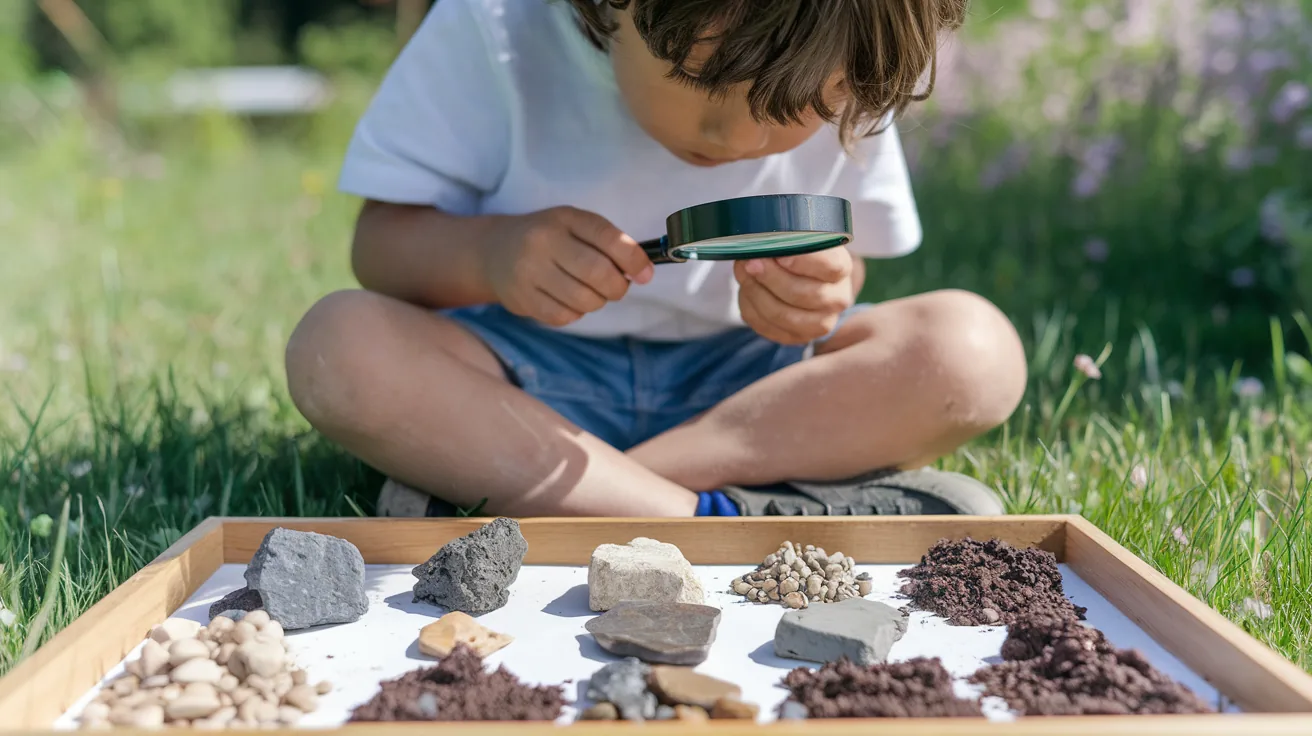
If your Year 3 child has started coming home with pockets full of stones and questions about fossils, they have begun the rocks unit. It is a short unit with three statutory points, but schools usually teach the three rock types alongside it, and the vocabulary can pile up.
This guide covers what Year 3 children need to know, points out what belongs to later years, and gives you practical ways to revise it at home.
What Do Year 3 Students Learn About Rocks and Soils?
The National Curriculum for England specifies that Year 3 pupils should be taught to:
- Compare and group together different kinds of rocks on the basis of their appearance and simple physical properties
- Describe in simple terms how fossils are formed when things that have lived are trapped within rock
- Recognise that soils are made from rocks and organic matter
Beyond these statutory requirements, most schools also cover:
- The three main rock types: igneous, sedimentary, and metamorphic
- Properties of rocks including hardness, permeability, and durability
- How different rocks are used in buildings and construction
- The composition of soil and how it supports plant growth
- Investigating soil permeability and drainage
Let's break down each of these areas in detail.
The Three Types of Rock
Rocks are classified into three main groups based on how they were formed. Understanding formation processes helps children remember the characteristics of each type.
Igneous Rocks
How they form: Igneous rocks form when molten rock (magma or lava) cools and solidifies. "Igneous" comes from the Latin word for fire.
Characteristics:
- Usually very hard
- Contain crystals, sometimes large enough to see
- Water does not pass through them easily
- Do not usually contain fossils (the heat would destroy any remains)
Examples children should recognise:
- Granite: Grey or pink speckled appearance with visible crystals; used for worktops, buildings, and monuments
- Basalt: Dark grey or black, fine-grained; makes up most of the ocean floor
- Pumice: Light-coloured, full of holes (air bubbles), can float on water; used in cosmetics and cleaning products
Sedimentary Rocks
How they form: Sedimentary rocks form when small particles (sediments) of rock, sand, mud, or organic material accumulate in layers, usually underwater. Over millions of years, these layers are compressed and cemented together into solid rock.
The process, simply: rocks break into tiny pieces; water or wind carries the pieces to the bottom of a river, lake or sea; they settle in layers; over a very long time the weight of the layers above squashes them together into rock.
Characteristics:
- Often formed in layers (you can see striping or banding)
- Usually softer and more easily broken than igneous rocks
- Often permeable (water can seep through them)
- May contain fossils of plants and animals that lived when the sediments were laid down
- Particles may be visible with a hand lens or even to the naked eye
Examples children should recognise:
- Sandstone: Made from compressed sand grains; feels gritty; used in buildings; often yellow, brown, or red
- Limestone: Made from calcium carbonate (often from shells and skeletons of sea creatures); sometimes contains visible fossils; used in buildings and for making cement
- Chalk: A type of limestone made from tiny shells; soft, white, crumbly; used for making cement (most "blackboard chalk" sold today is actually gypsum, a different material)
- Shale: Made from compressed mud; splits easily into thin layers
Metamorphic Rocks
How they form: Metamorphic rocks form when existing rocks (igneous or sedimentary) are changed by extreme heat and/or pressure deep underground. "Metamorphic" means "changed in form."
The change happens deep underground, where it is very hot and the weight of the rock above presses down hard.
Characteristics:
- Usually hard and durable
- May show distorted or wavy layers from the pressure that formed them
Examples children should recognise:
- Marble: Formed from limestone; contains calcite crystals; often white but can be coloured by impurities; used for statues, floors, and worktops
- Slate: Formed from shale; splits easily into smooth, flat sheets; used for roof tiles and flooring
Properties of Rocks
Beyond classification by type, rocks can be described and compared by their physical properties. Year 3 students investigate these through hands-on observation and simple tests.
Hardness
How resistant the rock is to being scratched or broken. Hard rocks like granite resist scratching; soft rocks like chalk can be marked with a fingernail.
Simple test: Try scratching the rock with a fingernail, then a coin, then a metal nail. Softer rocks will scratch more easily.
Permeability
Whether water can pass through the rock. Permeable rocks have tiny spaces (pores) that allow water to seep through; impermeable rocks don't.
Simple test: Place a few drops of water on the rock surface. Permeable rocks will absorb the water; impermeable rocks won't.
Why it matters: Permeability affects where water collects underground, where buildings can be constructed safely, and how soil drains.
Durability
How well the rock lasts outdoors over time. Durable rocks (like granite) last thousands of years; less durable rocks (like sandstone) wear away more quickly.
Observation: Compare old buildings made from different rock types. Notice how some have sharp, clear edges while others have become worn and rounded.
Fossil Formation
A fossil is what is left of a living thing that died a very long time ago and was trapped in rock. Sometimes it is a hard part such as a shell or bone; more often it is the shape of the living thing, because the original material has slowly been replaced by minerals. So most fossils are rock in the shape of a plant or animal.
How Fossils Form (Simplified for Year 3)
- An animal or plant dies, usually in or near water
- The soft parts rot away, but hard parts (bones, shells, teeth) may remain
- The remains are buried under layers of mud, sand or silt
- More layers build up over a very long time and squash the layers below
- Minerals in the water replace the remains, leaving the shape in stone
- The layers turn into sedimentary rock, with the fossil inside
- The rock wears away or is dug up, and the fossil is found
Key points for children to understand:
- Fossilisation is very rare; most living things rot away completely
- It takes millions of years for a fossil to form
- Fossils are usually found in sedimentary rocks, not igneous or metamorphic rocks
- Fossils tell us about living things from long ago and what the world was like then
Soil Composition and Formation
Soil might look simple, but it's a complex mixture formed over thousands of years through the breakdown of rocks and the accumulation of organic matter.
What Soil Is Made Of
Soil contains:
- Mineral particles: Tiny pieces of weathered rock (sand, silt, clay)
- Organic matter (humus): Decayed plant and animal material, providing nutrients
- Water: Held in spaces between soil particles
- Air: Also in spaces between particles, necessary for roots and soil organisms
- Living organisms: Worms, insects, bacteria, fungi, and plant roots
How Soil Forms
Rocks very slowly break into smaller and smaller pieces. Dead plants and animals rot and mix in with the rock pieces. Worms, insects and tiny living things mix and break everything down further. This takes hundreds or thousands of years for just a few centimetres of soil.
Types of Soil
Different proportions of sand, silt, and clay create different soil types:
- Sandy soil: Large particles, feels gritty, drains quickly, low in nutrients, doesn't hold water well
- Clay soil: Very fine particles, feels smooth when wet and sticky, drains slowly, holds water and nutrients but can become waterlogged
- Garden soil and potting compost: Usually a mixture of the two, with plenty of rotted plant material; drains reasonably well but still holds some water
Investigating Soil Permeability
One of the most common Year 3 investigations involves testing how quickly water drains through different soil types. This practical activity develops fair testing skills and connects to real-world applications like agriculture and construction.
Setting Up a Fair Test
Equipment needed:
- Three identical clear plastic bottles cut in half
- Cotton wool or filter paper to plug the bottle necks
- Three different soil samples (sandy, clay, and ordinary garden soil or potting compost)
- Measuring cylinder or beaker
- Stopwatch
- Water
Method:
- Place the same amount of each soil type in separate bottle funnels
- Position each funnel over a collection beaker
- Pour the same amount of water into each soil sample at the same time
- Measure how long it takes for water to start dripping through
- After a set time (e.g., 5 minutes), measure how much water has drained through
Expected results:
- Sandy soil: Water drains through quickly (high permeability)
- Clay soil: Water drains through very slowly or not at all (low permeability)
- Garden soil or compost: Water drains through at a moderate rate
Key learning points:
- Identifying variables to keep the same (amount of soil, amount of water, size of container)
- Identifying the variable being changed (soil type)
- Measuring and recording results
- Explaining results in terms of particle size and spacing
Practical Uses of Rocks
Rock properties explain why different rocks are used for different jobs:
- Granite: Hard and long-lasting; used for buildings, kerbs, worktops and monuments
- Limestone: Softer but plentiful; used for buildings and for making cement
- Sandstone: Attractive and easy to cut; used for decorative buildings
- Slate: Splits into flat sheets; ideal for roof tiles and floors
- Marble: Polishes to a shine; used for statues, floors and worktops
- Pumice: Full of holes and rough; used for smoothing skin and in cleaning products
Common Misconceptions About Rocks and Soils
As with other science topics, children develop predictable misconceptions about rocks and soils that can interfere with accurate understanding.
Misconception: "All Hard, Solid Things Are Rocks"
Children sometimes classify bricks, concrete, glass, or metal as rocks because they're hard and stony.
Reality: Rocks are naturally occurring solid materials made of minerals. Bricks, concrete, and glass are manufactured materials, though they may be made from rocks.
Misconception: "Soil Is Just Dirt"
This trivialises soil as simply broken rock or unwanted mess.
Reality: Soil is a complex, living ecosystem containing minerals, organic matter, water, air, and millions of organisms. It's essential for plant growth and food production.
Misconception: "Fossils Are Just Old Bones"
Children often think a fossil is the actual bone or shell, unchanged.
Reality: Most fossils are rock in the shape of the original plant or animal. The original material has usually been replaced by minerals over millions of years, and many fossils are of shells or leaves, not bones.
Misconception: "Rock Types Are Determined by Colour or Hardness"
While these are properties of rocks, they don't determine classification.
Reality: Rocks are classified by how they formed (igneous, sedimentary, metamorphic), not by their appearance or properties.
Revision Activities to Do at Home
Hands-on activities and real-world observation reinforce classroom learning far more effectively than rereading notes.
Rock Collection and Classification
Collect rocks from your garden, local park or beach. Examine them carefully and try to classify them as igneous, sedimentary or metamorphic based on their features. Look for layers, crystals, fossils or other clues. In a city like Dubai or Singapore, building stone is easier to find than natural rock: look at the marble in a mall floor, the granite on a kerb, and the sandstone on an older building.
Building Material Survey
Walk around your local area and identify what rocks have been used in buildings, walls, pavements, and monuments. Discuss why particular rocks were chosen for particular purposes.
Soil Investigation
Collect soil samples from different locations (garden, park, roadside). Compare their texture, colour, and ability to hold water. Try growing seeds in different soil types and compare results.
Make a Sedimentary Rock Model
Layer different colours of playdough or clay in a clear container to represent sediment layers. Press down to compress them, demonstrating how sedimentary rocks form from layers of sediment.
Fossil Hunt
If you live near sedimentary rocks (beaches, quarries, certain hillsides), go on a fossil hunt. If you do not, look closely at polished limestone floor tiles in hotel lobbies and shopping malls; they often show the shapes of shells. Even without a find, looking closely at rocks develops observation skills.
Create Revision Flashcards
Make flashcards with rock names on one side and key features on the other:
- "Granite" → "Igneous, hard, crystals, pink/grey, used for worktops"
- "Sandstone" → "Sedimentary, gritty, made from sand, used in buildings"
Key Vocabulary to Master
Ensure your child can explain these terms in their own words:
- Igneous: Rock formed from cooled molten rock (magma/lava)
- Sedimentary: Rock formed from compressed layers of sediment
- Metamorphic: Rock formed by heat and pressure changing existing rock
- Permeable: Allowing water to pass through
- Impermeable: Not allowing water to pass through
- Fossil: Preserved remains or traces of organisms from millions of years ago
- Sediment: Small particles of rock, sand, or mud
- Organic matter: Material from living things (plants and animals)
- Humus: Decayed plant and animal material in soil
Sample Revision Questions
Test understanding with questions like these:
- Name the three main types of rock and explain how each one forms
- Which type of rock might contain fossils? Why?
- Describe the stages of fossil formation
- What is the difference between permeable and impermeable rock? Give an example of each
- Why is granite used for building but chalk isn't?
- What is soil made from?
- Which type of soil drains water most quickly? Why?
- How is metamorphic rock different from igneous and sedimentary rock?
- Name three uses of rocks in everyday life
If Your Child Is Struggling
This unit carries a lot of vocabulary, and it asks children to connect slow, invisible processes to the stones in their hands. If your child finds it hard:
Put real rocks in their hands: Examining real rocks, soil samples and, if possible, fossils makes the ideas concrete. A natural history museum with a rock and fossil display is worth a visit.
Learn the vocabulary in small groups: Get "igneous, sedimentary, metamorphic" secure before adding "permeable" and "impermeable".
If your child needs the topic explained another way, Fareed is an AI science tutor for this curriculum; it is currently on a waitlist.