
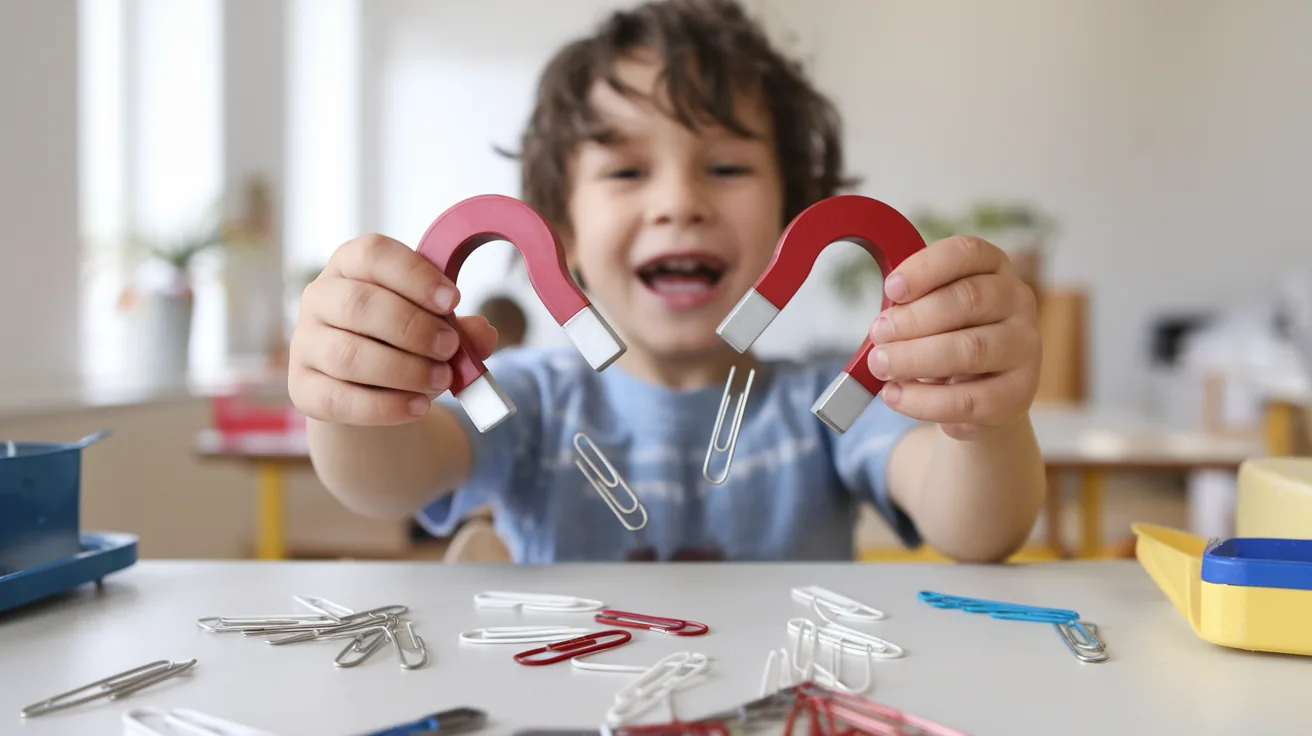
Forces and magnets is one of the first physics topics your child encounters in the National Curriculum for England, taught in Year 3 (ages 7-8). The ideas learned here, that a force is a push or a pull and that some forces act without touching, come back in Year 5 forces and in secondary school physics.
This is often where children begin to think of themselves as either "good at science" or not. The topic can seem deceptively simple — pushes and pulls are familiar from everyday life — but contains subtle concepts that confuse even bright children if not explained clearly. Understanding what your child is actually being taught, recognising common misconceptions, and knowing how to support learning at home can make a significant difference.
This guide explains what the Year 3 forces and magnets curriculum covers, the vocabulary your child needs, the common points of confusion, and practical activities you can do at home.
What the National Curriculum Requires
The Year 3 programme of study for forces and magnets specifies that pupils should be taught to:
- Compare how things move on different surfaces
- Notice that some forces need contact between two objects, but magnetic forces can act at a distance
- Observe how magnets attract or repel each other and attract some materials and not others
- Compare and group together a variety of everyday materials on the basis of whether they are attracted to a magnet, and identify some magnetic materials
- Describe magnets as having two poles
- Predict whether two magnets will attract or repel each other, depending on which poles are facing
Key Concepts Your Child Will Learn
1. What Forces Are
At its most basic, your child learns that a force is a push or a pull. This sounds simple, but it is an important foundation. Everything that moves or stops moving does so because a force acts on it.
Key understanding: Forces make things start moving, stop moving, speed up, slow down, or change direction. Forces can't be seen directly, but we can observe their effects.
Examples children explore:
- Pushing a toy car (push force)
- Pulling a door open (pull force)
- Kicking a football (push force)
- Opening a drawer (pull force)
At this stage, children aren't learning about gravity, air resistance, or other named forces in depth — those come in later years. The focus is simply on recognising that pushes and pulls are forces, and forces cause changes in motion.
2. Contact and Non-Contact Forces
One of the more sophisticated concepts in Year 3 is distinguishing between forces that require contact and those that don't.
Contact forces require the objects to be touching:
- Pushing a swing
- Kicking a ball
- Pulling a rope in tug-of-war
Non-contact forces can act at a distance:
- A magnet attracting a paperclip without touching it
- Magnetic repulsion pushing magnets apart without them touching
This is often children's first encounter with the idea that forces can act without objects touching — a genuinely counterintuitive concept. Gravity is also a non-contact force, though the curriculum doesn't focus on it heavily in Year 3.
3. Friction
Friction is introduced as a force that slows things down when surfaces rub against each other. Children investigate how objects move differently on different surfaces.
Key investigations:
- Rolling a toy car down a ramp onto different surfaces (carpet, smooth floor, sandpaper, grass)
- Observing how far it travels on each surface
- Recognising that rougher surfaces create more friction and slow the car more quickly
Understanding: Friction is a force that opposes motion. Smooth surfaces have less friction; rough surfaces have more friction. We sometimes want lots of friction (shoe soles gripping the ground) and sometimes want very little (ice skating).
Common misconception: Some children think friction is only important when things are moving fast. Actually, friction acts any time surfaces are in contact, even when stationary (static friction prevents a book from sliding off a tilted desk).
4. What Magnets Are and How They Work
Your child learns that magnets are objects that produce a magnetic force. This force can attract (pull towards) or repel (push away) certain materials and other magnets.
Key understandings:
Magnetic materials: Only certain materials are attracted to magnets. The main magnetic materials children learn about are iron, nickel, and cobalt. Most everyday magnetic objects contain iron or steel (which is mostly iron).
Non-magnetic materials: Most materials — wood, plastic, glass, aluminium, copper, paper, cloth — are not attracted to magnets.
Children typically test a wide variety of objects to classify them as magnetic or non-magnetic:
- Magnetic: Steel spoon, iron nail, steel paperclip, steel scissors, fridge door
- Non-magnetic: Wooden ruler, plastic bottle, glass jar, aluminium can, copper wire, brass door handle
Common misconception: Many children initially think all metals are magnetic. Testing reveals that most metals (aluminium, copper, brass, gold, silver) are not magnetic. Only iron, nickel, cobalt, and their alloys are.
5. Magnetic Poles
Every magnet has two poles: a north pole and a south pole. These are the regions where the magnetic force is strongest.
Key rules children learn:
- Opposite poles attract: North attracts south; south attracts north
- Like poles repel: North repels north; south repels south
This is explored through hands-on activities:
- Bringing the north pole of one magnet near the south pole of another — they pull together (attract)
- Bringing the north pole of one magnet near the north pole of another — they push apart (repel)
- Observing that you can't push them together when like poles face each other — they keep pushing apart
Children often use bar magnets with clearly marked N and S poles for these investigations. They make predictions before testing, then observe whether their predictions were correct.
Common misconception: Some children think the poles are magnets themselves, rather than regions of a single magnet. Clarify that you can't separate the poles — if you break a magnet in half, each piece becomes a new magnet with both a north and south pole.
6. Attraction at a Distance
Year 3 children explore the idea that magnets can attract objects without touching them. (The idea of a magnetic field, the region around a magnet where the force acts, comes later, in Key Stage 3.)
Investigations include:
- Holding a magnet above a paperclip and lifting it without touching
- Observing how close the magnet needs to be before attraction occurs
- Testing whether magnetic force works through different materials (paper, cardboard, plastic, glass, water, wood)
- Discovering that magnetic force can pass through non-magnetic materials
A popular demonstration: placing paperclips on top of a piece of paper and moving a magnet underneath to make them "dance" or move without direct contact.
Essential Vocabulary
Your child will need to understand and use these scientific terms:
- Force: A push or pull
- Friction: A force between two surfaces that slows down movement
- Magnet: An object that produces a magnetic force
- Magnetic: A material that is attracted to magnets (usually contains iron, nickel, or cobalt)
- Non-magnetic: A material that is not attracted to magnets
- Pole: The ends of a magnet where the magnetic force is strongest
- North pole: One of the two poles of a magnet (usually marked with N or coloured red)
- South pole: The other pole of a magnet (usually marked with S or coloured blue)
- Attract: To pull towards (opposite poles attract; magnets attract magnetic materials)
- Repel: To push away (like poles repel each other)
- Contact force: A force that requires objects to touch
- Non-contact force: A force that can act at a distance without objects touching
Practise using these words correctly in context. When your child says "The magnets are sticking together," encourage scientific language: "Yes, the opposite poles are attracting each other."
Common Misconceptions to Watch For
Children commonly hold several misconceptions about forces and magnets. Being aware of these helps you spot and correct them early.
Misconception 1: "All metals are magnetic"
Because some of the most familiar magnetic objects are made of metal (paperclips, nails, food tins), children often overgeneralise and assume all metals are magnetic.
Correction: Test various metals. Aluminium foil, copper wire, brass door handles and aluminium cans are not attracted to magnets. Only iron, nickel, cobalt and their alloys (like steel) are magnetic. Coins are a trap: many modern coins, including UK 1p and 2p coins made since 1992, are steel with a thin copper coating, so they are magnetic even though they look like copper.
Misconception 2: "Heavy things need a bigger push than light things"
While heavier objects do require more force to move, children sometimes confuse weight with friction. They might think a heavy wooden block needs more force to push than a light one, even on the same surface.
Correction: Explore how both weight and friction matter. A heavy object sliding on ice (low friction) might be easier to move than a light object on rough carpet (high friction). The surface matters as much as the weight.
Misconception 3: "Magnets attract everything, but some things more strongly"
Some children think magnets attract all materials, just weakly for most things and strongly for metals.
Correction: Emphasise that there is no in-between: materials are either magnetic (attracted) or non-magnetic (zero attraction), not a spectrum of weak to strong attraction.
Misconception 4: "The bigger/stronger the magnet, the more poles it has"
Children sometimes think powerful magnets might have multiple poles or extra-strong poles.
Correction: All magnets have exactly two poles — one north and one south. Stronger magnets have the same poles; they just produce a stronger magnetic force.
Misconception 5: "Friction only happens when things are moving"
Because friction is introduced in the context of things slowing down, some children don't realise friction exists when objects aren't moving.
Correction: Demonstrate static friction — try to push a heavy box that doesn't move. Friction is preventing motion. This type of friction acts between stationary surfaces.
Practical Activities to Support Learning at Home
The best way to reinforce forces and magnets concepts is through hands-on exploration. Here are activities requiring minimal equipment that genuinely build understanding.
Activity 1: Friction Ramp Investigation
You need: A smooth board or thick book for a ramp, a toy car, various surfaces to test (carpet, towel, aluminium foil, sandpaper, baking paper, bubble wrap)
Method:
- Create a ramp by propping one end of the board on books
- Place one surface material at the bottom of the ramp
- Release the car from the top and observe how far it travels across the surface before stopping
- Mark the distance with tape
- Repeat with each surface, releasing from the same height each time
- Compare distances and rank surfaces from lowest to highest friction
Discussion points: Which surface had the most friction? How do you know? Why might we want high friction on some surfaces (car tyres, shoe soles) and low friction on others (skis, skating rink)? If your home has tiled floors, as most flats in Dubai or Singapore do, the tiles make a good low-friction surface to compare with a rug.
Activity 2: Magnet Scavenger Hunt
You need: A magnet, household objects, paper and pencil
Method:
- Create a prediction chart with two columns: "Magnetic" and "Non-Magnetic"
- Gather 15-20 household objects (spoon, key, coin, paperclip, plastic bottle, wooden spoon, aluminium foil, etc.)
- Before testing, have your child predict whether each item is magnetic or not
- Test each item by bringing the magnet close
- Record actual results
- Discuss which predictions were wrong and why
Discussion points: What do all the magnetic items have in common? (They contain iron or steel.) Were any results surprising? Coins from different countries give different results, so test several; a coin that looks like copper may be steel underneath.
Activity 3: Magnetic Pole Exploration
You need: Two bar magnets with poles marked. Flat fridge magnets will not work for this; they are made so that one face sticks and the other does not, so they do not show clean attraction and repulsion.
Method:
- Bring north pole of one magnet near south pole of other — feel the attraction
- Try to push them apart while opposite poles face each other — notice how difficult it is
- Bring north pole near north pole — feel the repulsion
- Try to push them together while like poles face each other — notice they keep pushing apart
- Try all four combinations: N-S, S-N, N-N, S-S
- Record which combinations attract and which repel
Discussion points: Can you feel the force even when the magnets aren't touching? How is this different from pushing something with your hand?
Activity 4: Magnetic Force Through Materials
You need: A magnet, a paperclip, various materials (paper, cardboard, plastic container, glass jar, wooden cutting board, aluminium foil)
Method:
- Place the paperclip on top of one material
- Hold the magnet underneath
- See if the paperclip moves or lifts
- Test each material
- Try different thicknesses of the same material
Discussion points: Can magnetic force pass through non-magnetic materials? Does the thickness of the material matter? What happens if you use a stronger magnet?
Activity 5: Magnetic Strength Comparison
You need: Different magnets (fridge magnet, bar magnet, neodymium magnet if you have one), paperclips
Method:
- See how many paperclips each magnet can hold in a chain
- Measure how far each magnet can be from a paperclip and still attract it
- Rank the magnets from weakest to strongest
Discussion points: Do all magnets have the same strength? Do bigger magnets always attract more strongly?
When to Seek Additional Support
Most children grasp forces and magnets concepts with good teaching and some home reinforcement. However, watch for signs your child might benefit from additional support:
- Persistent confusion about basic concepts after multiple explanations (still thinks all metals are magnetic, can't predict pole attraction/repulsion)
- Difficulty describing what they observe in experiments
- Anxiety about science lessons or homework
- Consistently scoring poorly on science assessments despite effort
- Saying "I'm bad at science" or "I don't understand science"
Additional support might include:
- More hands-on experimentation at home
- Educational science videos showing concepts visually
- Fareed, an AI science tutor for this curriculum (currently on a waitlist)
- Speaking with your child's teacher about areas of difficulty
- Science activity clubs or workshops
Address difficulties early, before "I can't do science" becomes a fixed idea.