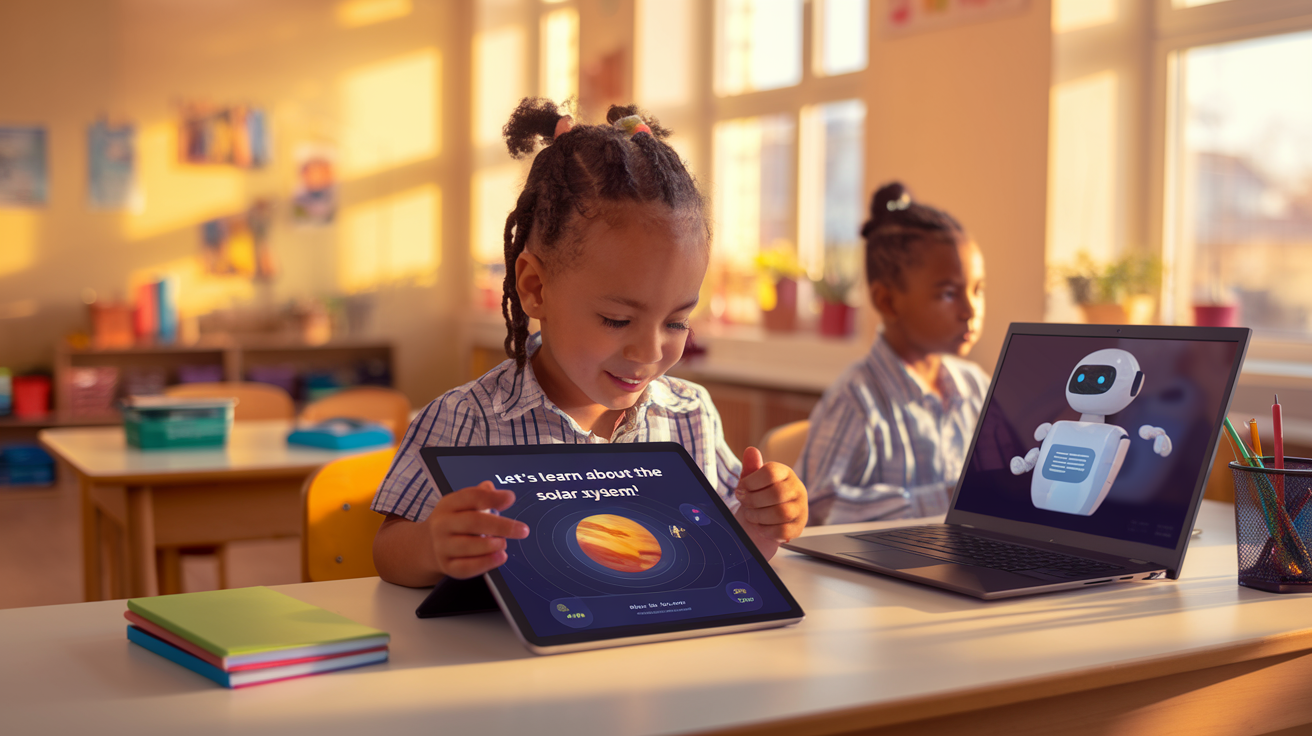
Your nine-year-old is stuck on their maths homework. They're confused about fractions, frustrated, and bedtime is approaching. You open ChatGPT on your phone, type in their question, and within seconds, receive a clear, detailed explanation. Problem solved, right?
Not quite.
ChatGPT and similar general-purpose AI chatbots are remarkable tools — versatile, knowledgeable, and impressively fluent. But when it comes to actually teaching children, they're fundamentally the wrong tool for the job. It's like using a Swiss Army knife when you need a precision surgical instrument: technically capable of cutting, but not designed for the specific task at hand.
This article explains why general AI chatbots and purpose-built AI tutors are categorically different technologies, despite appearing similar on the surface. Understanding these differences helps parents make informed decisions about which tools genuinely support their child's learning versus which just provide quick answers that can actually undermine educational progress.
The Fundamental Design Difference
To understand why ChatGPT isn't an effective tutor, we need to start with what it was designed to do.
What ChatGPT Was Built For
ChatGPT is a general-purpose conversational AI, trained to be helpful, harmless, and honest across an enormous range of topics and use cases. Its training focused on:
- Answering questions accurately across virtually any domain of knowledge
- Generating content (emails, essays, code, creative writing, etc.)
- Assisting with task completion for adult users
- Engaging in natural, coherent conversation
- Being broadly useful to as many people as possible
This generality is its strength for many applications. Need a recipe adjusted for dietary restrictions? ChatGPT can help. Want to draft a professional email? It excels. Looking for creative ideas? It generates them readily.
But this very generality makes it poorly suited for education. Teaching isn't about providing information efficiently — it's about building understanding progressively, diagnosing misconceptions, adapting to individual learning needs, and knowing when not to give the answer directly.
What AI Tutors Are Built For
Purpose-built AI tutors like Fareed are designed from the ground up with a singular focus: facilitating learning for children. Every architectural decision prioritises pedagogical effectiveness over conversational versatility. This means:
- Tracking what the child knows and doesn't know over time
- Identifying misconceptions and addressing them systematically
- Scaffolding learning — providing just enough support to keep the child in their optimal challenge zone
- Adapting teaching strategies based on how the individual child learns best
- Following educational frameworks like curriculum standards and learning progressions
- Knowing when to guide versus when to let the child struggle productively
- Building metacognitive skills, not just delivering content
These differences aren't superficial tweaks to a chatbot — they require fundamentally different architectures, training approaches, and underlying systems.
Why "Just Asking ChatGPT" Doesn't Support Learning
Let's examine specific scenarios to see why general AI falls short for educational purposes.
Problem 1: It Just Gives the Answer
Ask ChatGPT "What is 3/4 + 1/2?" and it will tell you: "3/4 + 1/2 = 5/4, which simplifies to 1 1/4." Efficient. Accurate. Completely unhelpful for learning.
The child who asks this question doesn't learn how to add fractions with different denominators. They don't discover why you need a common denominator. They don't practice the procedure. They just get the answer they need to write on their homework.
An AI tutor would instead recognise this as a learning opportunity and respond differently: "I see you're adding fractions with different denominators. Before we work this out together, can you tell me what you understand about why the denominators matter?" It might then guide the child through finding common denominators, only providing hints when they're genuinely stuck, ensuring the child does the cognitive work.
This distinction matters enormously. Research consistently shows that struggling productively with problems — making mistakes, working through confusion, constructing solutions — is where deep learning happens. Simply being told the answer produces no learning whatsoever.
Problem 2: No Memory or Personalisation
Each conversation with ChatGPT starts fresh. It doesn't remember that yesterday your child struggled with converting fractions to decimals, or that they consistently make the same type of error when multiplying negative numbers, or that visual explanations work better for them than verbal ones.
An effective tutor — human or AI — builds a model of the learner over time. They notice patterns: "Jamie always gets these right when we use number lines but struggles with abstract symbols." "Alex rushes through and makes careless errors when they're confident they know how to do something." "Sam needs to verbally explain their reasoning to solidify understanding."
AI tutors maintain detailed learner profiles tracking:
- What concepts have been mastered at what depth
- What misconceptions the child holds
- What teaching approaches have been most effective
- How the child responds to challenge and frustration
- What topics particularly engage or disengage them
This accumulated knowledge allows the tutor to adapt not just to what the child says in a single moment, but to patterns observed over weeks and months of interaction.
Problem 3: No Curriculum Alignment
ChatGPT doesn't know what Year 4 pupils are expected to learn in the National Curriculum, or whether a particular concept is appropriate for your child's age and prior learning. It might explain something using Year 8 mathematics when your Year 5 child asks about ratios, creating more confusion than clarity.
AI tutors are built around curriculum frameworks. They know that before teaching a child about fractions, they need to ensure understanding of whole number division. They know the progression from concrete to abstract, from simple to complex, from procedural to conceptual understanding that defines effective mathematics pedagogy.
This curriculum alignment means the tutor introduces concepts in a sensible order, uses age-appropriate language and examples, and builds systematically towards defined learning objectives rather than explaining things in whatever way happens to come up.
Problem 4: No Assessment of Understanding
If you ask ChatGPT to explain photosynthesis, it will provide an explanation. But it won't check whether your child actually understood it. There's no assessment, no follow-up questions to probe comprehension, no way of distinguishing between a child who genuinely grasped the concept and one who just nodded along.
Effective tutoring involves constant formative assessment: "Can you explain that back to me in your own words?" "What do you think would happen if...?" "Why do you think that's the answer?" These checks reveal whether understanding is genuine or superficial.
AI tutors incorporate continuous assessment. After explaining a concept, they'll pose questions that require applying the knowledge, not just recalling what was just said. They identify when a child's answer reveals a misconception versus a simple error. They adjust their teaching based on what these assessments reveal.
Problem 5: Inappropriate Content and Safety
General AI chatbots, despite extensive safety training, occasionally produce content inappropriate for children. They might use examples beyond a child's emotional maturity, explain sensitive topics without appropriate framing, or fail to recognise when a child is distressed and needs adult intervention.
Moreover, they're vulnerable to "jailbreaking" — children discovering prompts that bypass safety guardrails, often shared on playgrounds and social media. This isn't hypothetical; it's a documented problem with general AI systems.
AI tutors designed for children have multiple layers of child safety:
- All content is validated as age-appropriate before it's included in responses
- Conversation monitoring detects and flags concerning interactions for adult review
- The system recognises emotional distress or inappropriate requests and responds appropriately
- Architectural constraints prevent jailbreaking — the system simply can't be prompted to behave outside its pedagogical design
The distinction here is crucial. General AI has safety features bolted on. Purpose-built educational AI has safety woven into its fundamental design.
The Pedagogical Architecture of AI Tutors
What makes an AI tutor pedagogically effective? Let's examine the key architectural components that general chatbots lack.
Mastery Learning Models
Effective AI tutors implement mastery learning — the principle that students should achieve a threshold of understanding in foundational concepts before progressing to more advanced material. This was central to Bloom's 2 sigma research on one-to-one tutoring effectiveness.
The system tracks mastery level for each concept in a detailed knowledge graph. Before introducing fractions multiplication, it ensures the child has mastered fractions equivalence and whole number multiplication. If gaps are detected, it temporarily shifts focus to address them, then returns to the original learning path.
ChatGPT has no such structure. It responds to whatever you ask, regardless of whether you have the prerequisite knowledge to understand the answer.
Misconception Detection and Remediation
Children don't just lack knowledge — they often hold misconceptions that actively interfere with learning. In mathematics, common misconceptions include thinking multiplication always makes numbers bigger (untrue for fractions), or that "equal" means "the same" rather than "equivalent in value."
AI tutors are trained to recognise these specific, predictable misconceptions. When a child's answer reveals one, the system doesn't just correct the error — it explicitly addresses the underlying misconception through targeted examples and explanations designed to create cognitive conflict and promote conceptual change.
General AI might notice an error, but it lacks the domain-specific pedagogical knowledge to diagnose which misconception caused it or how to remediate it effectively.
Adaptive Scaffolding
Scaffolding means providing temporary support that's gradually removed as the learner becomes more capable. A skilled tutor knows when to offer a hint, when to rephrase a question, when to break a problem into smaller steps, and when to let the child struggle.
AI tutors implement dynamic scaffolding systems. If a child gets stuck, the system provides minimal help first — perhaps just a prompt to think about a particular aspect of the problem. If they're still stuck, slightly more specific guidance. Only if necessary does it model part of the solution. This ensures children are always working at the edge of their capability, which is where learning happens.
ChatGPT tends towards one extreme or the other: either providing complete solutions immediately or, if prompted to "not give the answer," sometimes withholding so much that it's unhelpful. It lacks the nuanced calibration that effective scaffolding requires.
Spaced Repetition and Retrieval Practice
We know from cognitive science that spacing practice over time and requiring active retrieval of information produces more durable learning than massed practice or passive review. AI tutors incorporate these principles automatically, revisiting previously learned concepts at optimal intervals to strengthen retention.
They also vary practice problems strategically — not just repeating the same type of question, but requiring the child to apply knowledge in new contexts, which deepens understanding and improves transfer.
General AI has no mechanism for any of this. Each conversation is isolated, with no intelligent scheduling of review or practice.
Metacognitive Development
Perhaps most importantly, AI tutors explicitly teach children how to learn, not just what to learn. They model problem-solving strategies, encourage self-explanation, prompt reflection on errors, and help children develop metacognitive awareness — understanding their own thinking processes.
A child who becomes dependent on ChatGPT for homework help learns that when stuck, you ask an outside authority for the answer. A child using an AI tutor learns strategies for working through difficulty independently, building genuine capability rather than learned helplessness.
When General AI Actually Harms Learning
It's not just that ChatGPT is less effective than purpose-built tutors — in some cases, it can actively undermine learning.
Homework Completion Versus Learning
Children quickly discover that ChatGPT can complete their homework for them. Type in "Write a paragraph about the water cycle" and receive a perfectly adequate paragraph seconds later. The homework is done. Zero learning occurred.
Even when parents supervise and children genuinely try to learn from ChatGPT's explanations, the ease of getting answers creates perverse incentives. Why struggle with a problem for five minutes when you can ask ChatGPT and move on? Why think deeply when shallow engagement suffices to complete the task?
This shifts children's orientation from "How can I understand this?" to "How can I finish this?" — a subtle but profound change in learning mindset.
Illusion of Understanding
ChatGPT's explanations often feel clear and comprehensive. After reading one, children (and adults) frequently experience what psychologists call "fluency illusion" — the mistaken belief that because the explanation was easy to follow, they now understand the concept.
But understanding gained passively through reading is far more fragile than understanding constructed actively through problem-solving. The child may feel they've learned, but when they encounter a novel problem requiring that knowledge days later, they find they can't apply it.
True learning requires effortful processing, making mistakes, receiving feedback, and refining understanding iteratively. ChatGPT's smooth delivery of information bypasses this necessary struggle.
Dependency and Learned Helplessness
Perhaps most concerning is the risk of developing dependency. If whenever a child encounters difficulty, they immediately turn to ChatGPT for the answer, they never develop the persistence, problem-solving strategies, and self-efficacy that come from working through challenges independently.
Educational psychologist Carol Dweck's research on mindset shows that children need to experience the connection between effort and achievement to develop resilience and belief in their capacity to learn. ChatGPT severs this connection — why exert effort when answers are instantly available?
The Right Tool for the Right Job
This critique of general AI for education doesn't mean it has no place in children's lives. ChatGPT and similar tools can be valuable for certain uses:
- Generating ideas: Brainstorming creative writing topics, science fair project ideas, or approaches to an open-ended problem
- Quick factual lookup: When you just need a specific piece of information (What year did the Battle of Hastings occur?)
- Adult support: Helping parents understand concepts so they can explain them to their children
- Curiosity exploration: Following interesting tangents that aren't part of formal learning goals
The key is recognising that these are supplementary uses, not core learning activities. For the actual work of building understanding, mastering skills, and developing as a learner, purpose-built educational tools designed around pedagogical principles are essential.
What to Look for in an AI Tutor
If you're considering an AI tutor for your child, here are the key features that distinguish genuine educational tools from repackaged chatbots:
Persistent Learner Models
Does the system remember your child across sessions? Does it track what they know, how they learn, where they struggle? Can you see evidence of this in how the teaching adapts over time?
Curriculum Alignment
Is the content explicitly mapped to educational standards (like the National Curriculum)? Does it follow research-based learning progressions within subjects?
Pedagogical Transparency
Can you understand why the tutor is teaching particular content in a particular way? Is it following established pedagogical principles, or just engaging in conversation?
Active Learning, Not Passive Delivery
Does the system require your child to do cognitive work — solving problems, explaining reasoning, making predictions — or does it primarily deliver information?
Assessment and Feedback Loops
Does it check for understanding, not just completion? Does it provide feedback that identifies what's correct, what's incorrect, and why?
Parent Visibility
Can you see what your child is learning, how they're progressing, and where they're struggling? Transparent reporting is essential for parental oversight.
Age-Appropriate Safety
Is the system designed from the ground up for child safety, with content moderation, conversation monitoring, and architectural constraints against misuse?
The Future: AI as Pedagogical Partner
The distinction between general AI and educational AI will become more important as these technologies become ubiquitous. Schools are already grappling with policies around ChatGPT use — some banning it entirely, others attempting to integrate it productively, most uncertain about the right approach.
The path forward isn't to reject AI in education, but to embrace AI that's genuinely designed for learning. Just as we don't use general-purpose tools for specialized medical care or legal advice, we shouldn't use general-purpose AI for the specialized work of education.
Purpose-built AI tutors represent the first generation of technology that can genuinely replicate key aspects of expert human tutoring at scale. They're not perfect — they can't replace teachers, and they work best in combination with human instruction. But they're fundamentally different from chatbots repurposed for education.
For parents navigating this landscape, the principle is straightforward: choose tools designed for learning, not just tools capable of answering questions. Your child's education is too important for a general-purpose solution.
Practical Guidance for Parents
Here's how to approach AI tools in your child's learning:
Set Clear Boundaries Around ChatGPT
If your child has access to ChatGPT or similar tools, establish clear expectations:
- It's fine for brainstorming ideas or satisfying curiosity about random topics
- It's not appropriate for completing homework or assignments
- If they use it to understand a concept, they should then close it and attempt problems independently to verify they've actually learned
Prioritise Active Learning
Whether using AI tutors or other resources, the test is simple: Is your child doing the thinking, or is the tool doing it for them? Learning requires active cognitive engagement.
Monitor for Understanding, Not Just Completion
Ask your child to explain concepts in their own words, apply knowledge to new situations, or teach something to you. This reveals whether genuine understanding has developed or whether they've just completed tasks.
Use Purpose-Built Tools for Core Learning
When it comes to systematic skill development — learning mathematics, literacy, science — invest in tools designed specifically for education. They're more expensive than free general AI, but the pedagogical architecture is worth it.
Model Good AI Use Yourself
Children observe how adults use technology. If they see you using ChatGPT thoughtfully — as one tool among many, with critical evaluation of its outputs — they'll learn to do the same.
Conclusion: Different Tools for Different Goals
ChatGPT is an remarkable achievement — a general-purpose AI that can engage fluently on nearly any topic. But remarkable generality doesn't translate to pedagogical effectiveness. Teaching children requires specialized expertise, careful curriculum design, adaptive personalisation, and architectural features that general chatbots simply don't possess.
The distinction matters because how children learn shapes not just what they know, but how they think about themselves as learners. Tools that provide easy answers without struggle undermine the development of persistence, problem-solving capability, and growth mindset. Tools designed around sound pedagogy build both knowledge and learner identity.
As AI becomes increasingly embedded in education, parents need to be discerning consumers. Not all AI is created equal. Purpose-built educational AI, designed around decades of learning science research and mapped to curriculum frameworks, is categorically different from general chatbots — even when the underlying language models are similar.
Choose tools that treat your child's education as seriously as it deserves: purpose-built, pedagogically grounded, and designed to develop genuine capability, not just provide convenient answers.