
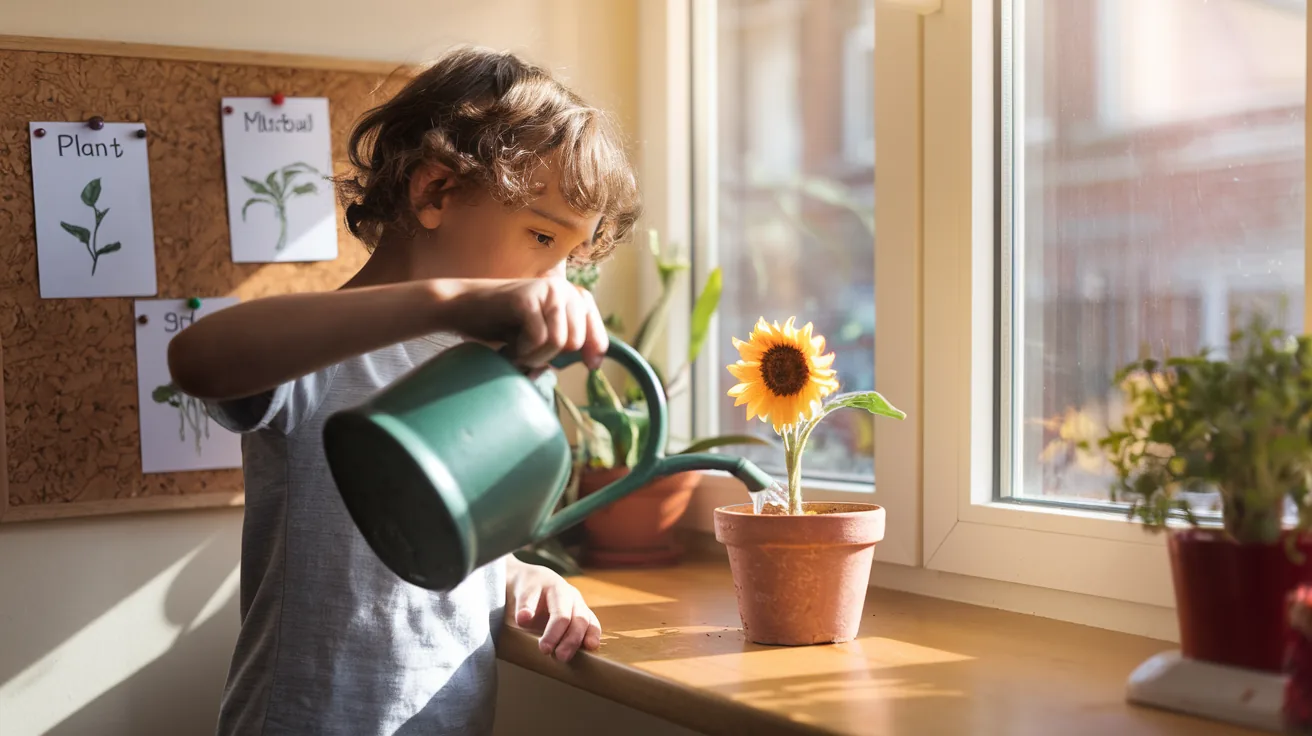
Plants are one of the most hands-on and engaging topics in the Year 3 science curriculum, but they're also where children develop some of their first persistent misconceptions about biology. Your child will investigate how plants grow, what they need to survive, and how water moves through their structures. These are the ideas that plant biology in secondary school builds on.
This guide walks you through exactly what your Year 3 child is learning about plants, the common misunderstandings to watch for, and practical ways you can support their learning at home without needing a science degree yourself.
What the National Curriculum Requires for Year 3 Plants
The Year 3 plants topic sits within the Key Stage 2 science programme of study under "Plants." According to the National Curriculum for England, pupils should be taught to:
- Identify and describe the functions of different parts of flowering plants: roots, stem/trunk, leaves, and flowers
- Explore the requirements of plants for life and growth (air, light, water, nutrients from soil, and room to grow) and how they vary from plant to plant
- Investigate the way in which water is transported within plants
- Explore the part that flowers play in the life cycle of flowering plants, including pollination, seed formation, and seed dispersal
This represents a significant step up from Year 1 and 2, where children simply identified and named common plants. Now they're investigating how and why plants work the way they do — moving from observation to explanation.
Part 1: The Functions of Plant Parts
Your child will learn that each part of a flowering plant has a specific job. This is more than labelling: it is understanding that the shape of a part relates to what it does.
Roots
Roots anchor the plant in the ground and absorb water and nutrients from the soil. Many children initially think roots are just "what holds the plant up," missing the absorption function. You'll know your child truly understands when they can explain why a plant with damaged roots will wilt even if you water the soil around it — the roots can't do their job of taking up that water.
Stem (or Trunk in Trees)
The stem transports water and nutrients from the roots to the leaves and flowers, and it supports the plant, holding leaves up to the light. This transport function is invisible to children, making it harder to grasp than the obvious support role. Watch for understanding by asking: "Why do flowers in a vase stay alive for a while even though they don't have roots anymore?" (The stem continues transporting water that's in the vase.)
Leaves
Leaves are where the plant makes its food, using light. Year 3 children do not need to know how; they should know that leaves need light and that plants cannot grow properly without them. The process itself (photosynthesis) is not taught until Key Stage 3.
Flowers
Flowers are involved in reproduction — they're where pollination happens, leading to seed formation. This is often the most fascinating part for children, especially when they learn about the role of bees and other pollinators. Many schools do observational drawings of flowers, dissecting them to identify parts like petals, stamens, and the stigma.
Part 2: What Plants Need to Grow
This section moves from structure to requirements. Children investigate what plants need to survive and grow healthily. This is typically taught through comparative experiments — a cornerstone of scientific enquiry at this age.
The Five Essential Requirements
Plants need light, water, air (what they use it for is covered in Key Stage 3), nutrients from soil, and room to grow. Notice that warmth is not on this list, though it affects the rate of growth. This is a subtle distinction: plants can grow in cold conditions (think winter vegetables), but they need the other five factors regardless.
How Requirements Vary Between Plants
This is where it gets more sophisticated. Not all plants need the same amount of these things. Cacti need less water than ferns. Some plants thrive in shade while others need full sun. Recognising this variation helps children understand that "what plants need" isn't a one-size-fits-all answer — an important step towards more careful biological thinking.
Common Misconceptions About Plant Needs
Several misconceptions are common in this area:
- Plants get their food from the soil: Many children (and adults) think plants "eat" through their roots. In reality, plants make their food in their leaves using light energy. They take up water and minerals from soil, but this isn't their food. This misconception is so widespread that it persists into adulthood unless directly addressed.
- All plants need the same amount of water and light: Children often overgeneralise from what they've learned about one plant (usually cress or bean plants used in experiments). Real botanical diversity is much richer than primary experiments suggest.
- Plants only need water, not air: Air is invisible, so children often forget it. Plants need air; what they take from it is covered in Key Stage 3.
If your child brings home a worksheet saying "plants need food from the soil," you might gently correct this to "plants need nutrients and minerals from the soil, and they make their own food in their leaves using sunlight." This precision matters because it lays the groundwork for Key Stage 3.
Part 3: How Water Travels Through Plants
This is one of the most memorable investigations in Year 3 science. Many schools do the classic white flower in coloured water experiment, where children place white carnations or celery stalks in water mixed with food colouring and watch as the colour travels up the stem and into the petals or leaves.
What Children Should Understand
Water travels from the roots, up through the stem, and into the leaves and flowers. This happens through tiny tubes (xylem vessels, though the technical term isn't required at this stage). Children should grasp that water follows a set path through the plant, from roots to stem to leaves, rather than sloshing about at random.
Why This Matters
Understanding water transport helps explain why plants wilt when they don't get enough water (the leaves can't get the water they need to stay rigid), and why cutting a plant's stem means it will eventually die (you've severed the transport system, even if the roots are still in soil and the leaves still in light).
Part 4: Pollination, Seed Formation, and Seed Dispersal
The final section of the Year 3 plants topic looks at plant reproduction and life cycles. This builds on what children learned about animal life cycles in Year 2, showing that living things have patterns of growth and reproduction.
Pollination
Pollination is the transfer of pollen from one flower to another (or from the male parts to the female parts of the same flower). Children learn that many plants rely on pollinators — bees, butterflies, birds, even bats in some parts of the world — to carry pollen between flowers. Some plants rely on wind instead.
Discussing why bees matter is a natural way into the idea that living things depend on each other, which comes up again in Year 4 habitats.
Seed Formation
After pollination, seeds form inside the flower. The details of fertilisation aren't covered at this stage (that comes in Year 5), but children should understand the sequence: flower → pollination → seeds form → seeds disperse → new plants grow.
Seed Dispersal
This is often the most engaging part for children. Seeds are dispersed in different ways:
- Wind dispersal: Light seeds with "wings" (like sycamore seeds) or fluffy parachutes (like dandelions) catch the wind and travel far from the parent plant.
- Animal dispersal: Some seeds have hooks that catch on animal fur (burdock), while others are inside fruits that animals eat, with the seeds passing through and being deposited elsewhere.
- Water dispersal: Coconuts can float across oceans; some riverside plants have seeds that float downstream.
- Explosion: Some seed pods dry out and burst open, flinging seeds away from the parent plant.
Understanding dispersal helps children see that the shape of a seed is not random; it helps the plant spread.
How to Support Your Child's Learning at Home
You do not need a garden or a science background to help. Here are practical approaches:
Grow Something Together
The best plant learning comes from direct experience. Even a few pots of herbs on a windowsill provide ongoing observation opportunities. Cress grows in days; tomatoes and beans are more involved but highly rewarding. The key is making it a shared investigation rather than a chore.
Ask questions as you grow: "What do you think will happen if we don't water this one for a week?" "Why do you think the instructions say to put these in a sunny spot?" Let your child do the watering and observing (with reminders when needed), building their sense of responsibility for a living thing.
Do Simple Investigations
The classic celery in food colouring experiment works brilliantly at home. You need celery stalks, clear glasses, food colouring, and water. Cut the bottom off the celery, place it in coloured water, and watch over 24-48 hours as the colour travels up and into the leaves. Celery works better than white flowers because you can see the coloured tubes clearly when you slice through the stem afterwards.
Another simple investigation: take two similar potted plants. Put one in a dark cupboard, give the other normal light, but water both equally. Your child will observe over a week or two how the one without light becomes pale and weak. This makes the light requirement something they have seen rather than only memorised.
Go on Nature Walks with Purpose
A walk in a park or woodland becomes a plant investigation when you bring along a simple question. "How many different ways can we find that seeds travel?" becomes a game. Collect sycamore helicopters, blow dandelion clocks, find sticky burdock seeds on your clothing, notice berries that birds will eat. In the Gulf or South-East Asia the plants differ but the game is the same: a date is a seed wrapped in sweet fruit for an animal to carry, and a coconut on a Malaysian beach is the classic water-dispersed seed. Your child is practising observation and classification.
Take photos of interesting plants and look them up together later. Apps like PlantNet or Seek by iNaturalist turn identification into an accessible, engaging activity that builds botanical knowledge without any expertise on your part.
Address Misconceptions Gently
If your child says "plants eat food from the soil," resist the urge to flatly correct them. Instead, ask questions: "What do you think plants get from soil? Where do you think they make their food?" Guide them towards the right understanding through questions. A misconception that a child has tested for themselves shifts more reliably than one that has only been contradicted.
Use Children's Non-Fiction Books
High-quality children's science books often explain concepts more clearly than school textbooks. The DK Eyewitness series has a good "Plant" volume. Reading books like this together, discussing the illustrations, and letting your child's questions guide the conversation builds understanding naturally.
Connect to Real-World Contexts
When you're cooking, talk about the plant parts you're eating. Carrots are roots. Celery is a stem. Lettuce leaves are… leaves. Broccoli is actually a flower bud. This makes plant knowledge tangible and relevant.
Discussing why farmers water crops, why houseplants near windows do better than those in corners, why supermarket flowers come with little packets of plant food — all of these everyday observations reinforce scientific concepts naturally.
When to Seek Additional Support
Most children grasp the Year 3 plants content well with good teaching and a bit of home reinforcement. However, if your child is:
- Struggling to remember basic plant parts and their functions even after hands-on activities
- Finding it difficult to record observations or explain what they've seen
- Showing anxiety around science lessons or practical work
- Consistently scoring well below their peers in science while performing adequately in other subjects
…then it's worth discussing with their teacher. Sometimes the issue is reading and writing skills rather than science understanding — a child who grasps concepts perfectly well in discussion may struggle to express them in writing.
If your child needs the topic explained another way, Fareed is an AI science tutor for this curriculum; it is currently on a waitlist.